
Illustrated · 2 min
Orbital Resonance
Resonance is a concept that most people are unknowingly familiar with.
Classically, the best Earth-based example is that of the playground swing. More precisely, as a child on a swing set you learned to pump your legs to make the swing go higher. The act of adding your energy to that of the swing was actually an example of resonance. Your motion, syncing up with the swing's in, let's say a 1:1 ratio (one precise leg pump for every full full wing), sped you and the swing up.
The same thing can happen in the solar system. Resonances formed between certain celestial bodies can supply a "push" to the motion of one body or both.
In many cases, these resonances prove to be unstable and the bodies will simply "push" each other (or exchange momentum) until the resonance is destabilized. In other cases the resonances created work to stabilize orbits, for instance the 1:2:4 resonance that exists between Ganymede, Europa and Io. We call these three body resonances with that specific integer relationship (1:2:4) A Laplace Resonance. These stabalized orbits prove to be very solid and highly reliable for observers.
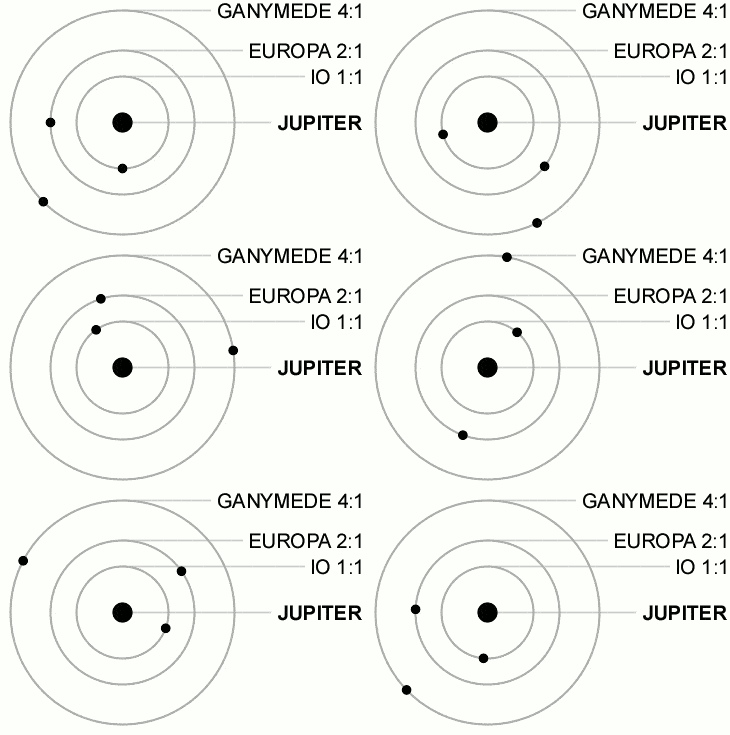
For every 1 orbit of Ganymede and Europa Io has made 4 and 2, respectively
Mean-Motion Orbital Resonances
Mean-motion resonance are those that have nice integer relationships. That is to say, two bodies share orbits that result in a simple integer ratio (2:3, 5:3, 4:2 etc.). Also relalize it is understood that an integer is a whole number, however in this case it simply means each side of the ratio possess a whole number- not that the resulting ratio is a whole number.
These resonances, as one can imagine, are not overwhelmingly common in our solar system. Some include:
Pluto-Neptune 2:3
Dione–Enceladus 1:2
Ganymede-Europa-Io 1:2:4
I included the last one to demonstrate the mean-motion orbital resonance can exist between more than two bodies.
Keep in mind there are other types of orbital resonances, however, mean-motion is the neatest type and often the easiest to observe.