Mass percent composition tells us what percent of a certain element is in a compound
Image source: By Caroline Monahan
How do you find the mass percent composition?
Let’s Walk-through An Example Problem:
A student has a 8.874g sample of a compound composed of 3.422g Chlorine, 2.345g Sodium, and 3.107 Oxygen, what is the percent composition of this compound
1) To determine the mass percent composition for this compound, all you have to do is plug in the given numbers into the equation!
Chlorine: 3.422/8.874 * 100% = 38.56% Chlorine
Sodium: 2.345/8.874 *100% = 26.42% Sodium
Oxygen: 3.107/8.874 *100% = 35.01% Oxygen
Check the answer by summing the percentages, the sum should be about 100% (it might be slightly less due to rounding, but as long as it’s a very small difference, then it can be assumed to be 100%)
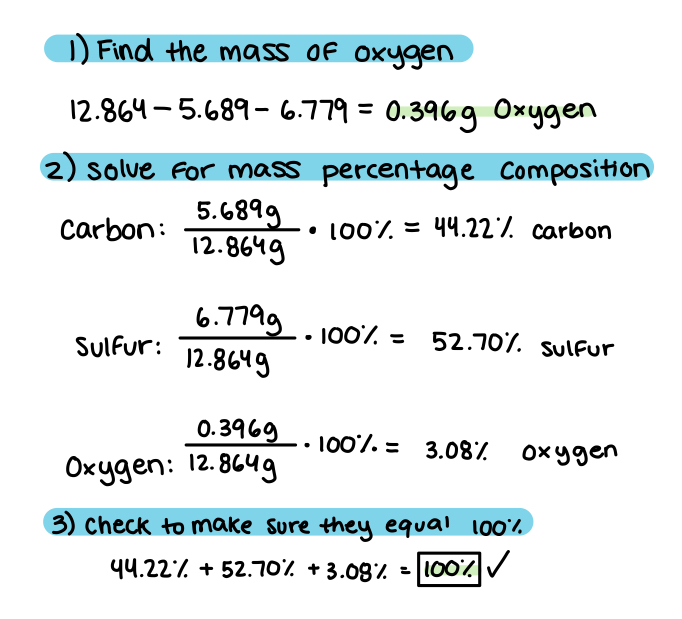
A student has 12.864g of a compound. 5.689g of the compound is carbon, 6.779g of the compound is sulfur, and the rest is oxygen. What is the mass percent composition?
Here's how to get the correct answer for the problem above:
In this video, The Organic Chemistry Tutor walks you through mass percentage calculations. He starts by showing you how to calculate the mass percent for each element in a molecule. Then you'll learn how to compare an element's mass percent between different molecules. Finally, he shows how to convert from mass percent to molar mass. All three types of problems are common exam questions. So, if you want to master mass percent calculations, this video is for you!
In a previous lesson, we examined Proust's law of definite proportions. In 1794, he concluded that the elements within a compound have a fixed ratio. For example, by mass, carbon dioxide is 72.7% oxygen and 27.3% carbon. That's true irrelevant of the mass or moles of carbon dioxide. Let's say we had two samples. One sample was 18.00 grams of carbon dioxide gas. The other was 1.45 grams of carbon dioxide gas. In both samples, the percentage of oxygen to carbon is the same. Proust's law is the basis for Mass Percent Composition.
As a side note, there are some exceptions to Proust's law. The most obvious one occurs because of isotopes. Not all atoms of the same element have equal numbers of neutrons. So, the masses of the same compound can vary. Typically, the effects of isotopes are negligible. Why? Many isotopes are uncommon. For example, oxygen-16 has a natural abundance of 99.74%. The other 0.26% gets distributed between oxygen-17 and oxygen-18. So, they have an unbelievably small impact.
What is Mass Percent Composition?
To start, let's examine the formula for Mass Percent Composition. It's %X=masscompoundmassX×100%. What does this formula tell us? The mass percentage of element X in a compound equals the element's mass divided by the compound's mass. We have two options for the units. We can use molar mass (molg) or molecular mass (amu). The formula is a percentage. So, the units cancel. Furthermore, the molar mass and molecular mass are the same number. They only have different units.
Steps for Solving Mass Percent Composition Problems
Here are the steps for solving the most common mass percent questions.
Mass Percent for Each Element in a Molecule
Determine the molecule's molar mass.
Calculate the atomic mass of each element within the molecule.
Use the periodic table to find the atomic mass of the element. Multiply the atomic mass by the number of atoms within the molecule.
Divide the weight of each element by the molecule's molecular mass.
Check to make sure the sum of the percentages is one-hundred percent.
Converting from Mass Percent to Molar Mass
You can use the mass percent formula to work backward. Let's say the problem gives you the mass percent and the mass of one element. In this scenario, the remaining variable is the mass of the compound. So, you can use mass percentage to determine the molar mass or molecular weight.
Plug in the mass percent composition and the element's mass.
A=masscompoundB×100%
Divide both sides by 100 percent.
100%A=masscompoundB×100%100%
Rearrange the equation to solve for the compound's mass.
Divide the percent composition of each element by its molecular weight. The value is called the relative number of atoms.
Divide each calculated relative number of atoms by the smallest value from step 1. The smallest valued element will be one. The rest will be a whole number ratio.
If there isn't a whole number ratio, multiply each number by the lowest common factor. That creates a whole number.
Use the calculated whole number ratio to write the empirical formula.
Example Problems
Example 1: Mass Percent for each Element in a Molecule
Calculate the mass percent of each element in chloroauric acid (HAuCl4).
Step 1: Find the molar mass of hydrogen, gold, and chlorine.
H:1.01molg
Au:196.97molg
Cl:35.45molg
Step 2: Find the molar mass of chloroauric acid.
MMHAuCl4=1.01+196.97+4×35.45=339.78molg
Step 3: Calculate the percent mass for each element.
H:339.78molg1.01molg×100%=0.30
Au:339.78molg196.97molg×100%=57.96%
Cl:339.78molg35.45×4molg×100%=41.7%
Step 4: Check the answer by summing the percentages
Total=0.30%+58.96%+41.73%=99.99
The slight difference is due to rounding.
Example 2: Converting from Mass Percent to Molar Mass
A molecule contains a single atom of sulfur. The percent composition is 32.7%. Calculate the compound's molecular mass.
Step 1: Use the periodic table to find the molar mass of sulfur.
It's 32.07molg
Step 2: Insert the percent composition and molar mass into the formula.
Step 3: Rearrange and solve the equation to solve for the compound's mass.
masscompound=32.7%32.07molg×100%=98.07molg
When I designed the problem, I thought of sulfuric acid. Its molar mass is 98.08molg. So, you can see that we were correct. Again, the slight error gets caused by rounding.
Example 3: Mass percentage to Empirical Formula
A compound consisting of hydrogen, carbon, and oxygen has respective mass percentages of 13.15%, 52.14%, and 34.73%. Calculate the empirical formula.
Step 1: Find the relative number of atoms for each element.
H:1.0113.15=13.01
C:12.0052.14=4.34
O:16.0034.73=2.17
Step 2: Divide each relative number of atoms by the smallest value.
H:2.1713.01=5.99→6.00
C:2.174.34=2.00
O:2.172.17=1.00
Step 3: Right the empirical formula.
C2H6O1
When I designed the problem, I was thinking of ethanol. It's an organic compound with molecular formulaC2H5OH. So, it looks like we solved the question correctly.