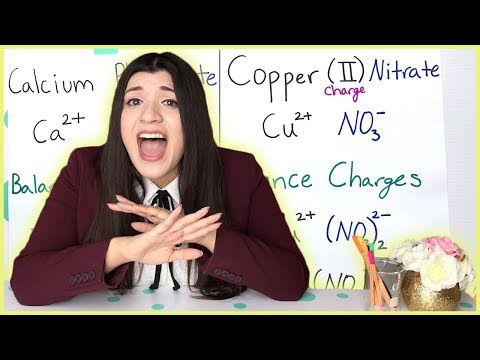
What are Ionic Compounds?
-
Ionic compounds are composed of ions. Ions are atoms that have gained or lost electrons. But, they still have the same number of protons. The positive ion(s) is called the cation. The negative ion(s) is the anion.
-
Ionic compounds are neutral. They have a neutral overall charge. So, the charges of the cations and anions are balanced.
-
Ionic compounds form ionic bonds. They are held together by the electrostatic attraction between the cation and anion.
Naming Ionic Compounds Walkthrough:
Name the following ionic compound: Fe(OH)3
1) First is to identify and name the metal
In this case, the metal is iron (Fe). But it is a transition metal. So, we need to identify its oxidation state.
To do this, we need to figure out the charge of the nonmetal. Remember, the positive and negative charges will balance. In the end, we'll have a neutral ionic compound.
-
The hydroxide ion (OH−) has a charge of -1. In this formula, we have 3 hydroxide ions. So, the total negative charge is -3.
-
To form a neutral ionic compound, iron must have a charge of +3. So, the name for this metal is iron (III).
2) Now identify and name the nonmetal
In this case, the nonmetal is the polyatomic oxoanion, hydroxide (OH−). Wait a second, hydroxide has the -ide ending. That's true! But, that's because this polyatomic ion's name is hydroxide. The -ide ending was not added.
3) Put the names together
Fe(OH)3 is Iron (III) hydroxide
Examples of Ionic Compound Names:
Here are some more examples of names of ionic compounds!
- Hg2Cl2 = Mercury (I) chloride
- NaCl = Sodium chloride
- AgI = Silver Iodide
- SnF4 = Tin (IV) fluoride
Now Try a Practice Problem!