Illustrated · 1 min
+2 contributors

Molecular Models
What is a ball-and-stick model?
-
A ball-and-stick model is a 3D representation of a molecule.
-
Ball-and-stick models help us understand how each atom is bonded in a molecule. It uses a line or stick to represent the covalent bonds between atomic nuclei.
-
The basis of the ball and stick model is Valence Bond Theory.
- They show sigma and pi bonding in molecules with multiple bonds.
- Ball-and-stick models also show relative bond lengths and ideal bond angles.
- They help us to visualize the molecular geometry and VSEPR shape.
- Physical models cannot show deviations from the ideal bond angle because they cannot model lone pairs.

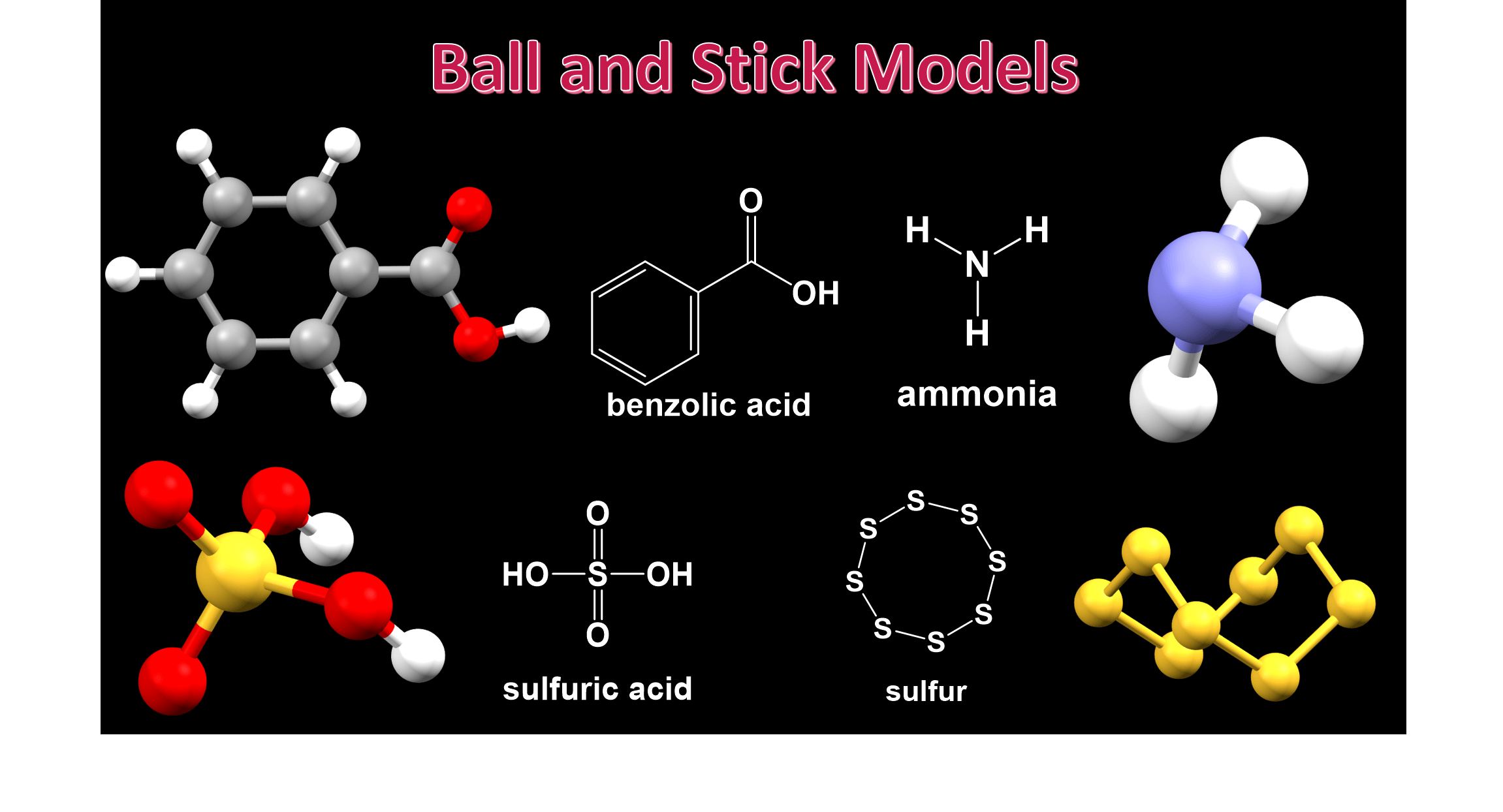
Image source: Caroline Monahan
- As seen above, the ball-and-stick models show a lot more detail compared to the lewis structures. The ball-and-stick models can show exactly how the atoms connect to each other in 3D space.
What is the space-filling model?
-
The Space-filling model also provides a 3D representation of a molecule.
-
It is "space-filled" due to the lack of visible lines connecting the atoms. Instead, the atoms are placed on each other (without using the visible bond lines).
-
The sizes of the atoms are proportional to the atomic radii of that atom. For example, oxygen will look larger than hydrogen due to its larger radius.
-
The Space-filling model is based on the Molecular Orbital Theory.
- Computational chemists use computer programs to create space-filling models. The program shows the molecule's electron cloud. So, we can predict reactivity, polarity, Van der Waal's forces, and solvent interactions.
- Biochemists apply space-filling models to study enzymes and proteins. It can help them study the electrostatic interactions of macromolecules. For example, they might model a ligand blocking an enzyme's binding site.

Image source: Caroline Monahan