Illustrated · 2 min
Predicting Reactivity Using the Periodic Table
- Predicting the reactivity of elements using the periodic table differs depending on the type of element.

What is Reactivity? Ahazard.sciencewriter, CC BY-SA 4.0 https://creativecommons.org/licenses/by-sa/4.0, via Wikimedia Commons
What is Reactivity?
-
Reactivity is an element's ability to ionize (gain or lose electrons) or share electrons. More reactive elements tend to gain or lose electrons. Less reactive elements tend to share electrons. So, we can generally think of reactivity in terms of electronegativity and/or electron affinity.
-
Most often, we compare reactivity for single-replacement and double-replacement reactions.
Predicting the Reactivity for Metals
For metals, the reactivity increases down a group. But, reactivity decreases when moving from left to right along a period.
-
Group 1 (Alkali Metals) are the most reactive compared to other metals. Why? The alkali metals contain only 1 valence electron. So, it loses its electron to fulfill the octet rule. In general chemistry, they exclusively form ionic bonds.
-
Group 2 (Alkaline Earth Metals) are the second most reactive metals. This is because this group contains only 2 valence electrons. So, it obeys the octet rule by losing both electrons. Generally, alkaline earth metals form ionic bonds. The exception is beryllium. Because of its small size, it has a relatively large electronegativity. This creates substantial first and second ionization energies. It takes a lot of energy for it to ionize. So, instead, it covalently bonds.
-
The reactivity of the transition metals is more complex. They are significantly less reactive than alkali and alkaline earth metals. But, because of their access to the d-orbitals, they can have multiple oxidation states. The successive ionization energies are quite small. So, they can form compounds with various charges. A great example is manganese (Mn). It can have charges ranging from +2 to +7! The d-orbitals also allow them to accept electron pairs from ligands.
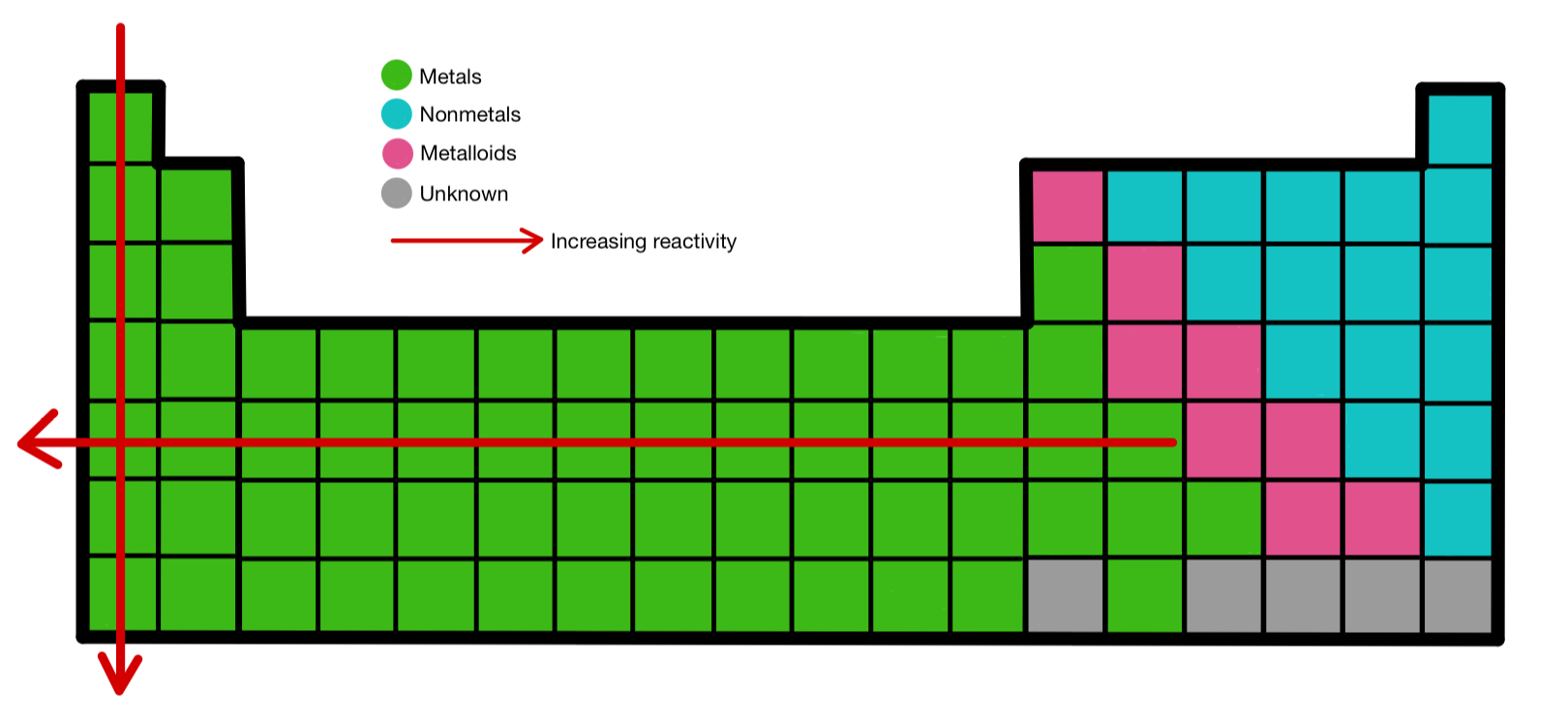
Image source: Caroline Monahan
Predicting the Reactivity for Nonmetals
When referring to nonmetals on the periodic table, the reactivity of these elements increases when going up a group. Reactivity also increases when moving from left to right in a row/period on the periodic table
-
Group 17 (Halogens) are the most reactive nonmetals. This is because Halogens have 7 valence electrons in the outer shell, thus they eagerly want to gain an electron in order to complete their octet.
-
Group 18 (Nobel Gases) are the least reactive elements. They already completed their octet. So, they generally don't want to gain or lose electrons. As a side note, you should know that Argon, Krypton, and Xenon are octet rule exceptions. Why? They have access to the d-orbitals. Radon is also an exception. But, it's unbelievably radioactive! The most stable isotope is Radon-222. It only has a half-life of four days! So, radon compounds are unbelievably challenging to study.

Image source: Caroline Monahan