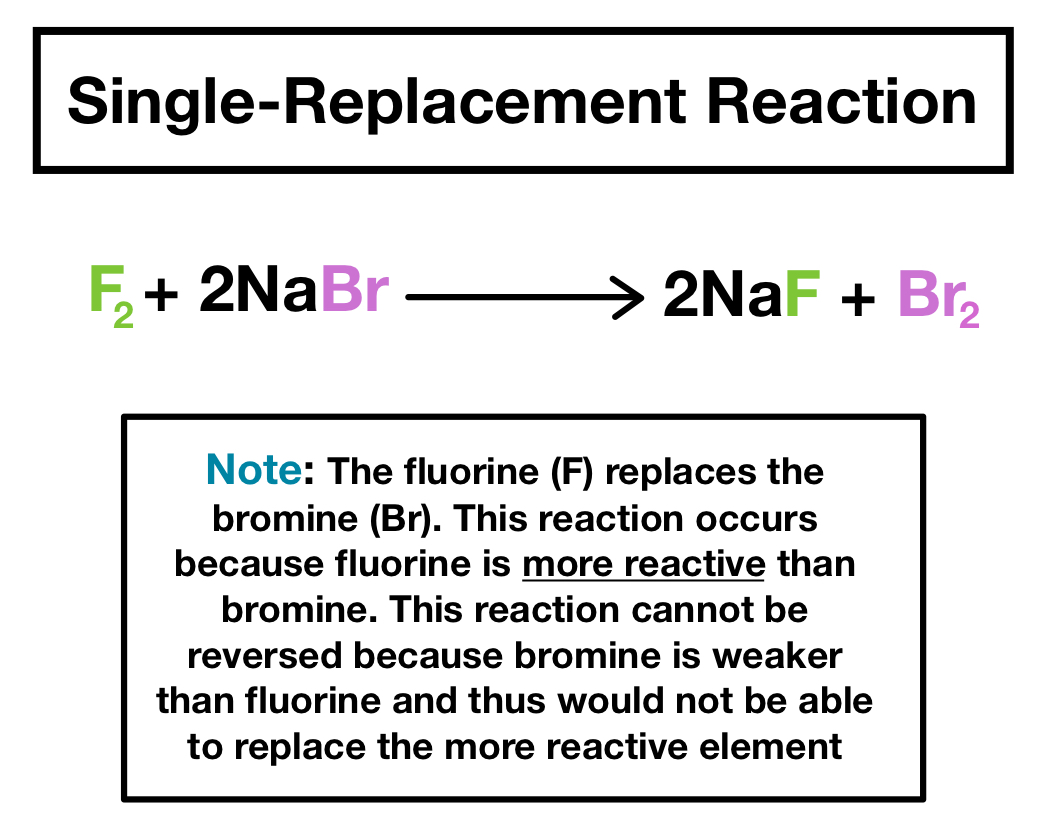
What is a single displacement reaction?
A single displacement reaction is a reaction where only a single atom is displaced in a reaction. If we were given a chemical equation: A+BC→C+AB, element A has replaced element C. We are able to see which atom is able to replace another through a reactivity series, shown in an image below. The more reactive an element the more capable it is at displacing an atom. If an atom is found to be less reactive, it cannot replace an atom that is more reactive.
Ultimately these reactions occur if it is more energetically favorable – which is always a reference to gibbs free energy.
Can any element participate in a single-displacement reaction?
Not if the element is trying to displace another element that is higher on the reactivity series than it is. A weaker element cannot replace a stronger one.
There are three main types of single replacement reactions determined by the reactivity series:
- Metal Replacement: where metal will displace another metal.
- Hydrogen Replacement: where hydrogen gas is produced through displacement by a metal.
- Halogen Replacement: when a halogen participates in displacement.
It is important to note that in a single-replacement reaction there is always a pure compound in the starting material. For example, a pure liquid, solid, or gas reacting with an aqueous solution. Once this pure substance – which has an oxidation state of zero – reacts it will become oxidized or reduced as it becomes an ion and displaces another atom. The atom will become a cation or anion depending on what it is.
An interesting way of remembering these rules is that elements on the metal side of the periodic table have a positive (+) charge as an ion and therefore need to lose electrons to become more favorable and satisfy the octet rule. For non-metal elements, their ions have a negative (-) charge meaning the ions need to gain electrons to fulfill the octet rule.
But how is the reactivity series determined?
Well, it is different for non-metals and metals. Let’s first take a look at the halogens. Halogens have 7 valence electrons, which is so close to the very desirable amount of 8 valence electrons according to the octet rule,which our noble gasses have. These halogens just need to gain one more valence electron to be in this favorable conformation. In the activity series, the more readily a halogen gains an electron, the more reactive it is and therefore the higher up on the activity series it is. This order is determined by electronegativity which is an atom's ability to attract/gain an electron.
For metals, the activity series is determined by the metal’s ability to donate electrons. The more a metal can donate electrons, the more reactive it is. But how would we know which metal can give electrons away more easily? Think of periodic table trends to help solidify your understanding. An electron is more easily taken away from an ion if that electron is not being held on to very tightly. This means that if an element has a larger atomic radius, the further away the electron is going to be from the positive, attractive force of the nucleus (where the protons are), and the more easily an electron can be taken away from the element and therefore the more reactive potassium will be.
Let’s compare the reactivity of Potassium (K) with Barium (Ba) and Sodium (Na) to get a better understanding.
K vs. Ba: Atomic radius wise, barium has a larger atomic radius than potassium, but barium as a cation needs to give up two electrons in order to fulfill the octet rule. Potassium only needs to give up one electron, therefore potassium will be the more reactive element.
K vs. Na: Potassium and sodium are in the same group meaning they both have the same number of valence electrons. Potassium will be the more reactive element because its larger radius makes an electron more easily taken away from it.
KeyQuestionstoAskAboutaPotentialSingleReplacementReaction
- Is one of the starting materials a pure solid, liquid, or gas?
- Is the pure substance a metal or a nonmetal?
- Is the pure substance capable of displacing an ion from the other starting material?
- Based on the starting material what products can form?
References: 1, 2