Illustrated · 3 min
+3 contributors

Quality and Quantity
You may have heard the phrase, "Quality is better than quantity", but when it comes to measuring data the phrase doesn't always apply. In chemistry, data can be measured in many ways, but it is broken down into two types:
-
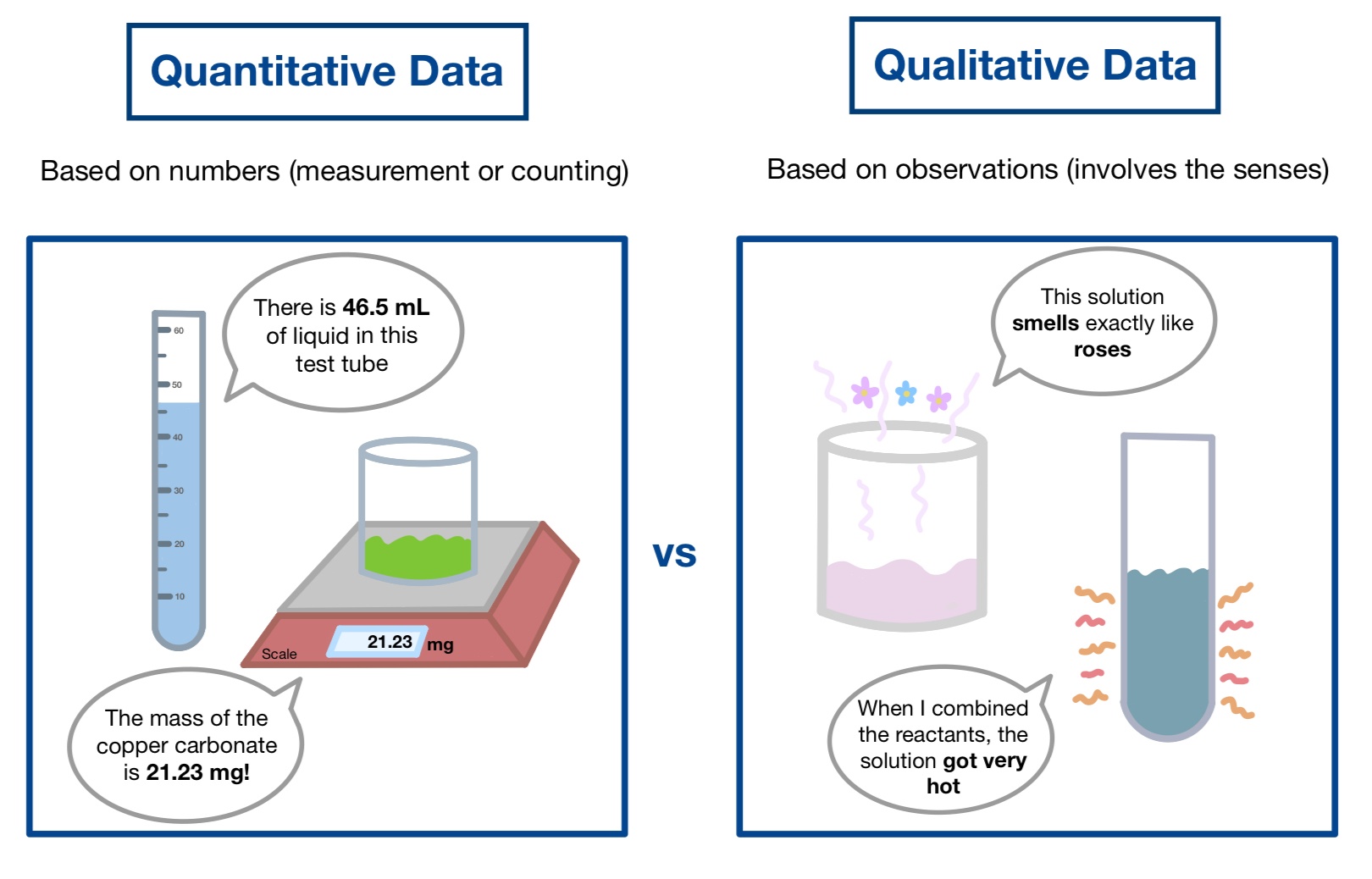
Qualitative data - this data describes qualities of a material, usually without values. It describes properties that can be judged with human senses.
-
Quantitative data - this type of data describes qualities of a material which are measurable and expressed with values. Often these properties require a type of scientific measurement and result in numerical data.
Both qualitative and quantitative data, coupled with statistical analysis, is integral to understanding datasets and developing a conclusion.
Everyday Example
Let's consider a bunch of apples! We can gather qualitative data by examining the apples.

Image source: By Cassie Gates
Qualitative data:
-
Color: The color of the apples are red, yellow, and green on the outside. When cut, the apple flesh is white. After sitting in air, the apple skin browns.
-
Smell: The apples have an earthy smell, but when cut they smell fruity.
-
Texture: The apples on the outside are smooth and waxy. Inside the apples are slightly gritty.
-
Taste: The red apples are sweet, the green ones are tart, and the yellow ones are sweet and tart.
Quantitative data:
-
Quantity: There are 8 apples in total: 3 yellow, 3 green, and 2 red.
-
Mass: The mass of the apples can be found using a scale or balance.
-
Chemical composition: Analytical chemists can determine the atoms and molecules that make up the apple. How? They use specialized instruments and techniques. The amount of each compound in a known portion of an apple can be used to determine the amount in the whole apple. As the cut apples brown, the chemical composition changes. The apple flesh undergoes oxidation with the air. The color and oxidation state are related!
-
Absorbance: The skin of the apples are different colors. The pigments in the skin can be isolated from the apples. These pigment compounds can be studied to determine their composition and absorbance. The absorbance will be related to the color of the apple.
Example in Chemistry
When you run a chemical experiment in chemistry, often both types of data are used to gain information. Let's start with a chemical reaction! Two solutions are made:
-
Calcium chloride () in water
The solutions are mixed together. As they mix, a white solid forms and precipitates out of the solution! This indicates a chemical reaction might be occurring.
So far, we are able to gain some qualitative data:
-
The two initial solids are white
-
The initial solutions are both clear, colorless liquids.
-
After the solutions mix, a white precipitate forms in a clear liquid
-
There's no smell from any part of the reaction
Note that there are no observations about taste. It would be unsafe to taste chemicals which are not food or food safe.
So far we need more information and data to get an idea of what is going on. Let's try writing out a balanced chemical equation: We know that silver nitrate and calcium chloride dissolve in water from observation, but this is also supported by solubility rules. If the reaction undergoes a double-replacement reaction, calcium nitrate and silver chloride will form. Based on solubility rules, silver chloride is not soluble in water. So, it's likely our precipitate.

Experiments like this can be carried out in test tubes and qualitative tests carried out.
Image source: By Cassie Gates