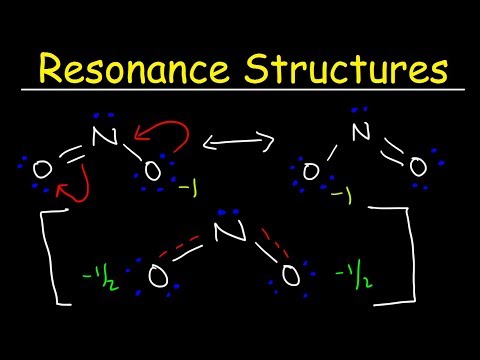
We like to understand a molecule's structure. We know a couple of rules and trends that help us. The most basic is electronegativity. It helps us determine if the bond is ionic or covalent. If we have a covalent molecule, we can apply the octet rule. There are a few exceptions. But, it works most of the time. All of these help us to draw the Lewis structure. But sometimes, we find a molecule that has multiple lewis diagrams. What do we do?!
Exploring Multiple Lewis Structures
Try drawing the lewis structure for the polyatomic oxoanion, nitrate (NO3−). I'll write out the steps I would take.
-
Nitrogen is a group 5 element, and oxygen is a group 6 element of the periodic table. We also have to remember that nitrate is an ion. So there is an extra electron. How many total valence electrons do we have? 5+(3×6)+1=5+18+1=23.
-
The central atom will be nitrogen. How many lone pairs are on nitrogen? LP=2VE−8n=223−8×3=2−1. What does it mean to have a negative number of lone pairs? The formal charge on the central atom is positive. A lone pair is two electrons. So, that's a negative two charge. So, FC=2−1×−2=+1. Our nitrogen atom will have a positive formal charge.
-
Let's start with our nitrogen single-bonding three times. Once to each oxygen. But, we know that nitrogen doesn't have a lone pair. So, to satisfy its octet, it needs to double bond to one of the oxygens. We'll call it oxygen number one. That completes nitrogen's octet and oxygen number one's octets.
-
What do we do with the other two oxygens? At this point, we should count our electrons. You'll see we only have two left. So, oxygen numbers two and three get an extra electron. Their octets are satisfied!
What are the formal charges?
On nitrogen, it's plus one.
FC=VE−(nonbondinge−)−(bonds)=5−0−4=+1.
On oxygen number one, it's zero.
FC=VE−(nonbondinge−)−(numberofbonds)=6−4−2=0.
For both oxygen two and three, it's negative one.
FC=VE−(nonbondinge−)−(numberofbonds)=6−6−1=−1
The total ionic charge is negative one. So, we've drawn our ion!
Charge=Σ(FormalCharges)=+1+−1+−1=−1
Yay! We've solved the lewis structure of nitrate! But, have we?
Physical chemists have experimentally measured the bond length of nitrate's bonds. What did they find? All three nitrogen-oxygen bonds are shorter than a single bond. But, they're also more elongated than a double bond. All three nitrogen-oxygen bonds are between a single and a double bond. What does that mean? Our original lewis structure was lacking. We had other options! What else could we have done? We could have drawn the double bond to oxygen number two or three. The actual nitrate molecule is a composite of all three possibilities. It has resonance!
What's resonance?
Resonance is an application of valence bond theory. Sometimes, one structure doesn't accurately describe a molecule. When computational chemists use valence bond theory, they collect many models. The sum of all the models gives us the most precise conception. In our case, each nitrate structure was only a partial picture. The actual nitrate molecule is a mixture of all three models. From molecular orbital theory, we learned that bonding electrons distribute throughout the molecule. That's what's happening in resonance. The electrons are delocalized. They don't remain between atoms. Instead, they contribute to bonding across the entirety of the molecule. That's why all the bonds are between a single and double bond.
How do we draw resonance? We draw a dashed line to show partial bonds. So, in nitrate, each oxygen would have a solid line. That's the single bond. Next to it would be a dashed line. That's the delocalized electrons contributing a partial bond. The dashed line notation is called a resonance hybrid.
Not all resonance forms are equal. For example, let's say we replaced one of our oxygens with sulfur. Sulfur has the same number of valence electrons. So, it should bond similarly. But, oxygen has a larger electronegativity because it's at the top of the periodic table. So, the electrons would spend more time with the oxygens. The bonds would not be even. It's challenging to draw that. So, we don't change the resonance hybrid. But, we do need to know that the bonds would be uneven.
Tips for Drawing Resonance Structures
-
Resonance structures obey all the lewis structure rules.
-
Resonance structures will have the same number of electrons. But, the electrons' locations vary across the molecule.
-
The hybridization of the central atom is constant. In nitrate, we could draw three different lewis structures. The nitrogen was always sp2 hybridized. It had two single bonds and a double bond.
-
The skeletal backbone remains the same. Only pi bonds or lone pairs can move. So, a double bond can move. But, a single bond cannot move. In nitrate, we always had nitrogen bonded to three oxygens. We never broke a nitrogen-oxygen bond.
-
We still use formal charges to determine the stability. The structures that minimize them contribute the most to resonance.