Пі-зв'язки

Before this, knowСигма-зв'язки

Illustrated · 2 min

What are Sigma Bonds?

Sigma (σ) bonds are strong covalent bonds that occur when atomic orbitals overlap. When the atomic orbitals overlap to create a bond, the electrons are shared creating electron density between the nucleus of each atom. The location of the electron density is the σ bond. A single bond is made of one σ bond.
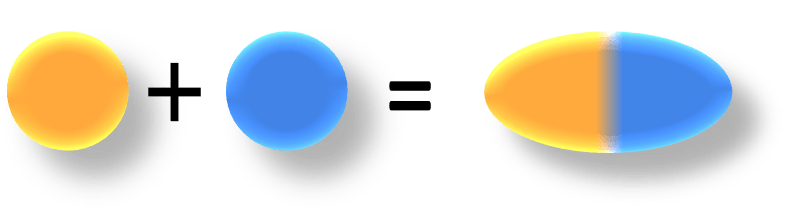
Image description: Two spherical orbitals combine to create an oval shaped bond orbital.

Here are two orbitals (s orbitals) of two atoms. They combine to create a σ bond orbital which is more oval in shape. The nucleus of each atom is on opposite ends.

Image source: By Cassie Gates

Think about taking two bubbles, each on a bubble wand. When they are brought close them together, they will start to merge and form an oval shape. The wand is the nucleus and the bubble is the orbital. The electrons would be in the space inside the bubble and when they merge, the most space is right between. The main difference if that you could bring the wants close together and create one large bubble, but the nucleus of each atom cannot get that close. The nucleus of each atom will repel each other somewhat so that the electron density around the sigma bond isn't perfectly round.

Types of Sigma Bonds
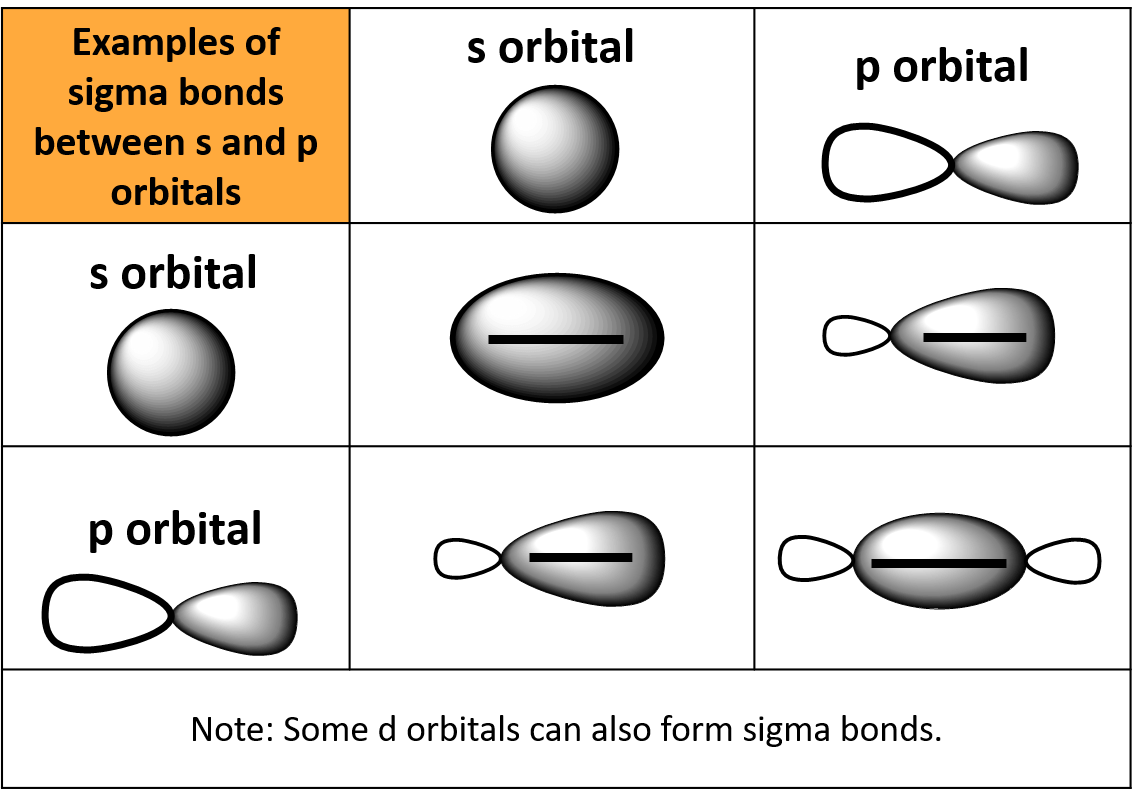
Image description: types of sigma bonds formed between s and p orbitals

Sigma bonds can occur between different orbitals. The bond is denoted by the black line. The orbitals combine so the same shaded lobes or phases combine. If opposite phases combine it is called anti-bonding.

Image source: By Cassie Gates

An important feature of orbitals are nodes. Nodes are areas of orbitals where electrons do not exist or there is no electron density. The node often occurs between phases. For example, the p orbital which looks like a figure eight has a shaded and unshaded side or phase. The point between these two phases is a node. The s orbital has no node.

It is also important to note that when a sigma bond is formed between two orbitals, no node exists between the orbitals which form a sigma bound.

What are Pi Bonds?

Pi (π) bonds are covalent bonds where two orbital lobes on one atom combine with two lobes on another atom. This means that between these two orbitals, there are two places of overlap separated by a node.

Image description: Combinate of two p orbitals to create a pi bond

The p orbitals combine to create a pi bond. Note that there is a node created in the pi bond.

Image source: By Cassie Gates

The π bond can form between p orbitals, d orbitals, and between these orbitals.

These bond are present in double and triple bonds. A double bond is made up of one σ and one π bond. A triple bond is made of one σ and two π bonds.

Illustrated · 1 min

Sigma Bonds

  • Sigma bonds (σ) are a result of a end-to-end overlap of atomic orbitals.

What does that mean?

This means that the end (or the head) of the atomic orbital from one atom overlaps with the end of another atom’s atomic orbital, causing a sigma bond to form.

Image showing the head-to-head overlap of atomic orbitals that form sigma bonds

Image source: By Caroline Monahan

  • Sigma bonds are what form a single bond.
  • The overlap of orbitals that form sigma bonds occurs between the two nuclei of the atoms.
  • Sigma bonds are stronger than any other covalent bond!

Pi Bonds

Pi bonds (π) are a result of the sideways overlap of atomic p orbitals.

What does that mean?

This means that when two p-orbitals are near each other, they overlap sideways, causing a pi bond to form.

Image showing how the sideways overlap of p orbitals form the pi bond (in ethene)

Image source: By Caroline Monahan

  • Pi bonds are what form double bonds and triple bonds .
  • The overlap of orbitals where pi bonds form is above/below the plane as shown in the image above.

One sigma bond and one pi bond = double bond.

One sigma bond and two pi bonds = triple bond.

Video

(Video) Hybridization of Atomic Orbitals - Sigma & Pi Bonds - Sp Sp2 Sp3

by The Organic Chemistry Tutor

In this video, The Organic Chemistry Tutor explains hybridization and sigma versus pi bonding. He starts with the electron configuration of carbon. Next, you'll learn each variety of hybridization. He also shows you the orbital diagram. So, you'll see how the hybrid orbitals' energies compare to the original. With this foundation, you can determine a molecule's sigma and pi bonds. He walks you through an example of a large organic molecule. Do you want a better understanding of sigma and pi bonding? This video can help!

Read · 4 min

We've been studying chemical bonding. Our understanding of covalent bonds is an extension of the quantum mechanical model. We learned that electrons reside in atomic orbitals. But remember, we can treat electrons as particles or waves. That's the wave-particle duality. In quantum mechanics, we consider everything to be a wave. So, everything is probability based. An orbital defines a 90 percent probability of finding an electron.

After building the foundation of quantum mechanics, we turned to chemical bonding. Remember, there are two main theories. The oldest is the valence bond theory. In it, covalent bonds form because of the overlap of atomic orbitals. The electrons stay localized between the atoms. The newer theory is the molecular orbital theory. In it, bonding electrons become delocalized. After bonding, they do not belong to specific atoms. So, the electrons can be in any position around the molecule.

Both theories use the sigma and pi bond terminology. Let's study how each method employs these terms.

σ\sigma Bonds

Let's start with the definition. Sigma bonds are covalent bonds created by the direct overlap of two atomic orbitals. They form directly along an axis. So, they are symmetrical. They also allow for rotation around the axis. So, they are not rigid bonds.

In valence bond theory, a sigma bond is a single covalent bond. Two atoms share one valence electron each. The electron density is between the two atoms. What would we see if we looked at an electron cloud diagram? The most likely place to find the electrons would be between the atoms. Valence bond theory gives an intuitive picture. It also helps us understand polarity and electronegativity. The more electronegative element will pull the electrons towards itself. So, it creates a dipole.

In molecular orbital theory, a sigma bond is also a single covalent bond. But the electrons spread throughout the molecule. The two atomic orbitals combine to produce sigma-bonding and antibonding molecular orbitals. Its benefit is its ability to explain why bonds do or do not form. For example, let's consider diatomic hydrogen and helium. In hydrogen, two electrons fill the sigma bonding orbital. So, we have a sigma bond! Diatomic helium would still originate from the 1s-orbital overlap. But it would have four electrons. So, two electrons fill the bonding orbital. Yet the two other electrons fill the antibonding orbital. So, no bond forms. The molecular orbital theory explains bond polarity via energy diagrams. The more electronegative atom will have a bonding orbital with less energy. So, that atom has more stability.

π\pi Bonds

Pi bonds are the result of a sidelong overlap of two orbitals. The most common overlap is from two p-orbitals. Let's imagine two atoms approaching each other. Remember, p-orbitals have two lobes. For the pzp_{z}-orbital, one lobe is above the atom, the other below. When these lobes overlap, the bond forms above and below the two atoms. The result is a rigid bond that prevents rotation.

In valence bond theory, pi bonding produces double and triple bonds. The overall bond strength increases with each addition. But a pi bond is actually weaker than a sigma bond. Why? A sigma bond comes from direct overlap. The pi bond occurs from indirect overlapping. That's also why pi bonding shortens the bond length. The length between the atoms decreases to maximize the pi orbital overlap.

What about molecular orbital theory? In it, pi bonding creates a set of bonding and antibonding orbitals. Remember, each atom brings three pi orbitals. So, we produce six molecular orbitals. Three of the orbitals are bonding. The other three are antibonding. On the energy diagram, they are between the sigma bonding and antibonding orbitals. For pi orbitals, the original p-orbitals have more energy than the sigma's s-orbitals. So, pi-bonding orbitals have more energy than sigma-bonding orbitals. But, the overlap is less. Remember, the antibonding state comes from destructive interference. The minimal overlap reduces the total interference. So, the antibonding state has less energy than the equivalent sigma antibonding state.

δ\delta and ϕ\phi Bonds

As a fun side note, there are also delta and phi bonds. Delta bonds are the result of d-orbital overlap. They are unbelievably rare! Why? The atoms need d-orbitals with a low enough energy to form covalent bonds. One example is the rhenium-rhenium bond in the octachlorodirhenate(III) anion (Re2Cl82−Re_{2}Cl_{8}^{2-}). It contains a quadruple bond between the rhenium atoms! A phi bond is the result of f-orbital overlap. There is only one known example of a phi bond. It occurs between a thorium atom and an organic eight-carbon ring. The eight-carbon ring has alternating double bonds. So, its electrons are delocalized. It acts as a ligand with thorium. You don't need to know any of this. But it's fun to know that delta and phi bonds exist.

Type a concept, like “slope” or “photosynthesis”.

↑ ↓ to choose · Enter to openSearch explanations and problems