Interactive · 4 questions
+7 contributors





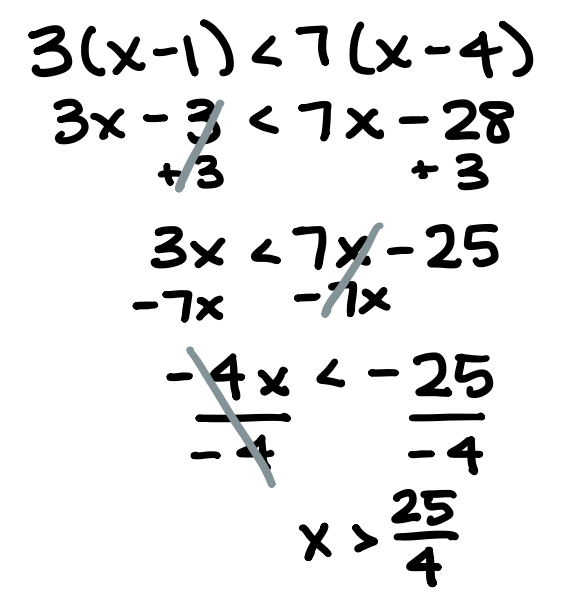
The general approach to solve a complex inequality is the same as a simpler one. We will simplify and isolate our variable on one side of the equation. Let's focus on a technique based on the distributive property.
Remember, when you're working with inequalities you must FLIP the inequality sign if you multiply or divide both sides by a negative number.
Consider this inequality:
What does this inequality look like once we use the distributive property?
Let's look at another example:
You can usually tell when you need to use the distributive property when you see an expression in parentheses (in this case, ) with a coefficient outside. We saw this before with simplifying equations.
What is the coefficient outside the term in parentheses?
As a reminder, think of "distributing" a value like dragging a paintbrush through the parentheses. We're going to be pulling the (in this case) across each of the terms in the parentheses.

Image source: By Clker-Free-Vector-Images CC0 via pixabay.com
Consider our inequality:
Distribute the . What is the result?
Now that we've handled the distribution, we can isolate on one side of the equation and solve.
Which inequality is equivalent to the one above?
Notice that we flipped the inequality sign from "greater than" to "less than" because we divided both sides of the expression by .