
Interactive · 3 questions
+3 contributors

Parallel Lines
Parallel lines are lines that do not meet, ever. It's important that we include "ever" in the definition because when we look at some graphs, our lines don't cross. Here's an example:

Notice how the red and blue lines don't actually meet anywhere on our graph. However, in order to be parallel, our lines can't meet EVER.
Imagine extending both the red and blue lines into infinity. We can see then that they'd eventually cross on their lower halves. Thus, we can say that these two lines are * not parallel.*

Here's the same graph just zoomed out. Notice they do intersect.

Consider the graph above. Are these two lines parallel?
Another way to think about it: in order for two lines to be parallel, the distance between them must be constant.
We can see in the graphs above that the lines are much closer together near the bottom and much farther apart at the top. This means that the distance between them is not constant and that the lines are not parallel.
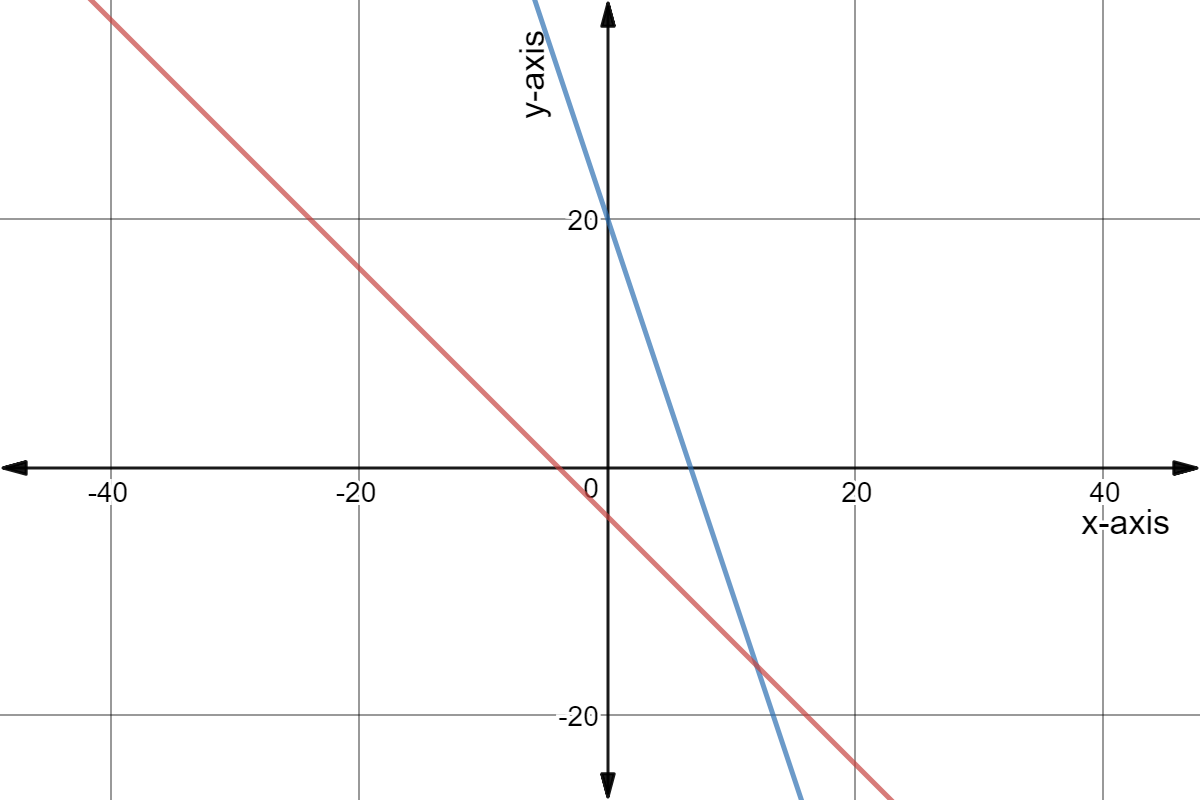
This is the same graph but zoomed out. As you can see, the lines intersect eventually.
You can also tell if two lines are parallel if they have the same slope and different -intercepts. Let's look.
Consider the equations of these two lines. Are they parallel?
Line 1:
Line 2:
Consider the equations of these two lines. Are they parallel?
Line 1:
Line 2:

