Перпендикулярні прямі

Before this, knowВизначення рівняння прямої

Interactive · 7 questions

What are Perpendicular Lines?

Perpendicular lines intersect once and always at a right (90°90°) angle.

There are 2 graphs.  Graph 1 shows two lines that intersect at a right angle.  Graph 2 shows two lines that intersect at a 60 degree angle.

Consider the two graphs above. Which show(s) perpendicular lines?

Choose one answer

Stretch your creativity

Contest problems rarely look like the examples you studied. Solving one means finding your own way in. These are real problems from the AMC 8, AMC 12 and AIME, the national math competitions for middle and high school students, each with a worked solution on LIVE by Po-Shen Loh.

Read · 1 min

Perpendicular Lines

If two lines are not parallel, one other interesting possibility is that the lines are perpendicular, which means the lines form a right angle (9090 degree angle—a square corner) where they meet. In this case, the slopes when multiplied together will equal −1-1. Solving for one slope leads us to the definition:

Perpendicular Lines

Given two linear equations f(x)=b+m1xf(x)=b+m_1x and g(x)=b+m2xg(x)=b+m_2x.

The lines will be perpendicular if m1⋅m2=−1m_1\cdot m_2=-1, and so m1=−1m2m_1=\frac{-1}{m_2}

We often say the slope of a perpendicular line is the "negative reciprocal" of the other line's slope. Example 9

Find the slope of a line perpendicular to a line with: a)a slope of 2b)a slope of −4c)a slope of 23\begin{array}{ll} \text{a)}&\text{a slope of }2\\ \text{b)}&\text{a slope of }-4\\ \text{c)}&\text{a slope of }\frac23 \end{array} If the original line had slope 22, the perpendicular line's slope would be m2=−12m_{_2}=\frac{-1}{2}.

If the original line had slope −4-4, the perpendicular line's slope would be m2=−1−4=14m_{_2}=\frac{-1}{-4}=\frac14.

If the original line had slope 23\frac23, the perpendicular line's slope would be m2=−123=−32m_{_2}=\frac{-1}{\frac23}=\frac{-3}2.

Example 10

Find the equation of a line perpendicular to f(x)=6+3xf(x)=6+3x and passing through the point (3,0)(3,0).

The original line has a slope m=3m=3. The perpendicular line will have a slope m=−13m=\frac{-1}{3}. Using this and the given point, we can find the equation for the line. g(x)=b−13xg(x)=b-\frac13x then at (3,0)(3,0), 0=b−13(3)b=10=b-\frac13(3)\\ b=1 This line we're looking for is g(x)=1−13xg(x)=1-\frac13x.

Example 12

A line passing through the points (−2,6)(-2,6) and (4,5)(4,5). Find the equation of a perpendicular line that passes through the point (4,5)(4,5).

From the two given points on the reference line, we can calculate the slope of that line: m1=5−64−(−2)=−16m_{_1}=\frac{5-6}{4-(-2)}=\frac{-1}{6}

The perpendicular line will have a slope m2=−1−16=6m_{_2}=\frac{-1}{-\frac16}=6

We can then solve for the vertical intercept that makes the line pass through the desired point: g(x)=b+6xg(x)=b+6x then at (4,5)(4,5), 5=b+6(4)b=−195=b+6(4)\\ b=-19 Giving the line g(x)=−19+6xg(x)=-19+6x.

Video

(Video) Equations of Parallel and Perpendicular Lines

by ProfRobBob

Here's a good video by ProfRobBob going over some problems you might see involving parallel and perpendicular.

Summary\large{\text{Summary}}

Two lines are said to be parallel (∥\parallel) if they have the same slope. Two lines are said to be perpendicular (⊥\perp) if their slopes are negative reciprocals of each other.

Test Yourself: Find the equation of a line perpendicular to x+2y=2x+2y=2 that passes through the point (3,3)(3,3).

Choose one answer

Video

(Video) Parallel and Perpendicular Lines

by Mahalo Math

Mahalo Math has a good video explaining equations of perpendicular lines and how to find them.

Summary\large{\text{Summary}}

Perpendicular lines intersect at a 9090 degree angle. You can tell if two lines are perpendicular based on their slopes. When you multiply slopes together and get −1-1, the lines are perpendicular.

2×−12=−12\times-\frac{1}{2}=-1

Let's say you have a line y=3x−12y=3x-\frac{1}{2}. Take the slope of the existing line and find the negative reciprocal. The negative reciprocal of 33 is −13-\frac{1}{3}.

Video · + 1 min read

(Videos) Perpendicular Line Graphs

by HEGARTYMATHS

Here's some videos by HEGARTYMATHS explaining perpendicular lines and doing some problems.

Summary\large{\text{Summary}}

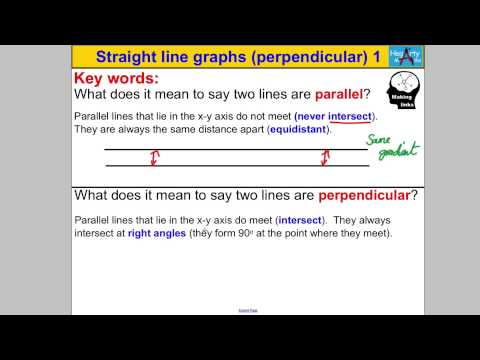
Two lines are said to be parallel if they have the same slope. That is, they never intersect and they're always the same distance from one another. Two lines are said to be perpendicular if their slopes are negative reciprocals of each other. That is they always intersect at right angles of one another.

The type of problems you will see involving perpendicular lines are usually in the form of, "Find the equation of a line perpendicular to y=mx+by=mx+b that contains the point (x,y)(x,y)." The steps to solve these problems are:

  1. Use the equation of the given line to find the slope.
  2. Take the negative reciprocal of that slope.
  3. Use the equation y−y0=m(x−x0)y-y_0=m(x-x_0).
  4. Put the negative reciprocal you found in Step 2 in the mm place.
  5. Put the point that they give you in the x0x_0 and y0y_0 place.
  6. Solve for yy.

Test Yourself: Find the equation of a line that's perpendicular to y=43x+12y=\frac43x+12 and contains the point (7,1)(7,1).

Choose one answer

Video

(Video) Parallel and Perpendicular Lines

by GVSUmath

This video by GVSUmath describes parallel and perpendicular lines.

Finding equations for parallel lines

Parallel lines have the same slope.

Perpendicular lines have opposite reciprocal slopes.

You have slope −3-3 and a point (1,2)(1,2). Let's find bb. 2=−3(1)+b2=-3(1)+b So, b=5b=5 and we can write the equation as y=−3x+5y=-3x+5

She walks through some more examples in the video. Check them out if you want more!

Video · + 1 min read

(Video) Perpendicular Equations of Lines

by mathman1024

Here's a video by mathman1024 showing you how to find an equation for a line given a perpendicular line and a point.

Summary\large{\text{Summary}}

Two lines are said to be perpendicular if they meet or cross at a 9090 degree angle. You can tell if two lines are perpendicular if they have negative reciprocal slopes.

The problem he goes over is, "Find the equation of a line perpendicular to y=5x−4y=5x-4 and passing through the point (3,4)(3,4)." Since we know our line has to be perpendicular to the line given just take the negative reciprocal of the slope. Since the slope is 55 the negative reciprocal would be −15-\frac15. Once you have the slope you can use either the slope intercept formula or the point slope formula to find the equation of the line. y−y0=m(x−x0)y−4=−15(x−3)y−4=−15x+35y−4+4=−15x+35+4y=−15x+235\begin{align} y-y_0&=m(x-x_0)\\ y-4&=-\frac15(x-3)\\ y-4&=-\frac15x+\frac35\\ y-4\color{red}{+4}&=-\frac15x+\frac35\color{red}{+4}\\ y&=-\frac15x+\frac{23}{5} \end{align}

Here's a video where he goes over a problem where the line is given in standard form.

The problem he does is, "Find the equation of a line perpendicular to 8x−9y=38x-9y=3 and passing through the line (−5,7)(-5,7)." Solving this is super easy. Take the Ax+ByAx+By part of the line that was given and re-write it in the form Bx+AyBx+Ay and change the sign of one of them. Then plug in the point given to find the new CC value. −9x+8y=□+9x+8y=□9(−5)+8(7)=□−45+56=11\begin{align} -9x+8y&=\square\\ \color{red}{+}9x+8y&=\square\\ 9(-5)+8(7)&=\square\\ -45+56&=11 \end{align} So the equation for our line is: 9x+8y=119x+8y=11

Test Yourself: Find an equation of a line perpendicular to 5x+6y=75x+6y=7 that passes through the point (3,1)(3,1).

Choose one answer

Video

(Video) Writing Equations of Perpendicular Lines

by Friendly Math 101

Here's a video by Friendly Math 101 showing you how to find perpendicular lines.

Summary\large{\text{Summary}}

Perpendicular lines are lines that intersect at 90∘90^{\circ} angles. This means that they will have opposite reciprocal slopes.

Let's look at an example. Find a line perpendicular to y=23x+1y=\frac23x+1 through the point (4,3)(4,3). We know the slope will be the opposite reciprocal of the one given. So if the slope is m=23m=\frac23 then the opposite reciprocal will be m=−32m=-\frac32. With our new slope and the point given, we can use point-slope form to find the equation of the line. y−y1=m(x−x1)y−(3)=(−32)(x−(4))y−3=−32(x−4)y−3=−32x+6+3=          +3y=−32x+9\begin{align} y-y_1&=m(x-x_1)\\ y-\color{red}{(3)}&=\color{red}{(-\frac32)}(x-\color{red}{(4)})\\ y-3&=-\frac32(x-4)\\ y-3&=-\frac32x+6\\ \color{red}{+3}&=\ \ \ \ \ \ \ \ \ \ \color{red}{+3}\\ \hline y&=-\frac32x+9 \end{align}

Try it yourself!

Write the equation of a line perpendicular to y=−4x+7y=-4x+7 and through the point (3,−2)(3,-2).

Choose one answer

Read · 1 min

Two perpendicular lines have opposite, reciprocal slopes. What does this mean? Let's break it up into parts.

The word opposite can be used to mean many different things. In math world, opposite of a number refers to the number having the opposite sign (i.e. positive or negative). For example, the opposite of 22 is −2-2, and the opposite of −1.5-1.5 is 1.51.5. Just switch the sign on any number, and you've got its opposite.

The reciprocal of a number is the number with the numerator and denominator flipped. Mathematically, it's what you get when you divide 11 by the number. With fractions, this is pretty straightforward. The fraction 23\frac{2}{3} has reciprocal 32\frac{3}{2} and the fraction 14\frac{1}{4} has reciprocal 41\frac{4}{1} (a.k.a the number 44). When we want to find the reciprocal of a whole number, we have to remember to put it over 11 first. For example, 55 is equal to 51\frac{5}{1}, so the reciprocal is 15\frac{1}{5}. Similarly, −3-3 is the same as −31\frac{-3}{1}, so the reciprocal is −13\frac{-1}{3}.

The opposite reciprocal is simply a combination of the two!

Illustrated · 1 min

In order to find the slope of a line perpendicular to another line, lets call it L1, there are two things we need to do.

1) Find the Reciprocal of the Slope of L1

2) Negate the Reciprocal of L1

​ .

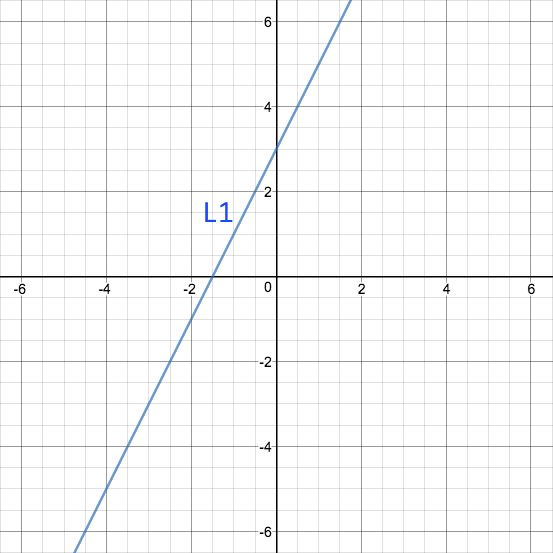
A graph of L1 where L1 is the line with equation y = 2x + 3

Reciprocal means that the top and bottom of the fraction will be flipped. For example, the reciprocal of 23\frac{2}{3} is 32\frac{3}{2}

Negate means put a negative sign in front of the fraction.


Note: If you are having trouble remembering that the reciprocal means to flip the top and bottom of a fraction, try creating a mnemonic for yourself! They are a little silly, but can really help some people (myself included).


My Mnemonic Device: For me, I read reciprocal and see the word PRO (reci-PRO-cal) which reminds me of how I always wished I could be a pro water bottle flipper (not really but it helps me remember to flip my reciprocals)!

Find the equation of the line perpendicular to L1:

L1: y = 2x + 3

L2 = ?

Step 1: Find the Reciprocal of the Slope of L1 Slope of L1 = 2 (2 is the same as 21\frac{2}{1}) Reciprocal of L1's Slope= 12\frac{1}{2}

Step 2: Negate the Reciprocal of the Slope of L1 −12\frac{-1}{2}

(just put a negative sign in front of the reciprocal)

So that is our slope for L2 is −12\frac{-1}{2} !

The slope of L2 (the perpendicular line) is the only thing we need in order to write out the rest of its equation because everything else is the same as L1.

So the equation for L2, a line perpendicular to L1 is: y = −12\frac{-1}{2}x + 3

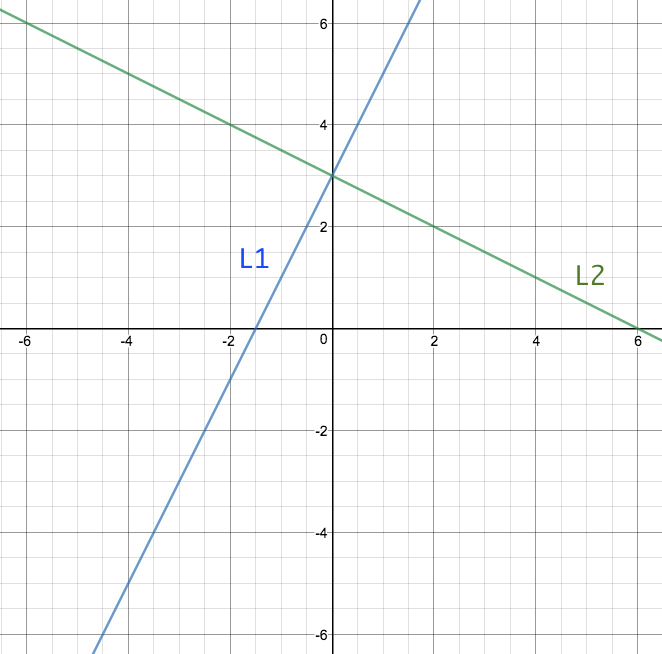
A graph of L1 and L2 where L1 is y = 2x + 3 and L2 is y = -1/2x +3

Type a concept, like “slope” or “photosynthesis”.

↑ ↓ to choose · Enter to openSearch explanations and problems