
Video

(Video) Solve Log Equations with the Same Base
by PreMath

In this video by PreMath, you will learn a neat trick to solve logarithmic equations with the same base.
Video
by PreMath
In this video by PreMath, you will learn a neat trick to solve logarithmic equations with the same base.
Read · 2 min
We've learned plenty about logarithms so far: from adding and subtracting logarithms, to finding the log of a power.
In this next lesson, we will learn how to solve logarithm equations with the same base.
The overall mission here is to use properties of logarithms to manipulate the equation into a form where you can easily solve for the variable.
There are five steps we will do every time to solve log equations with the same base.
Make sure all logarithms in the equation have the same base. If they do not, you can use the change of base formula to rewrite all logs in the equation to have the same base.
We've learned log rules! This is their time to shine: use logarithm rules and properties of logarithms to condense, expand, or rearrange the equation on both sides of the equation. You can use the product rule, the quotient rule, or the power rule.
Just like in algebra, isolate the logarithm on one side of the equation.
Once the logarithm is isolated, rewrite the equation without the logarithm and solve for the variable.
As always, make sure to check your solution! With logarithms, you may come across domain issues after manipulating the equation.
Let's walk through an example together.
Solve the equation .
The base in this equation is for both logarithms. They're the same!
Using the sum rule for logarithms, we can combine the two logarithms.
We can exponentiate both sides to isolate the logarithm.
We can now simplify and solve for the variable.
We know that logarithms don't work for non-positive values; therefore, is an extraneous solution. The only solution is .
Illustrated · 1 min
When you solve logarithmic equations with the same base, you're working with logarithmic expressions that can be simplified. If there’s a logarithm on one side of the equation, and the other side is a number, you can convert it to exponential form. For example:
If there’s a log on both sides of the equal sign, and the bases match, you can drop the logs and just solve the resulting equation. This works because logarithmic functions are one-to-one, so if:
We can then say that: .
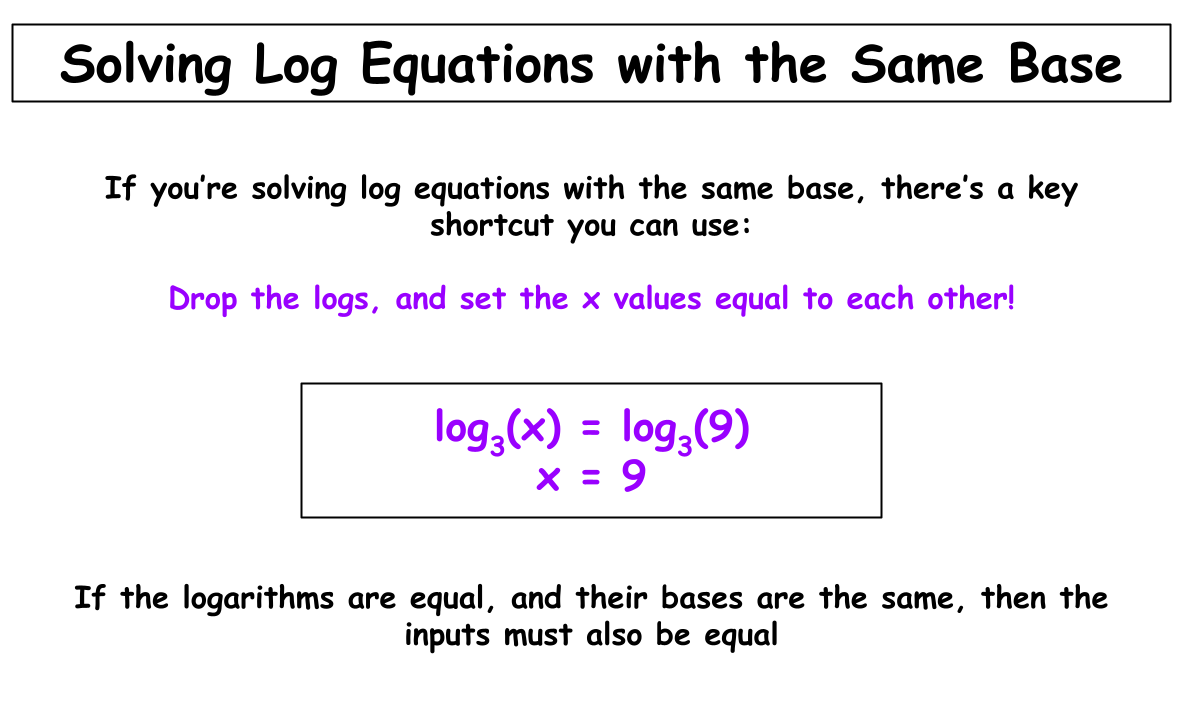
Image source: by Anusha Rahman
Sometimes you have to combine multiple logs into a single logarithm before solving. Use properties like the product rule or the quotient rule to simplify. After that, you can rewrite the original logarithm equation in exponential form and solve the resulting exponential equation.
In some cases, the equation might turn into a quadratic equation, and you’ll need to solve it using factoring or the quadratic formula. Once you find solutions, check your answers by plugging them back into the original equation.
Remember, you cannot take the log of zero or negative numbers!
Knowing when to use log rules and when to rewrite in exponential form is the key to learning how to solve logarithmic equations successfully. Always look at what's on each side of the equation and follow logical steps to get to the answer.