Графік функції квадратного кореня

Before this, knowОбласть визначення та область значень функції квадратного кореня

Interactive · 1 question

Square Root Graphs

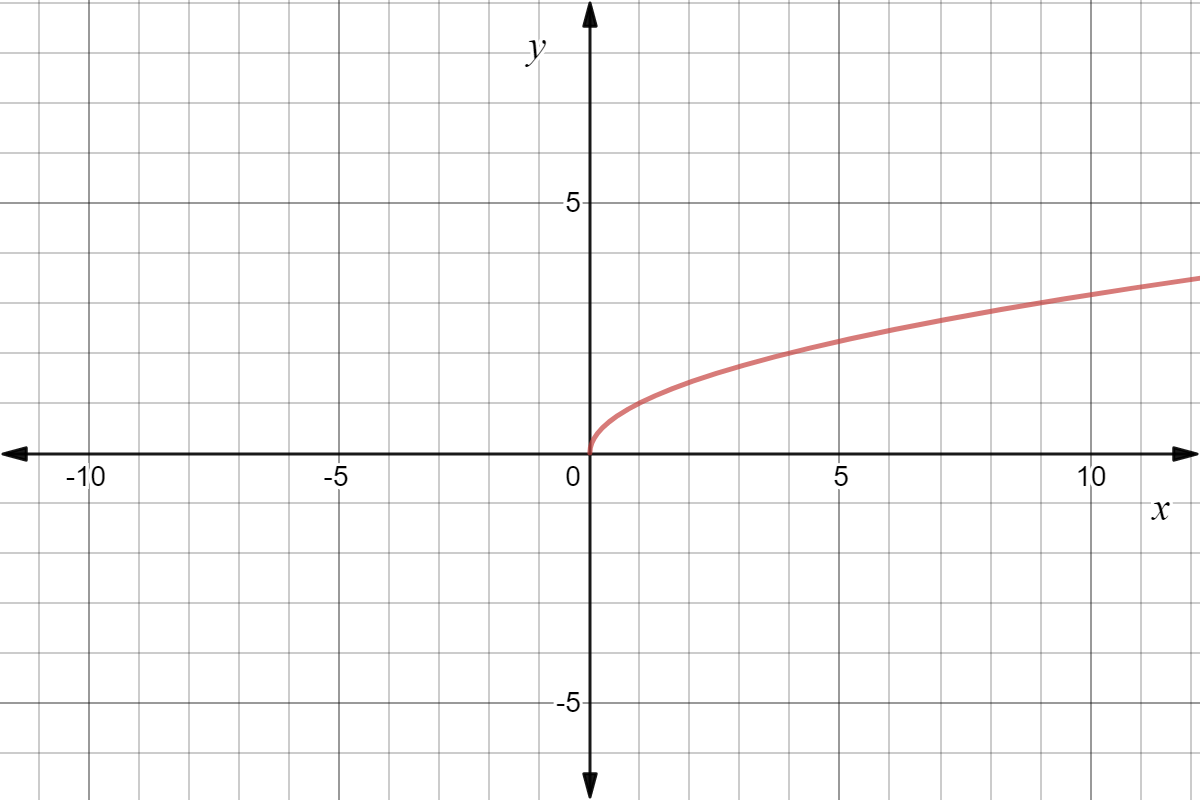
We're going to dive into the details of the square root graph. Let's start by looking at the most basic case, f(x)=xf(x)=\sqrt{x}.

The function starts at (0,0) and extends upwards and to the right in a smooth curve.

Made with Desmos

The graph starts at the point (0,0)(0,0) and extends upwards and to the right. Written in interval notation: Domain:[0,∞)Range:[0,∞)\begin{align} \text{Domain}&: [0,\infty)\\ \text{Range}&: [0,\infty)\end{align}

This is because of the rules for both square roots and functions. We know that we cannot have a negative underneath the square root (such as −3\sqrt{-3}). This means that we will only have positive xx-values in an unaltered square root function. We also know that a function needs to pass the vertical line test, or in other words, there can only be 11 yy-value for every xx-value. This means that we will only use the positive answers for a square root. For example, we will only use 9=3\sqrt{9}=3 when it comes to graphing the unaltered square root function.

Transformations

Square root functions can be transformed the same way any other function can. These can be categorized into shifts, stretches/compressions, and reflections.

Shifts

Shifts can be shown by adding or subtracting. Let's take a look at the graph of the following functions (with matching colors): f(x)=x Originalf(x)=x+1 Shift up one unitf(x)=x−1 Shift down one unitf(x)=x−1 Shift right one unitf(x)=x+1 Shift left one unit\begin{alignat*}{2} f(x)&=\sqrt{x} &&\text{ Original}\\ f(x)&=\color{blue}{\sqrt{x}+1} &&\text{ Shift up one unit}\\ f(x)&=\color{green}{\sqrt{x}-1} &&\text{ Shift down one unit}\\ f(x)&=\color{purple}{\sqrt{x-1} }&&\text{ Shift right one unit}\\ f(x)&=\color{red}{\sqrt{x+1}} &&\text{ Shift left one unit}\end{alignat*}

The graph shows each of the different shifts of the square root graph. There is a shift of one unit in each direction from the origin.

Made with Desmos

The above graph shows all of the possible directions of shifts from the parent function f(x)=xf(x)=\sqrt{x}.

Stretch/Compress

Stretches/Compressions are done by multiplying. The following functions show a stretch or compression: f(x)=ax Vertical stretch/compressionf(x)=ax Horizontal stretch/compression\begin{alignat}{2}f(x)&=a\sqrt{x} &&\text{ Vertical stretch/compression}\\ f(x)&=\sqrt{ax} &&\text{ Horizontal stretch/compression}\end{alignat}

Let's look at the following examples on a graph (with matching colors): f(x)=x Originalf(x)=2x Vertical stretch by 2f(x)=12x Vertical compression by 2f(x)=12x Horizontal stretch by 2f(x)=2x Horizontal compression by 2\begin{alignat}{2} f(x)&=\sqrt{x} &&\text{ Original}\\ f(x)&=\color{blue}{2\sqrt{x}} &&\text{ Vertical stretch by }2\\ f(x)&=\color{green}{\frac12 \sqrt{x}} &&\text{ Vertical compression by }2\\ f(x)&=\color{purple}{\sqrt{\frac12 x}} &&\text{ Horizontal stretch by } 2\\ f(x)&=\color{red}{\sqrt{2x}}&&\text{ Horizontal compression by }2\end{alignat}

Graph of all of the different types of stretches of the square root graph.

Made with Desmos

Notice that the vertical stretch and compression are the extremes. Horizontal stretches and compressions can be a little bit hard to visualize, but they also have a small vertical component when looking at the graph.

Reflction

Reflections are the most clear on the graph but they can cause some confusion. Let's look at the following functions on the graph: f(x)=x Originalf(x)=−x Vertical reflectionf(x)=−x Horizontal reflectionf(x)=−−x Vertical and Horizontal reflection\begin{alignat}{2}f(x)&=\sqrt{x} &&\text{ Original}\\ f(x)&=\color{blue}{-\sqrt{x}} &&\text{ Vertical reflection}\\ f(x)&=\color{green}{\sqrt{-x}} &&\text{ Horizontal reflection}\\ f(x)&=\color{purple}{-\sqrt{-x}} &&\text{ Vertical and Horizontal reflection} \end{alignat}

The functions extend in all directions!

Made with Desmos

The reflections allow the square root graph to go in any direction!

Combinations of Transformations

A quick note about horizontal reflections: reflecting over the yy-axis makes the horizontal shifts behave the opposite of what you've seen before. Based on the given information it would be easy to think that y=−x−1y=\sqrt{-x}-1 has a graph that is reflected over the yy-axis and shifted one unit to the right, but it is actually shifted one unit to the left.

The graph starts at the point (-1.0) and extends upwards and to the left.

Made with Desmos

We can make some sense of this just by rearranging the function. If we pull out a −1-1 under the radical, we see something that lines up a little better with the graph: y=−x−1y=−1(x+1)\begin{align}y&=\sqrt{-x-1}\\ y&=\sqrt{-1(x+1)}\end{align} Now we can see the reflection and the shit as two separate parts! Always be sure to watch out for this when dealing with horizontal reflections.

We use this same method when thinking about transformations that include horizontal stretches/compressions. Try out this problem:

What transformations are shown by the function y=−2x−3+4y=-\sqrt{2x-3}+4 Select all correct answers.

Choose all correct answers

Video

(Video) Graphing Square Root Functions

by Marty Brandl

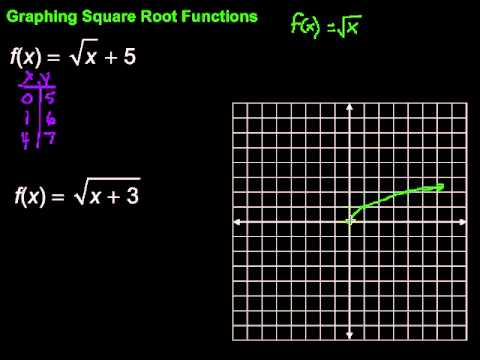
Marty Brandl has a very good video on how to Graph a square root function.

Illustrated · 1 min

Square Root Graphs

We've seen function transformations before. We can do the same vertical shifts, horizontal shifts, vertical stretches and compressions, and horizontal stretches and compressions.

We've previously learned that the parent function of the square root graph is:

y=xy = \sqrt{x}

Some characteristics of the square root parent function:

  • Starts at the origin, (0,0)(0,0)
  • Curves slightly upward and to the right
  • Gets less steep as xx increases

Some important points to remember:

  • 0=0\sqrt{0} = 0
  • 1=1\sqrt{1} = 1
  • 4=2\sqrt{4} = 2
  • 9=3\sqrt{9} = 3

So, the graph passes through: (0,0),(1,1),(4,2),(9,3)(0,0), (1,1), (4,2), (9,3)

Square root graphs
Parent 
Vertical shift, horizontal shift, stretch, compression

Image source: by Anusha Rahman

These rules work for square roots of a positive integer, not necessarily the square root of negative values. That is where it gets complex.

Domain and Range

Square roots have a key restriction. You cannot take the square root of a negative number (in basic algebra).

So when we think of the domain and range:

  • Domain: x≥0x \geq 0
  • Range: y≥0y \geq 0

That is why the graph only appears on the right side of the coordinate plane.

Transformations

You can change the shape and position of the graph using this form:

y=ax−h+ky = a \sqrt{x-h} + k

The variables mean:

  • h→h \rightarrow shifts the graph left or right
  • k→k \rightarrow shifts the graph up or down
  • a→a \rightarrow stretches, shrinks, or reflects the graph

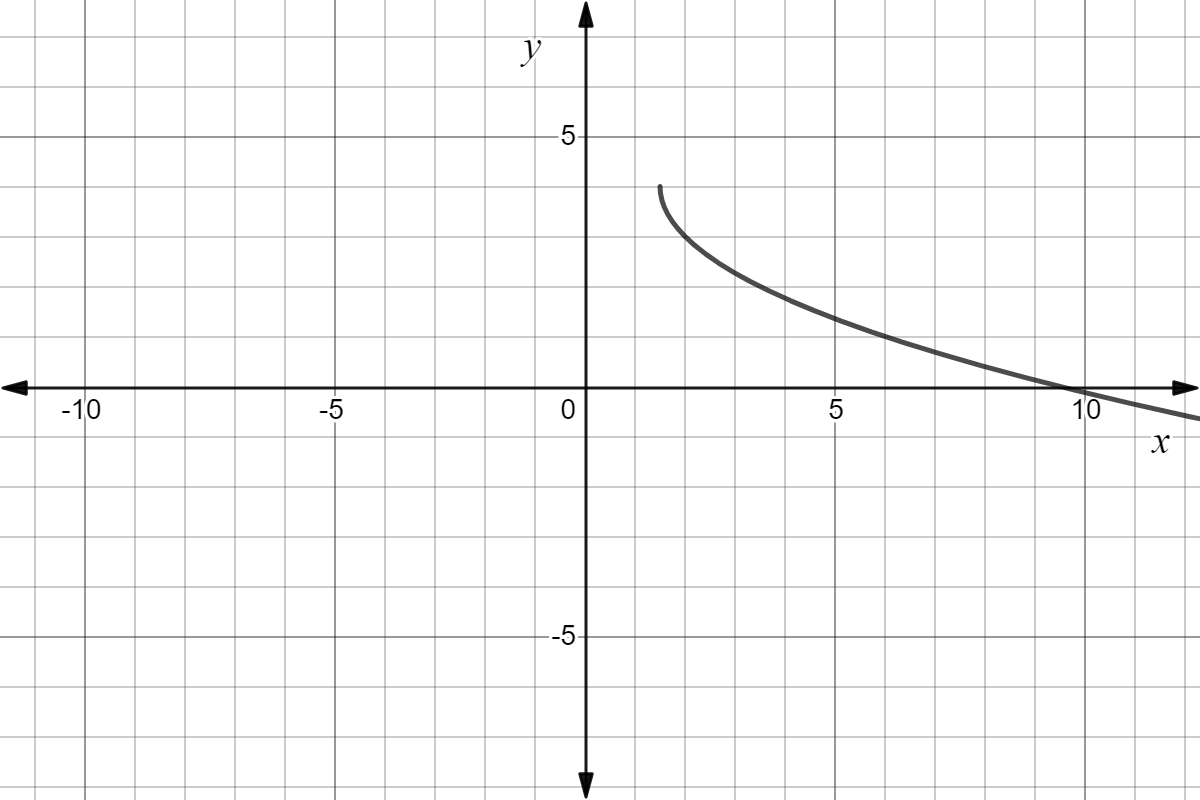
The starting point of a transformed graph is (h,k)(h,k).

Type a concept, like “slope” or “photosynthesis”.

↑ ↓ to choose · Enter to openSearch explanations and problems