Вертикальний перенос функції квадратного кореня

Before this, knowОбласть визначення та область значень функції квадратного кореня

Video · + 1 min read

(Video) Horizontal and Vertical Shifts

by mathman1024

Here's a video by mathman1024 showing you how to quickly graph a square root function by looking at it's horizontal and vertical translations. The general form will be: f(x)=x±a±bf(x)=\sqrt{x\pm a}\pm b

Here the aa is the horizontal translation because it is inside the square root part. A positive number shifts the graph to the left and a negative number shifts the graph to the right.

The bb is the vertical shift because it is outside the square root part. A positive number shifts the graph up and a negative number shifts the graph down.

The example he graphs is: f(x)=x+5−4f(x)=\sqrt{x+5}-4. So first we notice the number inside the square is +5+5. Since this is the horizontal shift and it's positive we know the graph shifts to the left five units. Then the number outside the square is −4-4. This is the vertical shift and it's negative so we know the graph will shift down by four units.
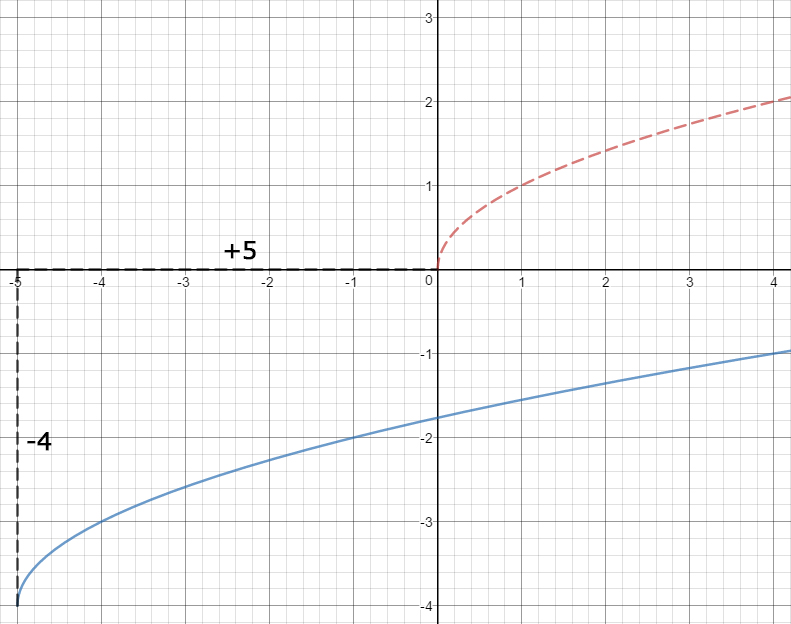
Graph of f(x)=\sqrt{x+5}-4. A dotted line of the parent function.

Graph made by Desmos

Test Yourself!

Graph f(x)=x+1+3f(x)=\sqrt{x+1}+3

Here is what your graph should look like!
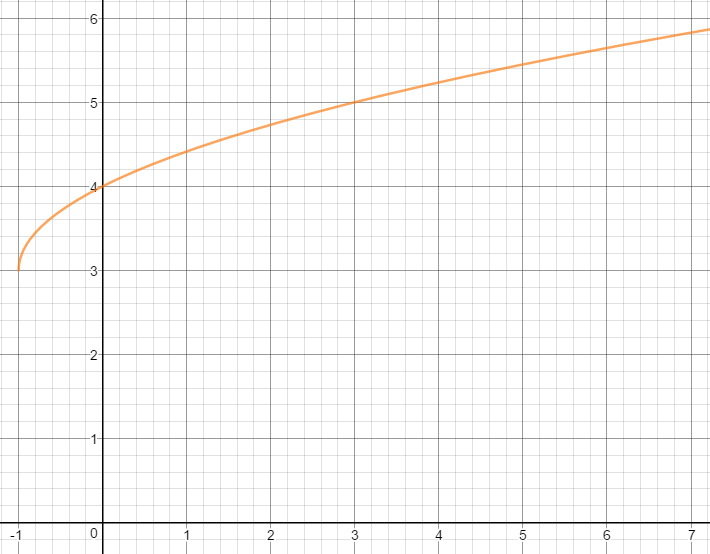
Graph of f(x)=\sqrt{x+1}+3

Graph made by Desmos

Illustrated · 2 min

In the previous couple of lessons, we learned about square root functions, cube root functions, and fourth root functions. We've briefly learned about function transformations associated with the radicals. In this lesson, we'll go more in-depth on translating radical graphs vertically.

Translating Radical Graphs Vertically

For this lesson, we're going to use the cube root function, x3\sqrt[3]{x}, as our parent function, but any other radical function would work!

Let's review what the cube root graph looks like:

Cube root graph.

Made using Desmos

The midpoint, or turning point, of the function is at the origin, (0,0)(0,0). The function goes through the points (1,1,)(1,1,) and (8,2)(8,2), though you can't see the latter.

If we want to shift this function vertically, we call that a vertical shift.

Vertical shift: shifting the function up or down by a value, dd. Adding dd shifts the function up, and subtracting dd shifts the function down. y=x3+dy=\sqrt[3]{x} +d

Example: Shifting Up

Say we want to shift the parent function, y=x3y=\sqrt[3]{x}, up by four units. We would add 44 to the entire function:

y=x3+4y=\sqrt[3]{x} +4

We are adding 44 units to the yy-value, which moves the function up on the yy-axis. The graph of this cube root function looks like:

Graph of \sqrt[3]{x}+4

Made using Desmos

We can find a vertical shift by focusing on the midpoint. In the parent function, x3\sqrt[3]{x}, the midpoint is at the origin, (0,0)(0,0). In this new function, y=x3+4y=\sqrt[3]{x} +4, the midpoint has been shifted up by 44 units, to (0,4)(0,4).

Now, let's look at what happens when we shift the function down!

Example: Shifting Down

Say we want to shift the parent function, y=x3y=\sqrt[3]{x}, down by three units. We would subtract 33 from the entire function:

y=x3−3y=\sqrt[3]{x} -3

We are subtracting 33 units from the yy-value, which moves the function down on the yy-axis. The graph of this cube root function looks like:

Graph of y=\sqrt[3]{x}-3

Made using Desmos

We can use our midpoint technique to see that the new function has shifted down by 33 units. The midpoint of the parent function is at the origin, (0,0)(0,0). The midpoint of this new function is (0,−3)(0,-3). This means the function has been shifted down by 33 units.

Illustrated · 1 min

Translating Radical Graphs Vertically

In this lesson, we are going to learn how to move radical graphs up and down, a vertical translation.

Translating Radical Graphs Vertically
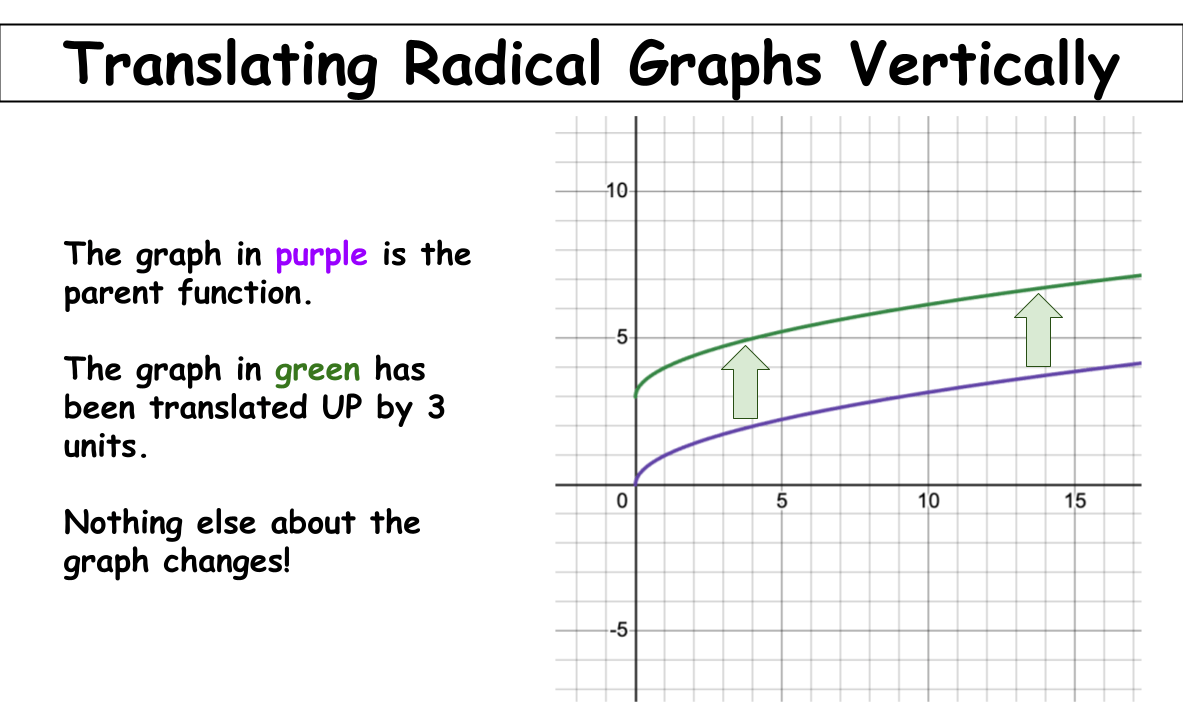
The graph in purple is the parent function.

The graph in green has been translated UP by 3 units.

Nothing else about the graph changes!

Made using Desmos

Let's start with the basic radical graph, the parent function:

y=xy=\sqrt{x}

This graph can be seen above in purple, where it starts at the origin, (0,0)(0,0) and curves up and to the right. Now, if we were to change the equation to:

y=x+3y=\sqrt{x}+3

The +3+3 means that we move the graph up by 33 units. Every point in the original graph goes up by 33. So, (0,0)(0,0) becomes (0,3)(0,3). We're very familiar with vertical translations at this point.

Now, let's say that the equation is y=x−2y=\sqrt{x}-2. The graph would go down by 22 units. That's because of the −2-2 at the end.

Vertical translations change how high or low the graph is, but they don't change its shape.

Type a concept, like “slope” or “photosynthesis”.

↑ ↓ to choose · Enter to openSearch explanations and problems