Read · 2 min
What is a Theoretical Yield?
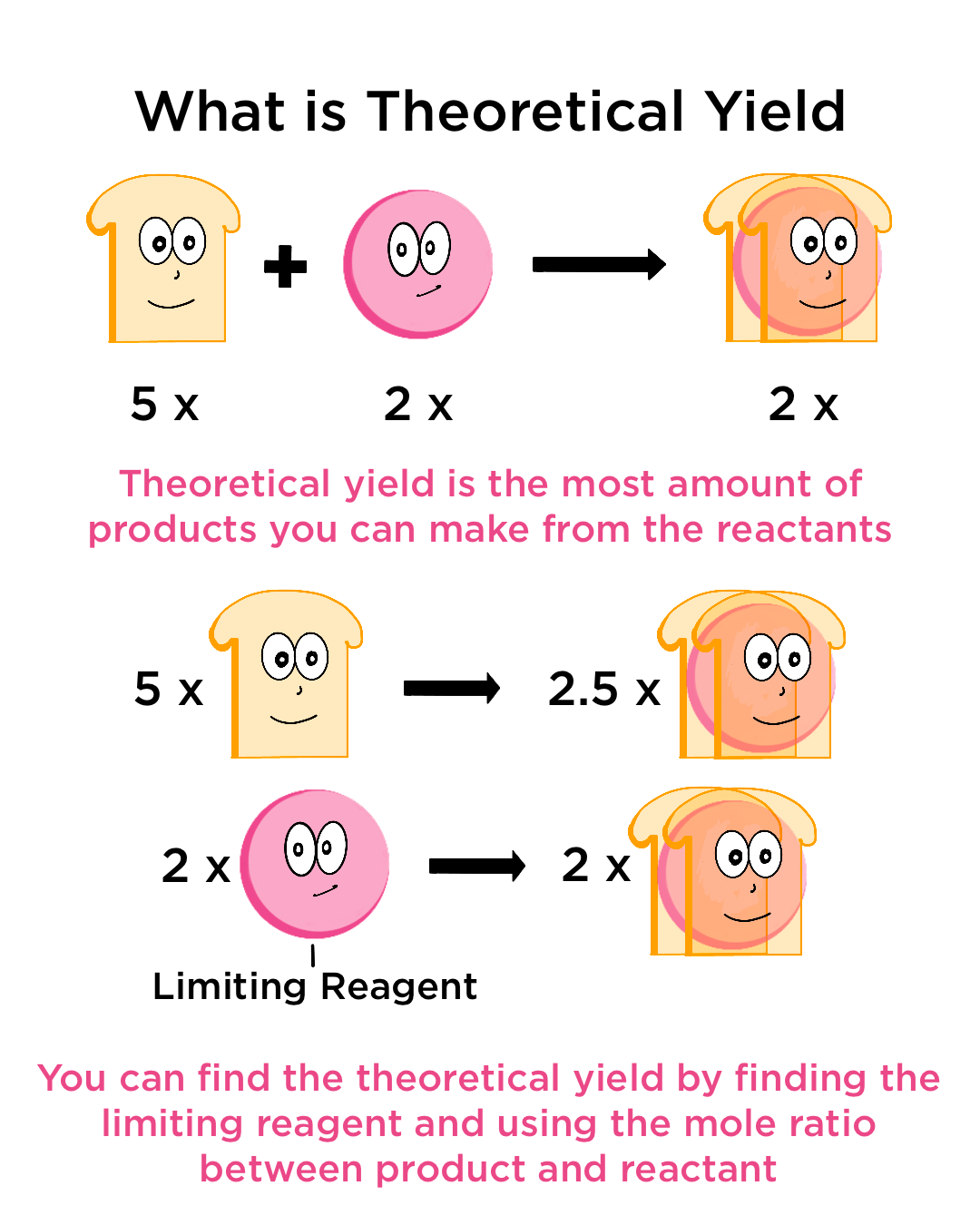
We've been studying stoichiometry. But so far, it's just been a lot of dimensional analysis. Why do even care? When we combine reactants, we start a chemical reaction. In theory, the reaction will yield the maximum amount of product. We call the maximum possible amount of product the theoretical yield. The only way to know the theoretical yield is to calculate it! How? Using stoichiometry!
How to Determine Theoretical Yield
The steps for determining the theoretical yield are...
-
Balance the chemical equation.
-
Determine the moles of each reactant.
- If we are told the mass, we need to use the molecular weight.
-
Determine the limiting reagent. Convert moles of reactant to moles of product for each reactant. Remember, this involves using the mole ratio. The smaller quantity is the limiting reagent.
-
Use the limiting reagent to calculate the mass or volume of the product. This is the theoretical yield!
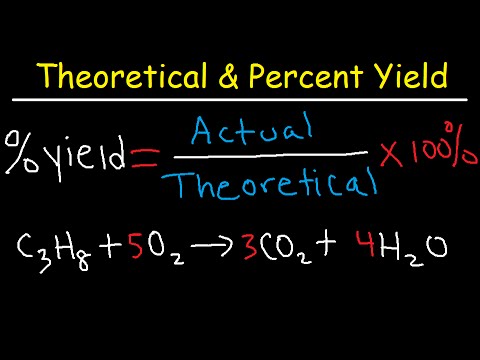
The amount of product calculated from the limiting reagent is the theoretical yield. This is the maximum amount of product we can make. However, reactions do not always produce 100% of the expected theoretical yield. The reaction may not go to completion or some product may be lost when transferring material. The amount collected is the actual yield. The comparison of the actual and theoretical yields is the percent yield. It represents how experimental error and uncertainty affected our reaction.
Example Calcualtion
5.00 grams of solid sodium hydroxide reacts with 5.00 grams of liquid hydrogen chloride , in a double-replacement reaction. The products are sodium chloride and water. What is the theoretical yield for ?
Balance the Chemical Equation:
Determine the Moles of Each Reactant:
Determine Limiting Reagent:
Sodium hydroxide produces less sodium chloride. So, it's our limiting reagent.
Determine the Theoretical Yield of NaCl: