What is Percent Yield?
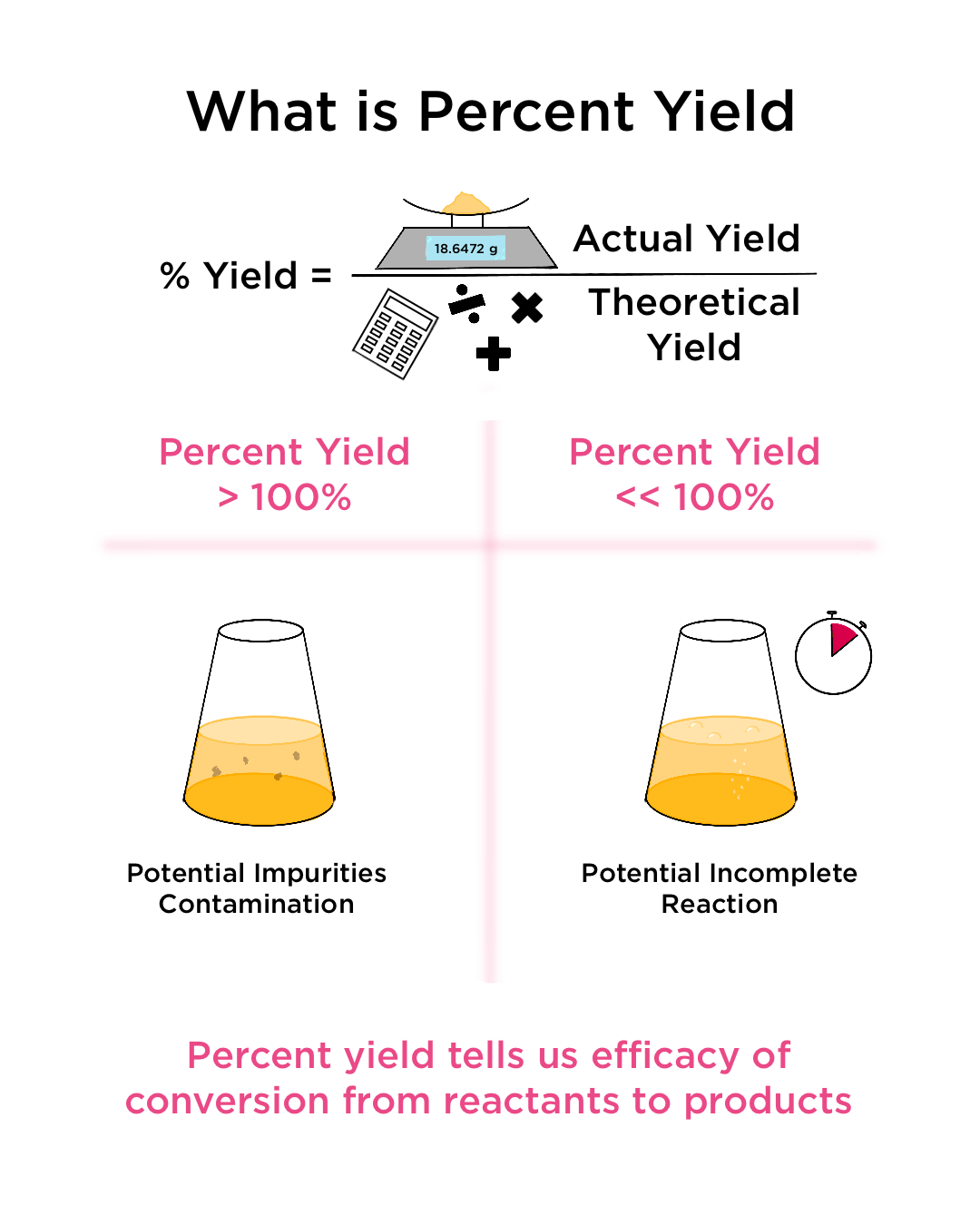
Let's imagine an ideal world. What do we want every time we perform a chemical reaction? We want every single reactant atom or molecule to react. In an ideal world, any chemical reaction would always produce 100% of the expected product. The theoretical and actual yields would always be equal. Unfortunately, that's never the case.
The percent yield is a comparison of the actual and theoretical yields. But what does it actually tell us? It's a measure of our efficiency! What causes the difference between the two yields? Sources of error and uncertainty! To quantify the effects of these factors, we calculate a percent yield. What is a good percent yield? It depends on the reaction and the setting. For example, in industrial chemical manufacturing, sometimes we are happy with lower yields. Why? Some syntheses are unbelievably challenging at such massive scales. But, when I was in college, it was similar to a sliding grade system. So, 90%+ was excellent. You absolutely got an A! The 70%-80% range was good. You probably got an A or B+. Anything below 50%, you had to worry about your grade. At that point, you were praying for a C. But again, it depended on the reaction and experimental method.
What Causes Loses in Yield?
There are many reasons for losses. Sometimes, they are unavoidable. It may just be a part of the reaction mechanism. But sometimes, they are caused by carelessness.
Inefficiency in the Reaction Mechanism:
-
Sometimes, there is no perfect route for completing a reaction. In general chemistry, most of our chemical reactions are just one step. But, if you take advanced chemistry, you'll learn reactions that have many steps. Sometimes, there are side reactions that consume the limiting reactant. Another possibility is that we make various products. For example, consider a combustion reaction. Theoretically, it should only produce carbon dioxide and water. In actuality, they also create carbon monoxide. We call it incomplete combustion.
-
Other times, a reaction might produce a mixture of molecular geometries. For example, when I took organic chemistry, we learned about the drug Thalidomide. Chemists developed it in the 1950s. It had two possible geometries. One helps reduce morning sickness, while the other is toxic! But, the same reaction forms both geometries. So, we have to separate them. Sadly, at the time, chemists didn't realize that and many babies were born with underdeveloped limbs.
-
We'll study reaction rates and equilibrium in future lessons. But sometimes, reactions are unbelievably slow. Other times, the reaction favors the reactants. So, it only produces a small amount of product.
Losses from the Experimental Method:
-
Often, the last step of our procedure is a separation. We have to separate the product from any remaining reactants or impurities. Most separation methods manipulate the solubility rules. We want the reactants and impurities to have high solubilities in our solvent. Meanwhile, our compound should have a low solubility. But, even if the solubility is low, a small amount may dissolve. So, you incur some losses.
-
It's impossible to get the last microgram of your compound of the glassware. Does your procedure require you to transfer material from one container to another? If so, you'll have losses. That's a part of chemistry.
Losses from Carelessness:
- Sometimes, we have a bad day in the lab. Let's say you trip and spill. Or you get confused and dump half of the product down the drain. You created a huge loss!
Steps for Calculating the Percent Yield
- We need to start by finding our theoretical yield. So, it becomes a stoichiometry problem. Below I've written a bullet summary of the stoichiometry scenarios we've already learned.
-
Next, we need our actual yield. Remember, the actual yield comes from our experiment. We go into the lab and perform the reaction. We need to make sure we take accurate quantitative measurements. Primarily, we must know the reactant and product quantities. But it is also necessary to note your conditions. For example, if you aren't at STP, you should record the temperature and pressure. Why? Because the conditions influence the reaction yields.
-
Finally, we compare the theoretical yield to the actual yield. We use the formula, TheoreticalActual×100%. Remember to check your units. The value is a percentage. So, it's the units must cancel. The theoretical and actual yields must cancel.
Practice Problem
A chemist is performing a synthesis reaction between nitrogen gas and hydrogen gas. The product is ammonia gas. They start with 14.5 liters of nitrogen and 28.9 liters of hydrogen. They produce 0.7 moles of ammonia. Calculate the percent yield.
- To start, we need to calculate the theoretical yield.
The balanced chemical equations is 1N2(g)+3H2(g)→2NH3(g).
Now let's determine the limiting reagent. The problem gives us the gas volumes. So, we'll need to convert volume to moles.
N2(g): 14.5L×22.4L1mol×1molN22molNH3=1.3mols
H2(g): 28.9×22.4L1mol×3molH22molNH3=0.9mols
Hydrogen gas produces less ammonia. So, it's our limiting reagent. Our theoretical yield is 0.9 moles.
- Now, we can calculate the percent yield.
TheoreticalActual×100%→0.90.7×100%=77.8%