
Illustrated · 1 min
Strong Acid and Strong Base Titration
Strong acids and strong bases dissociate completely, When they react together water and a salt are created. When they react completely, the equivalence point is reached. Water is the majority species at the equivalence point and the pH at the equivalence point will be at pH 7.
Example
Let's begin by titrating 50.00 mL of 0.20 M HCl with 0.150 M NaOH. To create a titration plot of the reaction, we need to do some calculations. These calculations allow us to determine the pH and plot that with the amount of titrant added.
The chemical reaction of NaOH and HCl is:
Initially:
- The pH will be low when starting with an acid solution. For HCl the pH will be around 1.0.
Before Equivalence Point:
As NaOH is added the pH will begin to increase. The hydronium ions will begin to react with hydroxide ions forming water.
- mmol OH added:
- mmol of HO after neutralization:
- Total volume:
- Concentration of HO after neutralization:
- pH
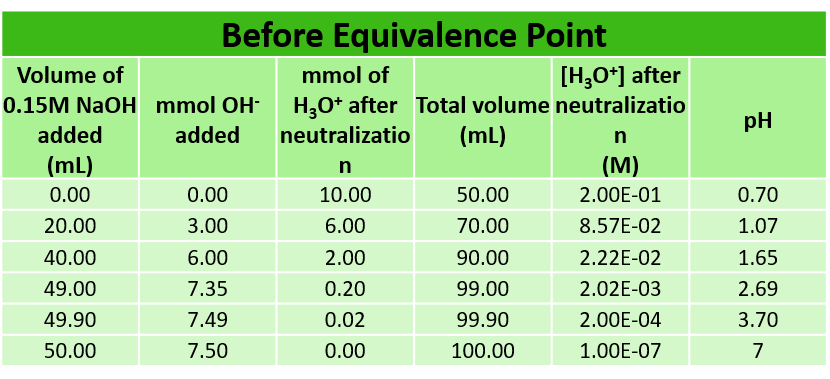
This data is for before the equivalence point.
Image Source: By Cassie Gates
Equivalence point:
Once enough NaOH is added to react with HCl completely, only water and NaCl will be present in solution. The pH at the equivalence point is 7 because that is the pH of water. This means the hydronium ion concentration is .
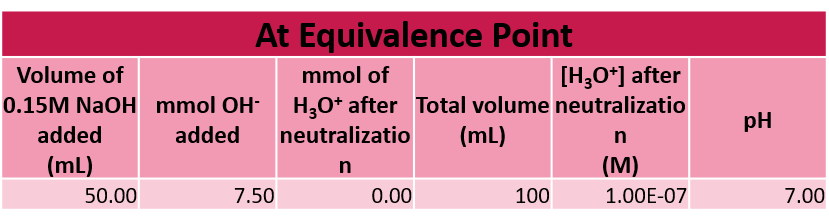
At the equivalence point.
Image source: By Cassie Gates
After Equivalence Point:
The pH will increase more and eventually plateau until it reaches the pH of NaOH. Since all the HCl has reacted, the pH will reflect that of a basic solution from the hydroxide ions.
- mmol of OH after neutralization:
- Concentration of OH after neutralization:
- Concentration of HO after neutralization:
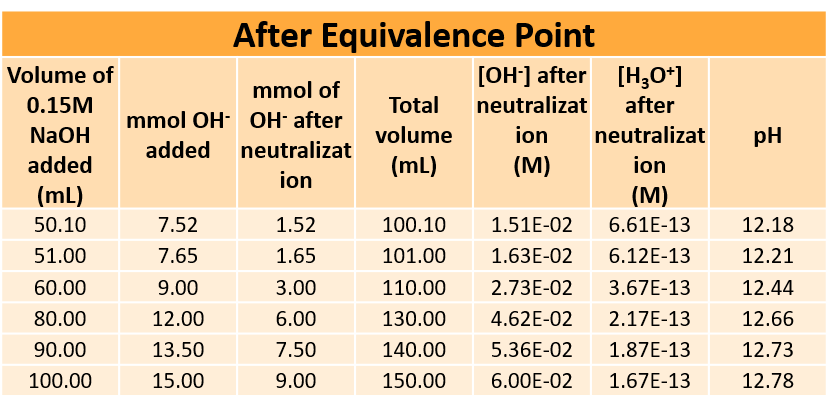
After the equivalence point.
Image source: By Cassie Gates
Titration Plot
The values calculated can be used to generate a titration plot. Since a strong acid and strong base are reacting there is less gradation between pH values.
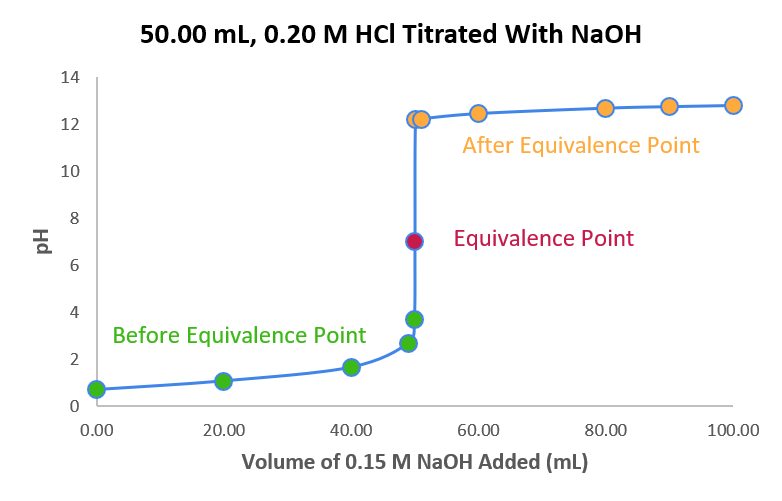
Titration of 50.00 mL of 0.20 M HCl with 0.15 M NaOH
Image Source: By Cassie Gates
