
Illustrated · 12 min
Let's talk about more about the different types of acid-base titrations!
If we recall, an acid-base titration is a quantitative method for determining the concentration of an acid or a base by neutralizing it with a a different acid or base solution of known concentration. Typically, a pH indicator is utilized to monitor the progress of the reaction. There are three types of acid-base titrations that you will need to know, I have them listed here with a common example of each:
- Strong acid-strong base hydrochloric acid and sodium hydroxide
- Weak acid-strong base ethanoic acid and sodium hydroxide
- Strong acid-weak base hydrochloric acid and ammonia
On this page, we are going to focus on the last type, Strong Acid-Weak Base Titrations. Let's dive in!
Strong Acid-Weak Base Titrations
In the titration of a weak base and strong acid, usually the acid will serve as the titrant and the base will act as the titrand, or the analyte (the terms can be used interchangeably).
The titrant is the "known" solution, meaning that the precise concentration is known, and the analyte is the "unknown" solution for which you are trying to find the concentration. With the titrant, both concentration and the volume added are known values, but for the analyte, only the volume is known. In other words, the analyte is the substance which is being analyzed in the titration.
Typically in a strong acid-weak base titration, a small amount of acid titrant will be added to a buret that is positioned above an Erlenmeyer flask containing a known volume of the weak base analyte.
Either a pH electrode can be positioned within the flask and connected to a computer to provide pH readings to monitor the progress of the reaction, or a few drops of indicator can be added to the analyte! In the case of a strong acid-weak base titration, methyl-orange will typically be the best indicator to use. Check out the link to learn more about selecting an indicator. The strong acid is then titrated into the weak base by opening the stopcock.
Let's take a look at the conventional setup of a lab titration.
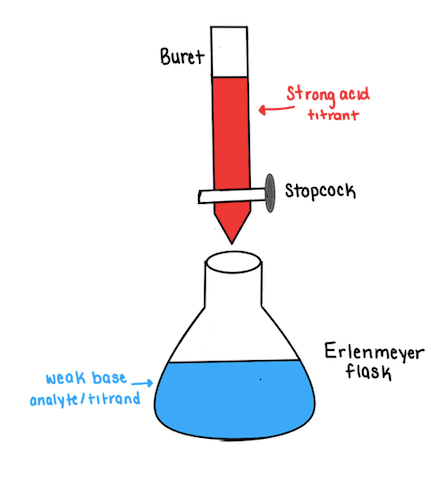
Conventional setup of a laboratory titration by Summer Black
Common Examples of Strong Acids and Weak Bases
Some examples of strong acids and weak bases are provided below for reference. It may be worth becoming familiar with the names-- you may not always be informed of the type of acid-base titration you are dealing with.
Strong acids
Weak Bases
Recall that strong acids completely dissociates in a solution, while weak bases only partially dissociate. In water, one mol of strong acid () dissolves to yield one mol of hydronium () and one mol of conjugate base ().
To help distinguish between strong and weak acids, know that stronger acids will have a larger acid dissociation constant () and a smaller logarithmic constant () than weaker acids will.
Remember: is the dissociation constant
As we know, a solution of weak base would look a bit different. Both the acid and the conjugate base are present at equilibrium, so you will see both
and
This information is helpful to understand for when we start talking about analyzing the process of titration.
Analysis of a Strong Acid-Weak Base Titration
Chemists will often preform titrations to collect data that can be used determine the molarity and pH of the solutions at various different points in the process. Typically, they are interested in the following points: at the starting point before any acid is added, at the midpoint, at some point before the equivalence point (excluding the starting point), at the equivalence point, and past the equivalence point.
The data that is collected at these points can then be translated to points on a graph, resulting in what is known as a titration curve. If a pH probe is used to monitor the reaction progress, the output will be in the form of a titration curve.
For clarity, a titration curve is the plot of the pH of the analyte solution versus the volume of the titrant added as the titration progresses.
Let's take a look at what one would look like for a strong acid-weak base titration!
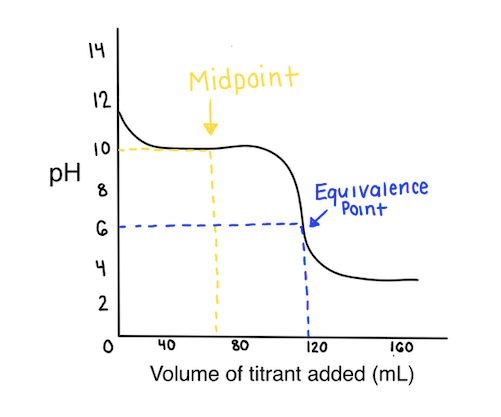
Strong acid-weak base titration curve
By Summer Black
On the titration curve, we can see that when titrating a weak base with a strong acid, the pH of the base will typically start high and then drop rapidly when the stopcock is released to allow for additions of acid. At the midpoint, the slope of the curve is near 0, while he equivalence point occurs when the curve is most vertical.
Let's break it down and talk a bit about what happens at each point of the titration process, and what information can be gained by analyzing these points.
Before titrant is added
Before any of the acidic titrant is released, the basic analyte in the flask is completely unreacted. In the titration of weak bases, water is always a reactant in the initial step, which puts its conjugate base, hydroxide, in the products. So this initial solution can be represented by the following equation:
- is the base analyte being titrated and is its conjugate acid
Chemists will often calculate the pH of this initial solution to analyze the changes undergone during the titration. To do so, it is helpful to construct an ICE (Initial, Change, Equilibrium) chart.
This is how the ICE chart would appear for this initial step. Since the quantity of water does not directly affect the reaction, its column is left blank. Also, since there is no or in the analyte solution at this point, their molarities are 0. This will not be the case once the stopcock is released and and begin to form, however.
Next, the information contained within the ICE chart can be used to set up an equilibrium expression. Typically, we have seen these for , but because the analyte that we are titrating is a base, will be used (this value should be given to you).
If we know the molarity of our base and are given , then we can solve for x using the quadratic equation. Since x represents the equilibrium molarity of , we can use the following relations to solve for the initial pH from pOH
Let's take a look at an example!
Example 1. Solving for pH before addition of titrant
Say that you are given 60 mL of 0.7 M , a weak base with , and 1 M HCl, a strong acid. What is the pH of the solution before any acid is added?
To solve, start by making your ICE chart!
Next, use this information to set up your equilibrium expression.
And solve for x using the quadratic equation! Upon solving,
To finish solving for pH, calculate pOH from x and subtract the value from 14.
Voila! Now you can solve for the pH of the initial solution! Moving on...
At the midpoint
The midpoint occurs when half of the analyte has been titrated, or the moles of strong acid added = moles of weak base initially in solution. On the titration curve, this point is where the curve levels out as the analyte is neautralized.
Determining pH is actually quite simple because at the midpoint, , and the value for is provided.
We can also determine how much strong acid needs to be added to reach the midpoint. If we know the molarity of the base, we can multiply that by the known volume to determine how many moles of base are initially in solution. Since the moles of strong acid is half of the moles of weak base, that value can be divided by two and then further divided by the the acid's molality to determine the amount that needs to be added.
Let's take a look at our example to practice with these ideas.
Example 2. Calculations at the midpoint
Say that you are given 60 mL of 0.7 M , a weak base with , and 1 M HCl, a strong acid. Calculate the pH at the midpoint and determine the volume of acid needed to reach this halfway mark.
A) At the midpoint,
Since ,
Therefore, the pH at the midpoint is 9.26.
B) Volume of acid needed to reach midpoint
Since the number of moles of added equals half the initial number of moles of , let's first determine the number of moles of present initially.
Next, determine the number of moles of HCl at the midpoint
Last, use stoichiometry to convert mol HCl to L HCl
Therefore, 21 mL of HCl needs to be added in order to reach the midpoint.
Now that we have a better understanding of what goes on at the midpoint, let's move on!
Titrant added before the equivalence point
The acidity of the analyte can also be calculated at any point between the initial and equivalence points to help chemists gauge where they are along the titration curve. For example, suppose that 25 mL of a 5 M strong acid is added to a base. Since moles base= moles acid at the equivalence point, we can determine if the equivalence point is passed without even looking at a graph.
Since molarity and volume of the acid are given, we can determine how many moles of strong acid have been added to the analyte
Therefore, if there is less than 0.125 moles of base initially, the equivalence point has been passed. If there were 0.125 moles of base initially, then the titration is at the equivalence point. Lastly, if there is more than 0.125 moles of base to start, then more acid is needed to reach the equivalence point.
We can use our handy ICE chart to determine the pH of the solution at any point during our titration. Let's fill out our chart for the most recent example.
Note: The units must be consistent across all values in the ICE chart. Either moles must be used for everything, or molarity for everything. In this ICE chart, moles will be used
Since there is no variable in the ICE chart for before the equivalence point, the Henderson-Hasselbalch equation can be applied to solve for the pOH.
Because moles were used in the ICE chart, the values must be converted to molarities before the Henderson-Hasselbalch equation can be used. The general equation can be used the converting to molarity:
Let's look back to our original example!
Example 3. pH before equivalence point
Say that you are given 60 mL of 0.7 M , a weak base with , and 1 M HCl, a strong acid. What is the pH after 40 mL of acid is added?
To start, find the moles of HCl in 40 mL of HCl using simple stoichiometry.
Next, we can set up our ICE chart recalling that there were 0.042 mol of in the initial analyte solution.
After 40 mL of acid has been added, there is still 0.002 mol of that has yet to be neutralized. Next, calculate the molarities of and its conjugate acid, to use in the Henerson-Hasselbalch equation. Because 40 mL has been added and we started with 60 mL of analyte, there is a total of 100 mL of analyte solution at this point.
Now that the molar values have been converted to molarities, the Henderson-Hasselbalch equation can be used:
Therefore, after the addition of 40 mL strong acid, the pH of the analyte solution had dropped from 11.55 to 6.96.
Now let's look at the equivalence point!
At the equivalence point
Yay! We finally made it! The equivalence point is defined as the point where the moles of strong acid = the initial moles of base in solution If an indicator is used, a color change will be observed at this point as the base is fully titrated. If more titrant is added, the reaction goes backwards, so at this point, the reaction is flipped. Instead of hydroxide, hydronium is now formed. As more titrant is added, the solution becomes increasingly acidic because of the hydronium found in the product.
In order to solve for pH at this step, we can follow a similar process to step one. However, instead of setting up an equilibrium expression for , we will use , since hydroxide is basic but the hydronium being produced now is acidic.
Since is given, we can use the following expression to find ():
Let's use our initial example to walk through this process.
Example 4. Calculating pH at equivalence point
Say that you are given 60 mL of 0.7 M , a weak base with , and 1 M HCl, a strong acid. What is the pH at the equivalence point?
First, calculate the molarity of at this point remembering that 40 mL of HCl have been added.
Next, let's set up our ICE chart (in units of molarity).
Before we use this information to set up our equilibrium expression, remember that we must convert to .
Using the quadratic equation, we can solve for x. Computation gives x=
Since x represents [],
Therefore, the pH of the analyte solution at the equivalence point is 4.81
There is one more part of the titration curve that chemists tend to look at, and that is the part that comes after the titration curve. We won't go so far into detail, but let's briefly discuss it.
Past the Equivalence Point
If the number of moles of strong acid added is greater than the number of moles of base, the titration is past the equivalence point. If you wanted to solve for the pH at this point, you would start by finding the moles of excess . This can be found by subtracting the initial moles of analyte from the moles of titrant added, if there is a 1:1 stoichiometric ratio. At this point, you can determine [] and solve for pH!
Let's take a look using our first example once more.
Example 6. pH past the equivalence point
Say that you are given 60 mL of 0.7 M , a weak base with , and 1 M , a strong acid. What is the pH after 60 mL of is added?
To start, determine the number of moles in 60 mL of and then subtract the initial moles of to solve for the excess amount of .
Next, determine the molarity of HCl in the flask at this point. Since we began with 60 mL of analyte and added 60 mL of titrant, there is a total of 120 mL, or 0.120 L of solution in the flask
Since dissociates into , we can equate [] to [] to solve for pH
Therefore, after the addition of 60 mL of HCl, our analyte solution has an extremely acidic pH of 0.82.
Phew! I know that was a lot of information but now you should be a pro at strong acid-weak base titrations!
