Вода: водневий зв'язок

Video

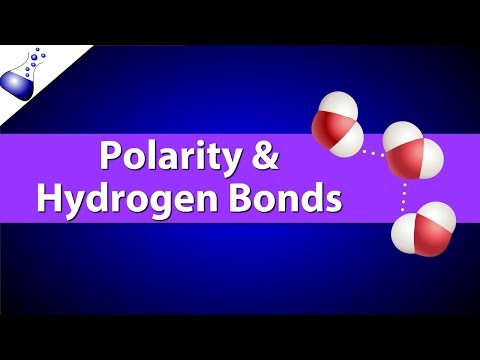
(Video) Polar Bonds and Hydrogen Bonds

by RicochetScience

This short video will teach you all about polarity and how it helps water molecules form hydrogen bonds. These bonds may be weak, but they allow water to do all of the cool things it does.

Read · 2 min

Hydrogen Bonding in Water

Hydrogen bonding is an important intermolecular interaction in water molecules. One molecule of water interacts with three other water molecules. The oxygen atom's lone pairs of electrons each interact with a hydrogen atom on another molecule. The two hydrogens on the molecule each interact with an oxygen atom on two other molecules. Hydrogen bonding is responsible for water's physical and chemical properties.

The basis for hydrogen bonding is water's polarity. There is a big electronegativity difference between oxygen and hydrogen atoms. Oxygen is more electronegative. So, it pulls the electron density toward itself. Furthermore, water has a bent molecular geometry. So, it has an internal dipole. The oxygen has a partial negative charge while the hydrogens have a partial positive charge. So, water is considered a polar covalent compound. Substances which can interact with water are usually polar and are called hydrophilic or "water-loving".

Hydrogen Bonding Effects on Water Properties

Water has many unique properties in which hydrogen bonding plays an important role.

Water has a high boiling temperature as a liquid which results from strong interactions between water molecules.

Water's surface tension is also caused by its strong hydrogen bonding interactions. Surface tension is caused by the different cohesive and adhesive forces on a surface. The surface molecules interact with the molecules below the surface. So, they get pulled downward. That's why we are able to drip extra drops of water onto a small surface before it spills over. Another example is that some insects can walk on water, even though they have a greater density.

When water freezes into ice, the hydrogen bonding causes a lattice structure in the ice. In the solid phase, the molecules arrange themselves to form hexagonal structures. The arrangement increases the space between each molecule. Because of the extra space between the molecules, ice is less dense than water. This is why ice floats on water instead of sinking. Ice forms these lattice structures because of the hydrogen bonding between the molecules.


Illustrated · 1 min

Hydrogen Bonding in Water (H2O)

Image of a wave.

Under it molecules of water drawn with one oxygen atom and 2 hydrogen atoms labeled. Hydrogen bonding between the hydrogen and oxygen shown with a purple dashed line.

Explanation is: Notice! Hydrogen bonds with the oxygen!

Image Source: By Trisha

Type a concept, like “slope” or “photosynthesis”.

↑ ↓ to choose · Enter to openSearch explanations and problems