
Illustrated · 1 min

Image Source: By Trisha
Illustrated · 1 min
Image Source: By Trisha
Video
by Crash Chemistry Academy
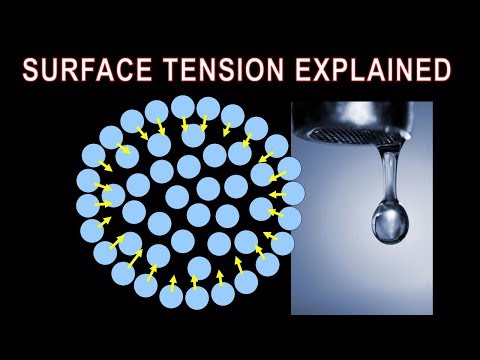
Watch this video to learn how water's properties allow it to form an outer surface known as surface tension.
Read · 3 min
We've already explored surface tension. We know that Van der Waal's forces generate a liquid's surface tension. But, let's learn more about the surface tension of water. Water has the second-largest surface tension of any known liquid. It's approximately 72 . Its units are force per length: millinewtons per meter. The only liquid that has a larger surface tension is the element mercury. Its surface tension is 500 ! Remember, mercury is a transition metal. It has such a large surface tension because it has metallic bonds.
How do we know the surface tension of water? We use an unusual analytical chemistry instrument named a Du Nouy ring. A thin platinum ring lowers into the liquid. Then it's very slowly pulled out. The liquid adheres to the platinum. We use platinum because it does not react. The adhesion causes the liquid's meniscus to move upward too. Eventually, the meniscus breaks from the ring. Meanwhile, the instrument measured the meniscus' circumference and the ring's force. The maximum force divided by the circumference equals the liquid's surface tension.
Similarly, water is known as the universal solvent because of it's polarity from the hydrogen bonds.
Water's powerful hydrogen bonds generate its surface tension. Remember, water hydrogen bonds four times. One time for each hydrogen. The other two times for each of oxygen's lone pairs. On a liquid's surface, the molecules only interact with the molecules below them. But, non-surface molecules experience electrostatic interactions in all directions. So, the net force on the surface molecules is inward. You've seen the effects of the inward pull. It's why raindrops are spherical! All the surface molecules are pulled towards the center.
Similarly, water is known as the universal solvent because of its polarity from hydrogen bonding, allowing it to dissolve many substances.
Let's review capillary action. Capillary action happens when adhesion overcomes cohesion. So, water climbs up its surroundings. A capillary has to be very small so that the adhesive force is greater than gravity.
Capillary action plays a significant role in plants. They have tiny capillaries in their roots called xylem. Xylems are only a few hundred micrometers wide. That's meters! In soils, the adhesive force between water and the plant's roots overwhelms cohesion. The roots suck up the water, and the xylems transport it. Some of the tallest trees are over one-hundred meters tall. Even they use xylem to transport water to their upper leaves!
At this point, you might wonder, "who cares?" It's nice that water forms raindrops. But honestly, that doesn't affect us. Well, I promise water's surface tension is essential for life! For example, if water had a lower surface tension, it would vaporize far easier. Think of ammonia. It has nitrogen-hydrogen bonds. So, it's a polar covalent molecule. But, ammonia's boiling temperature is C. It's a gas at STP! If water had a lower boiling point, our planet would be a desert. We wouldn't have any rain. So, all our plants would die. Rain forms because water vapor adheres to tiny particles in our atmosphere. The tiny particles are called condensation nuclei. Raindrops then grow through cohesion. When the mass of the raindrop is sufficient, gravity takes over.
The surface tension of water is also why bugs can float. For example, water striders have a larger density than water's density. So, they should sink. Instead, they float because their legs don't experience any attraction to the water. The water molecules stay attracted to themselves.
