Read · 3 min
We've been studying voltaic cells. But honestly, they don't look like our batteries. What we've been learning is the foundation. Physical chemist, Alessandro Volta, invented the first voltaic cell in 1800. Other chemists have built on that foundation. So, we developed standard electrode potentials. Then we learned to calculate the voltage under non-standard conditions. But what about the batteries we use every day? There are two common types of batteries: wet cell and dry cell. Let's explore each.
What is a Wet Cell Battery?
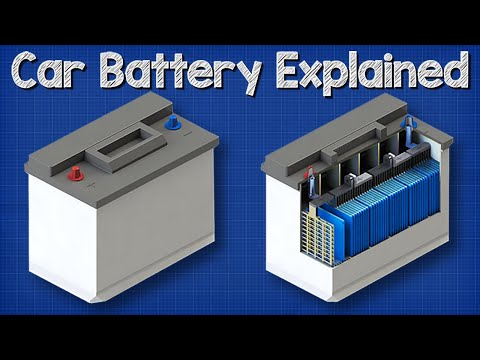
A wet cell battery contains an aqueous electrolyte. The most common wet cell is a lead-acid battery. Remember, chemists are very creative. So, the electrodes are elemental lead and lead dioxide. The electrolyte is sulfuric acid. Hence, the name lead-acid battery.
We don't separate lead-acid batteries into two cells. But why? Every voltaic cell we've studied had an anode and cathode half-cell. But, in all those cases, each half-cell had a unique electrolyte. In a lead-acid battery, the electrolyte is the same. Let's look at the half-reactions. For ease, I'm only going to put the phases in the net equation.
Cathode:
Anode:
Net Equation:
Both reactions use hydrogen sulfate ions as a reactant. So, we don't need to separate the cells. Also, notice that both reactants are solids. Moreso, one of the products is solid, and another is liquid. Remember, we exclude pure solids and liquids from the reaction quotient. So, our voltage only depends on the hydrogen sulfate concentration and the pH. So, lead-acid batteries tend to produce a steady voltage. Another advantage of lead-acid batteries is that they are rechargeable. We can reverse the reaction!
Applications of Wet Cells
The most common use for wet cell batteries is industrial. Sometimes we need a robust voltage. For example, it's challenging to start a car or airplane engine. Let's consider your car. Almost all vehicles use a wet cell battery. But, did you know the battery doesn't run the car? The battery's job is to power all the start-up functions. When you turn the key, you connect a circuit to the starter. So, the battery's redox reaction begins. It sends a short flow of electrons through the starter system. Eventually, at the spark plugs, the current combusts the fuel. And now your car is running!
The battery provides a quick, steady voltage that starts the car. But, doing that drains the battery. It takes a lot of energy to start an engine! Moreso, if you have a massive vehicle like a truck. So how does your car operate the electronic functions? Your car's alternator! During the initial start-up, the engine begins to fire. As your engine runs, it rotates the crankshaft. There is a pulley that connects the crankshaft and alternator. The pulley spins an electromagnet which sits within a series of copper coils. The electrostatic interactions between the magnet and metal coils generate a current. That current recharges the battery, powers the headlights, and plays the radio.
What is a Dry Cell Battery?
What comes to mind when thinking of a battery? Most likely, you imagine the small cylinders from Energizer or Duracell. You're pondering dry cell batteries. Why are they called dry cells? Because the electrolyte is a paste. Most commonly, it's potassium hydroxide. Why do we use a base? Because we want to keep the pH above seven. In alkaline conditions, it's difficult for the electrodes to corrode. Typically, the electrodes are zinc and manganese dioxide.
Applications of Dry Cells
I grew up in the late 1990s and early 2000s. Back then, we used batteries for everything! Dry cell batteries are famous for their portability. I remember playing my Gameboy. You could run down the street to your friend's house and play all afternoon. When the little light turned red, you popped out the batteries and inserted new ones. Just make sure you saved your game! Before there were iPods or iPhones, we had C.D. players. I remember people going for a run with a massive C.D player in hand or hooked to their belt. What did you do when the battery died? Again, pop them out and insert new ones. We still have devices that use dry cell batteries. But thankfully, now our everyday devices have rechargeable batteries.