
Interactive · 2 questions

Math in Music
Every sine function has an amplitude and a period. Amplitude is the distance between the center line of the function and the top or bottom of the function, and the period is the distance between two peaks of the graph, or the distance it takes for the entire graph to repeat.
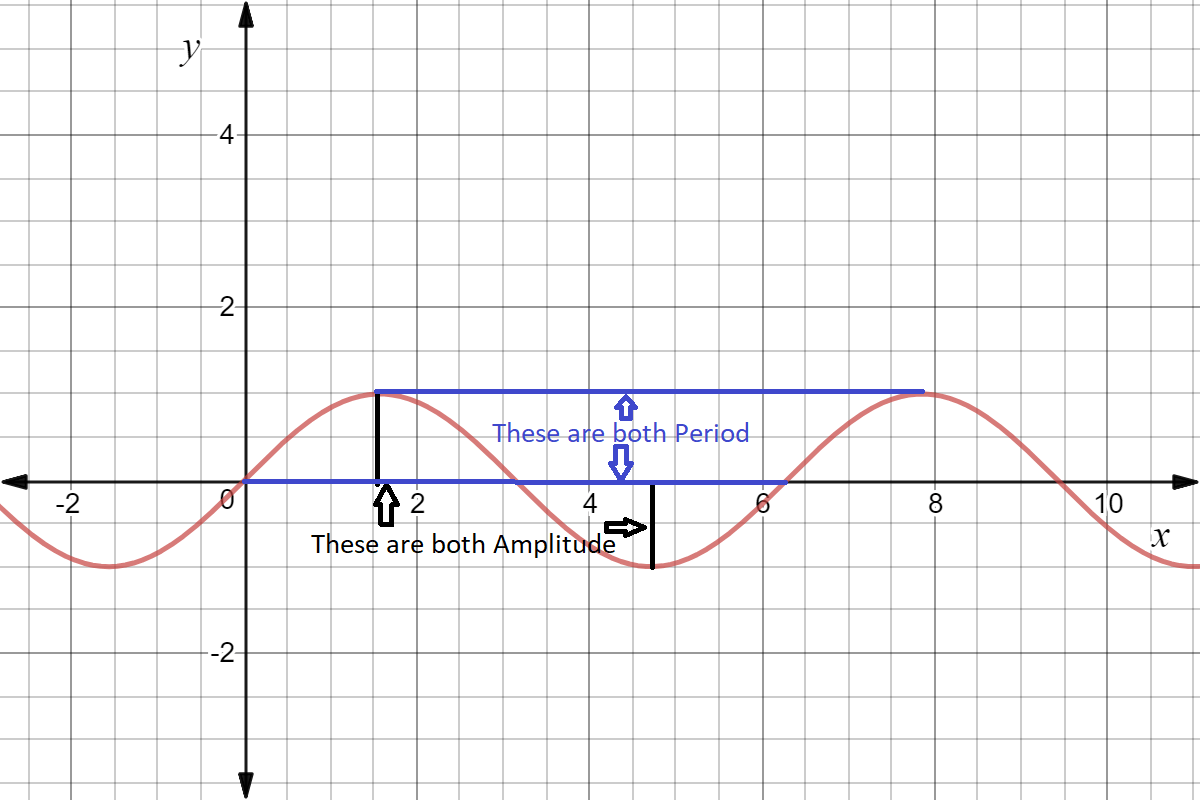
Graph of Made with Desmos
You can find both the amplitude and period of a sine graph without going through the entire process of graphing just by looking at the equation. The generalized equation for a sine graph is as follows:
Using this equation:
Remember that we are looking at our functions in terms of radians instead of degrees. Period is equal to because there are radians in a full rotation.
We are only looking at amplitude and period for now, so we can simplify the equation to:
The example graphed in the picture above is . Just by looking at the equation we can see that both and equal . This is shown in the graph as the amplitude is and the period is .
Let's try a practice problem:
What is the amplitude and period of ?
Here the amplitude is and the period is . Let's look at this on a graph.
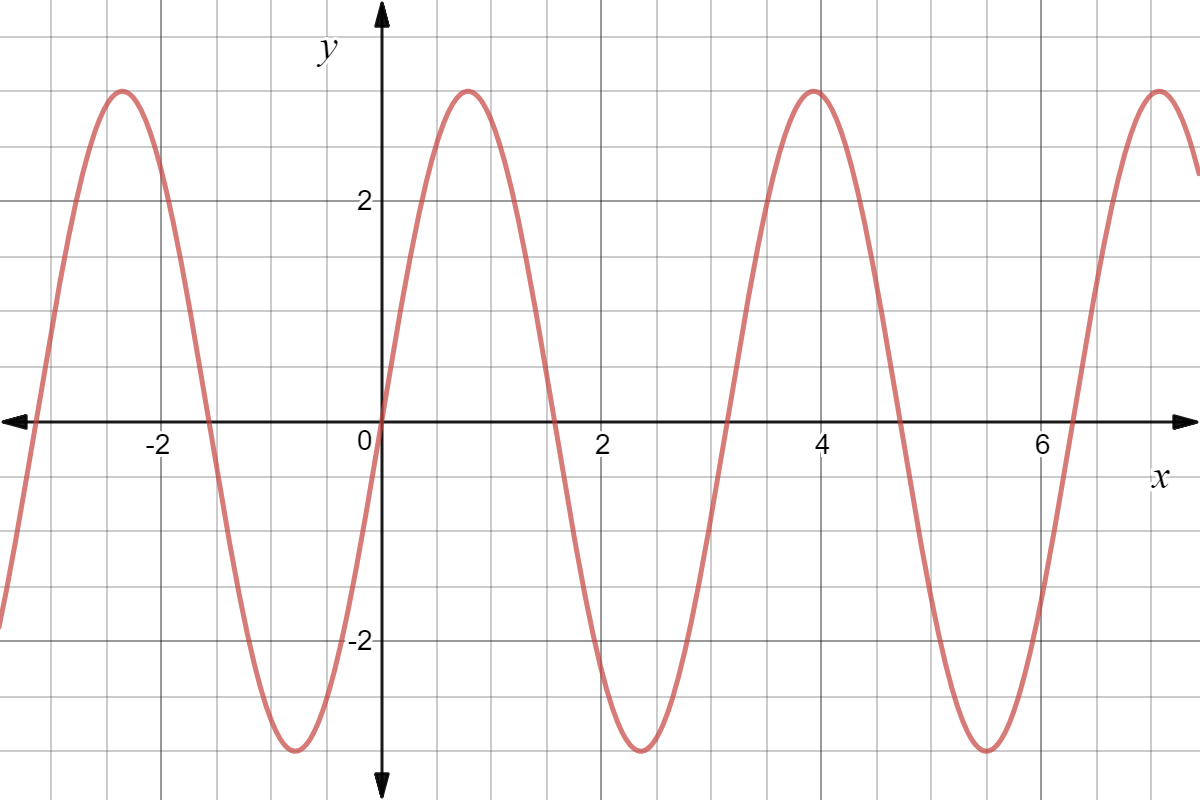
Graph of
Made with Desmos
The amplitude is easy to see as the maximums and minimums of the graph hit and respectively. The period is a little bit harder to see. If you look closely you can see that the graph crosses the -axis for the second time a little bit after . This is at the point where the graph has finished a cycle and starts a new one. It is also mirrored in the distance between any two of the peaks in the graph. This confirms our period of , as , and our graph repeats just after .
Sounds as Sine Functions
We can see, or rather hear, an application of periodic functions every day in the form of sound. All sound is caused by vibrations that cause pressure waves to move through the air, and the most basic pressure wave is a sine wave! Sine waves and other more basic waves are used very often in music, especially electronic music when the most basic waves can be combined or altered to make new sounds.
When we're thinking about graphing sound as a sine function, we have to make sure we are thinking about the -axis as time, where each whole number is second. Period in relation to sound is called frequency and it is measured in Hertz (), or cycles per second. The frequency is what gives a note it's pitch. For example, most tuning systems are based off of . The amplitude in sound is still just called amplitude, and is measured in decibels (). Amplitude determines the loudness of a sound but doesn't follow a linear scale. Some key points on the decibel scale are for a whisper, for normal piano practice volume, pain begins for some and is around the volume of the front row of a rock concert, is loud enough to rupture an eardrum, and is the loudest that our atmosphere can handle, and can even cause death!
Remember that our sounds are all based off the amount of cycles in one second, so each of our functions will have to include within the sine function. If we don't add this the frequency would be based on how many periods there are in seconds instead of in second!
We're gonna try a quick problem to check up on what we're doing.
What is the equation for a sound with frequency of and amplitude of ?
The correct equation is . Let's take a look at the graph of this.
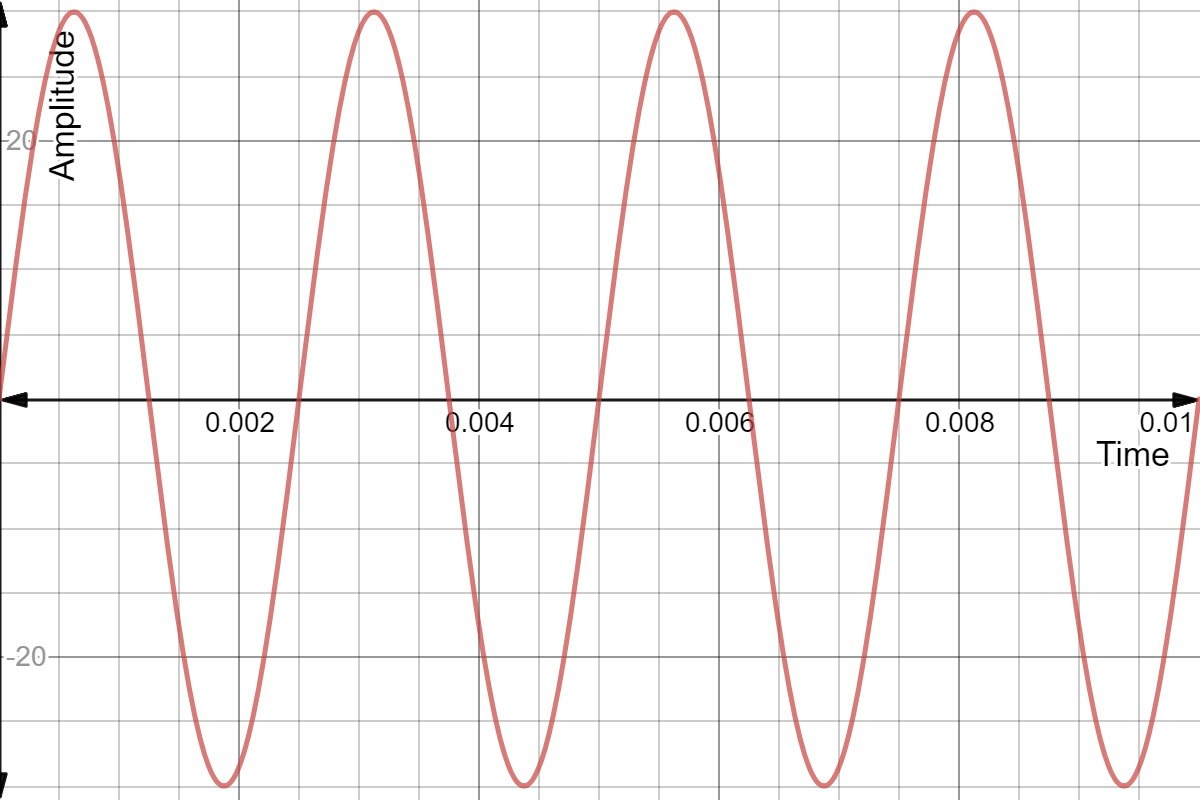
Made with Desmos
Notice that our graph only goes from seconds to seconds. This makes our graph easy to look at while still showing that over the course of entire second there would be periods of our wave. To show how condensed our graph can get, here is the same function but shown over the domain of to
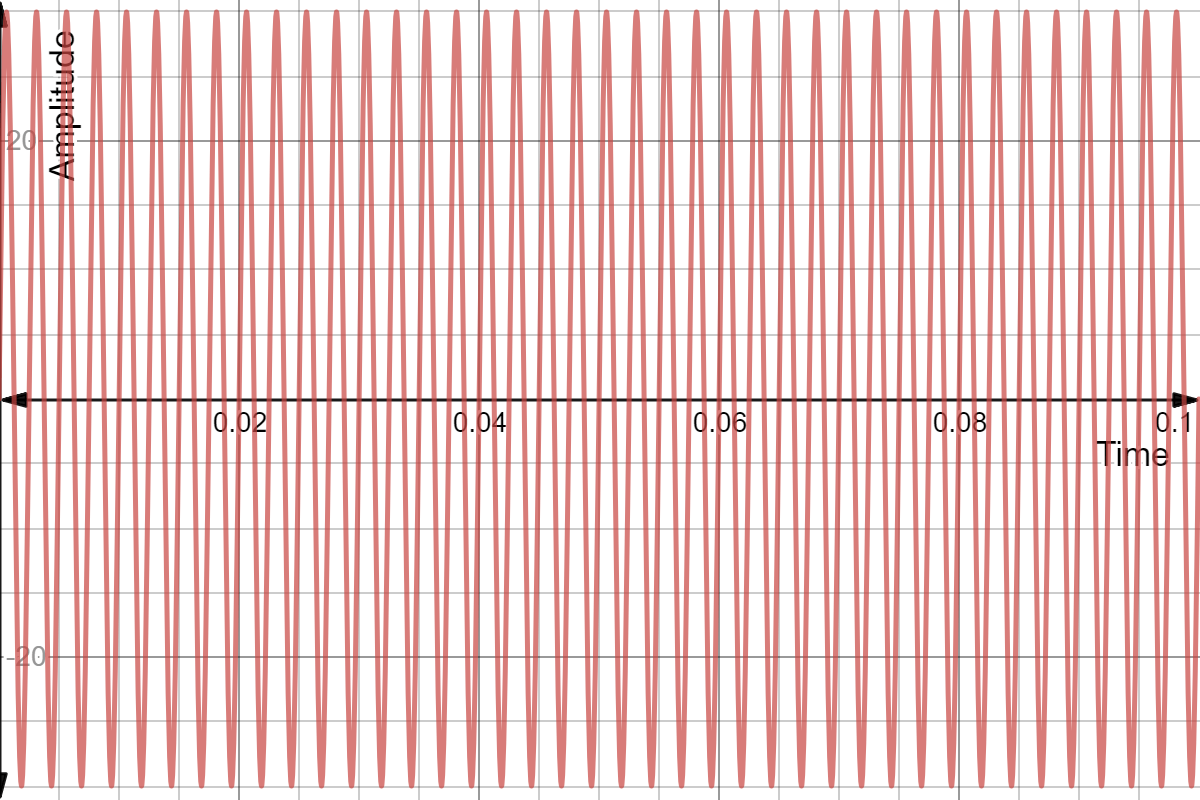
Made with Desmos
This graph shows periods of our sine function over the course of seconds.
All sine waves can be graphed but most sounds are not just a single. For fun we're gonna look at an A major chord. I'm going to graph this using some rules of tuning that are described in my explanation on Exponential Functions.
Our equation to be graphed is:
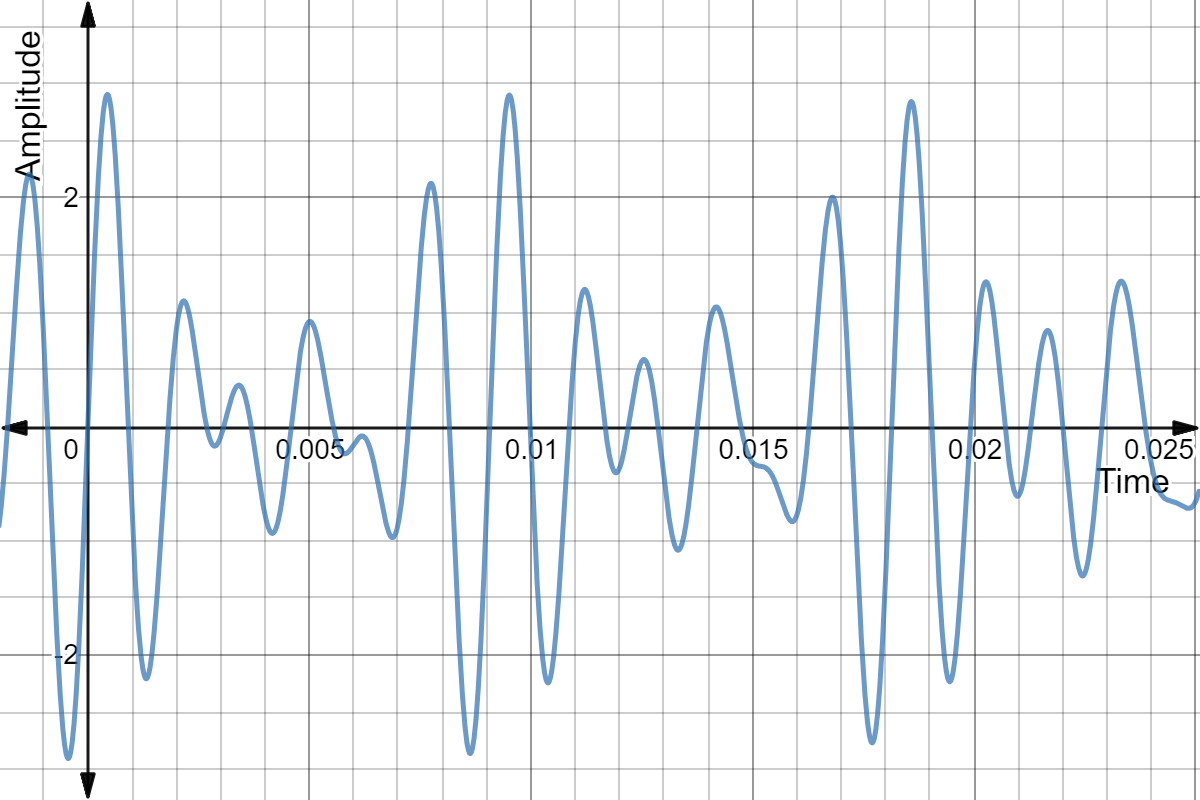
Made with Desmos
We can see that the function takes a drastically different form. It is easy to see that the amplitude is around decibels and our period is around , but they are much harder to calculate with our current knowledge.
Wrap Up
There is a generalized form of a sine function, , where amplitude, and period. This is part of a larger generalized function that involves variables and for horizontal and vertical shift, respectively. You can use the equation of the function to find the amplitude and period which makes it much easier to graph the function.
These same waves are the basis of music, and can be used to graph sounds the same way we would graph any other sine function.



