面积和几何图形的关联

Before this, knowFind Circular Areas and Perimeters

Illustrated · 1 min

Suppose two numbers xx and yy are each chosen such that 0<x<10 < x < 1 and 0<y<10 < y < 1. What is the probability that x+y≤12x + y \leq \frac{1}{2} ?

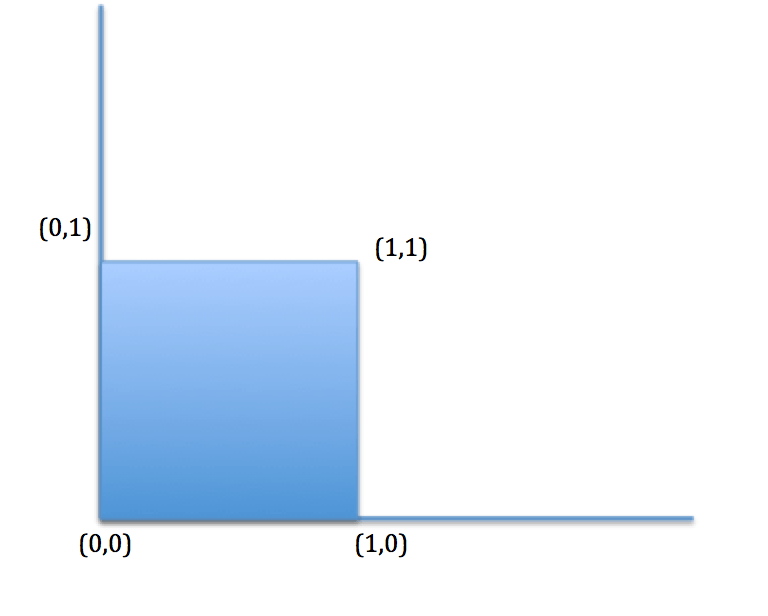
If we go about solving this problem using traditional counting methods, we would be in a dilemma. There would be infinitely many possibilities we would have to consider ... that would take way too long. Fortunately, there is a better method - geometric probability. This strategy is used to compute a probability when the outcome is continuous (that is, there are infinite possibilities). We consider our "successful" and "possible" regions as some geometric object. In this example, the possible region can be represented in the coordinate plane with 0<x<10 < x < 1 and 0<y<10 < y < 1. This region is a square with corners (1,0),(1,1),(0,1),(1, 0), (1, 1), (0, 1), and (0,0)(0, 0).

Total Outcomes Region

Now we need to draw the successful region. x+y≤12x + y \leq \frac{1}{2} is a line, and the region inside the square and below this line is the successful region.
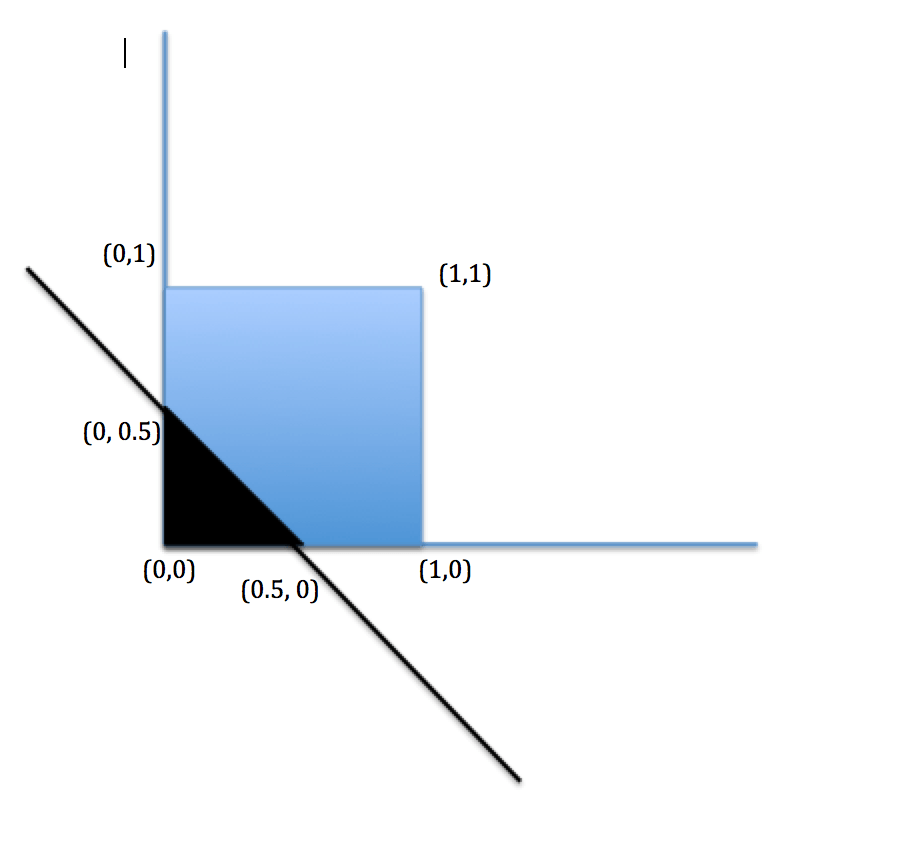
Possible and Successful Region

We now calculate the areas. The area of the square is 1, while the area of the triangle is 18\frac{1}{8}. The probability is

P(x+y≤12)=181=18P(x +y \leq \frac{1}{2}) = \frac{\frac{1}{8}}{1}=\frac{1}{8}

Preparing for a math contest?

Working through past problems on one idea at a time is one of the most effective ways to prepare. These are real problems from the AMC 8, AMC 10, AMC 12 and AIME, the national math competitions for middle and high school students, each with a worked solution on LIVE by Po-Shen Loh.

Illustrated · 1 min

Geometric Probability is the question of: When I choose a point in a given shape, what is the probability that it is in a certain region? This is answered by finding the area of the certain region and dividing that by the area of the whole shape:

In the picture above, the geometric probability that if I pick a random point in △ABC\bigtriangleup ABC I chose a point also inside △ACD\bigtriangleup ACD is the area of △ACD\bigtriangleup ACD divided by the area of △ABC\bigtriangleup ABC.

Type a concept, like “slope” or “photosynthesis”.

↑ ↓ to choose · Enter to openSearch explanations and problems