
Read · 1 min

Let be a matrix of size . Let and be scalars. The associative property of scalar multiplication says that . Basically, it doesn't matter what order you multiply the scalars in.
Example
Let and and .
Then,
And,
Read · 1 min
Let be a matrix of size . Let and be scalars. The associative property of scalar multiplication says that . Basically, it doesn't matter what order you multiply the scalars in.
Let and and .
Then,
And,
Video · + 1 min read
by MathTheBeautiful

This video by MathTheBeautiful describes the associate property, or the associativity, of matrix multiplication.
The Associative Property for matrices is very similar to the Associative Property you learned earlier with regular numbers.
The Associative Property tells us that when we have three items, we can place the parentheses in different ways. The order of grouping does not change the result.
Because of this,
The Associative Property allows us to multiply the items that are easiest to multiply. We can apply this property to matrices.
Saw we have the following expression:
We can see that the first matrix is , the second matrix is , and the third matrix is .
To multiply these three matrices, we need to check whether the middle result will work with the last matrix.
If we multiply the first two matrices, we get a matrix. This matrix can be multiplied by the third matrix, which is .
After multiplying them, the final result will be a matrix. Matrix multiplication works only when the inner dimensions match. Since the first result is and the next matrix is , the sizes line up, so the multiplication is allowed.
Additionally, if we multiplied the second and third matrices together, we would end up with a matrix. This intermediate matrix would be multiplied by the first matrix, which is a matrix, and that is also compatible. The result would be a matrix.
So, no matter which order we multiply the matrices, the middle matrix will still work with the last one. In both cases, the final result will be a matrix.
The next question is whether the result itself is the same each time. The answer is yes.
This happens because of the Associative Property.
Illustrated · 1 min
It may be helpful to review the Associative Property before diving into this lesson! That same concept will be applied here, to matrices.
In math, a matrix is a grid of numbers arranged in rows and columns. Sometimes, we multiply a matrix by a scalar, which is just a regular number. When you multiply a matrix by a scalar, you multiply every entry in the matrix by that number.
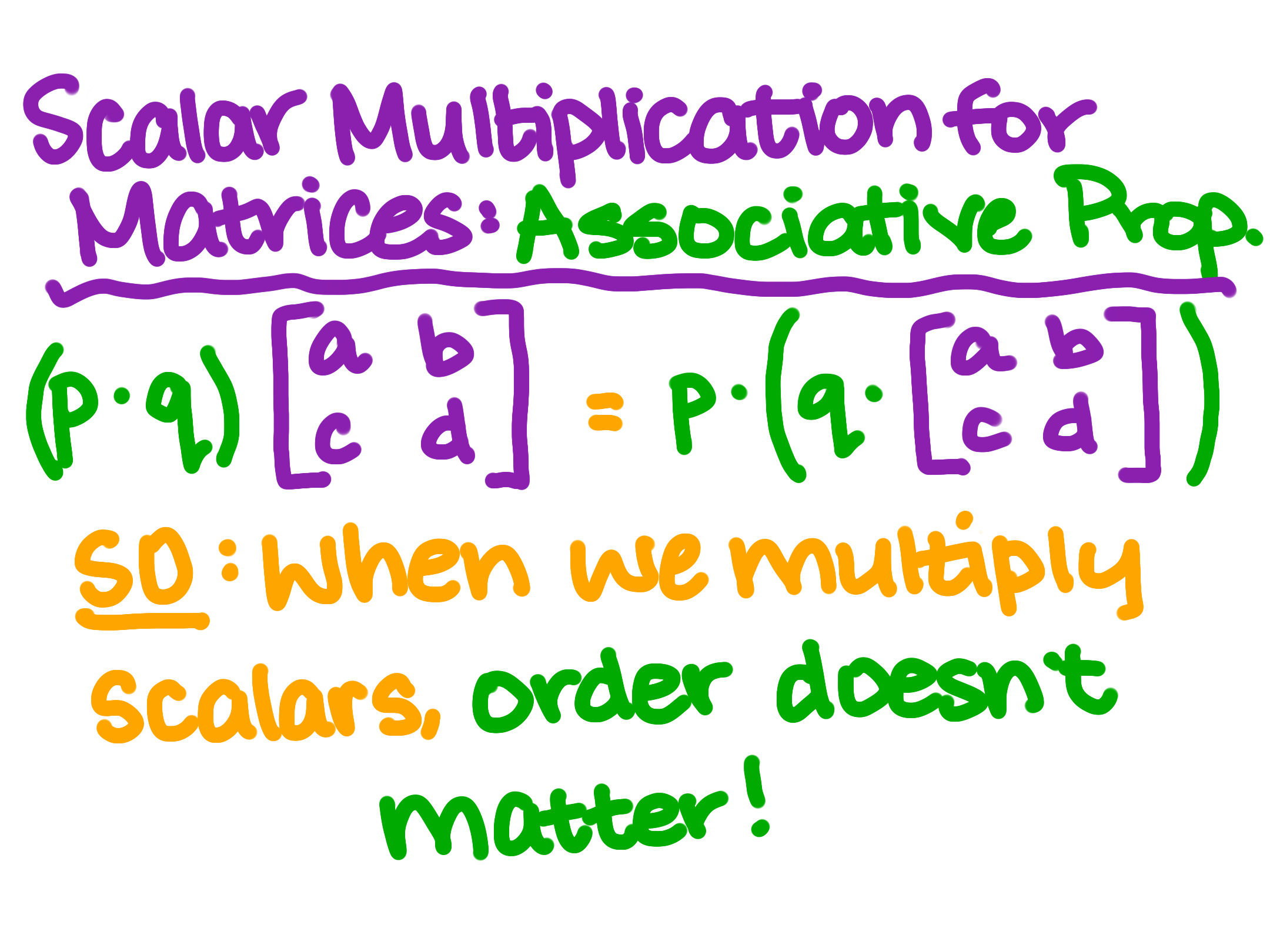
Image source: by Anusha Rahman
When we multiply a matrix by a scalar value, we can apply the associative property, which states that the order of the scalars don't matter.
The associative property of scalar multiplication tells us that it doesn’t matter which scalar you multiply first: the result is the same.
###Example
Consider the following equation:
This matrix can also be written as:
And it can also be written as:
If you use your nifty scalar multiplication skills, you will find that all of these matrices are equal to each other!
This rule helps make matrix math easier and more predictable when working with scalar multiplication.
In the next lesson, you will learn about the multiplicative property of zero for matrices.
