
标量乘法:零的乘法性质

Before this, know与标量相乘

Read · 1 min

The Multiplicative Property of Zero is very simple. If you have a matrix AA of size m×nm\times n then 0∗A=Om×n0*A=O_{m\times n}.

Example

Let A=[123456]A=\begin{bmatrix}1&2&3\\4&5&6\end{bmatrix}\\ 0∗A=0∗[123456]=[000000]\begin{align}\\0*A&=0*\begin{bmatrix}1&2&3\\4&5&6\end{bmatrix}\\&=\begin{bmatrix}0&0&0\\0&0&0\end{bmatrix}\end{align}

Video

(Video) Multiplicative Property of Zero for Matrices

by Anusha Rahman

In this video, Anusha Rahman goes over the Multiplicative Property of Zero and provides an example of the property.

Summary

The Multiplicative Property of Zero for Matrices is very similar to the Zero Property of Multiplication that we saw in pre-algebra.

The property says that for a given matrix, if multiplied by a scalar quantity of zero, the product will always be a zero matrix.

Example

[357268195]⋅0\begin{bmatrix} 3&5&7 \\ 2&6&8 \\ 1&9&5 \\ \end{bmatrix} \cdot 0

If we think back to scalar multiplication with matrices, you'll remember that we need to multiply each entry in the matrix by the scalar quantity. That means we get the following matrix,

[3⋅05⋅07⋅02⋅06⋅08⋅01⋅09⋅05⋅0]\begin{bmatrix} 3\cdot0&5\cdot0&7\cdot0 \\ 2\cdot0&6\cdot0&8\cdot0 \\ 1\cdot0&9\cdot0&5\cdot0 \\ \end{bmatrix}

We can simplify this matrix to a zero matrix,

[000000000]\begin{bmatrix} 0&0&0 \\ 0&0&0 \\ 0&0&0 \\ \end{bmatrix}

Illustrated · 1 min

Multiplicative Property of Zero: Matrices

Similar to the zero property you learned previously, the multiplicative property of zero for matrices says that:
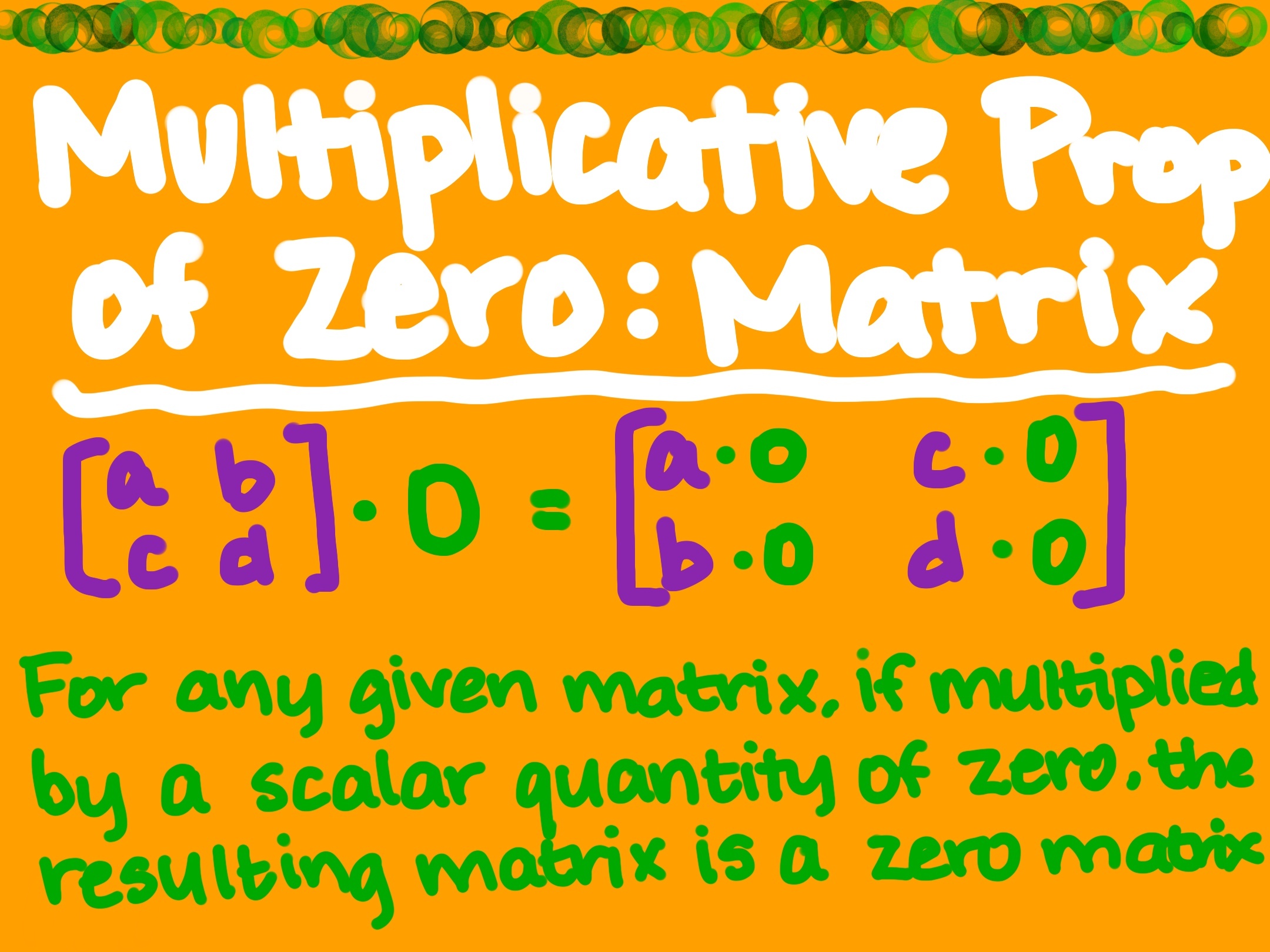
For any given matrix, if multiplied by a scalar quantity of zero, the resulting matrix must be a zero matrix.\text{For any given matrix, if multiplied by a scalar quantity of zero, the resulting matrix must be a zero matrix.}
Multiplicative Prop of Zero: Matrix
[a b c d] * 0 = [a*0 b*0 c*0 d*0]
For any given matrix, if multiplied by a scalar quantity of zero, the resulting matrix is a zero matrix.

Image source: by Anusha Rahman

Type a concept, like “slope” or “photosynthesis”.

↑ ↓ to choose · Enter to openSearch explanations and problems
