Video · + 2 min read

+2 contributors


(Video) Adding and Subtracting Exponents
by Mometrix Academy

In this video she goes over what the parts of an exponent are and what you need in order to be able to add or subtract two exponents.
Recall the parts of an exponent. The is called the coefficient. The is called the base. The is called the exponent.
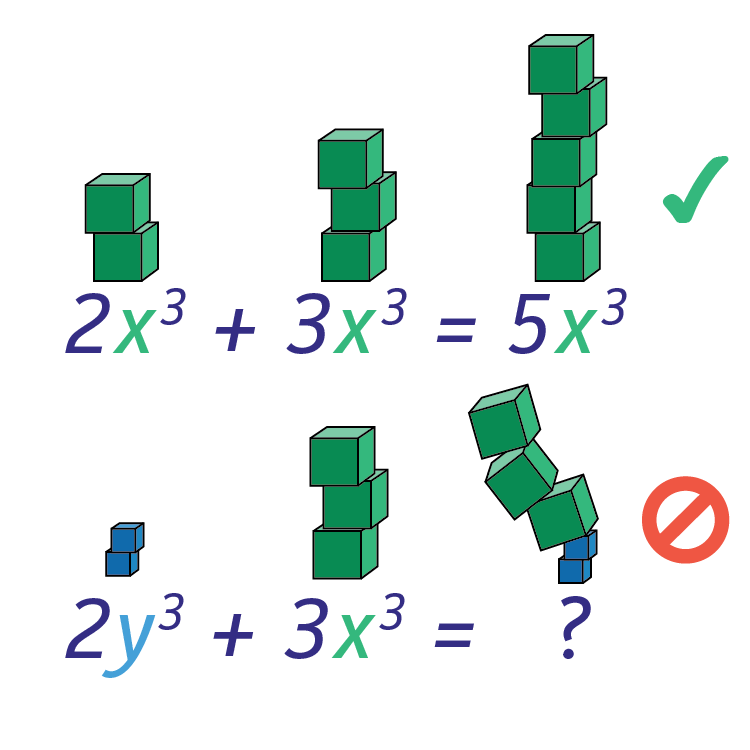
To combine exponents, add or subtract them, we need two conditions to be met:
- Same base
- Same exponent
If either condition fails, we cannot combine the exponents.
Example 1
Let's look at an example: These terms cannot be combined because they don't have the same exponent part. The first term has a and the second term has a . As a result, we cannot simplify this expression any more.
Example 2
Now, they have the same exponent but have different bases. The first term has an and the second term has a . Therefore, we cannot combine them.
Example 3
These terms have the same base, , and the same exponent, , so they can be combined. But how?
To add terms with the same base and exponent, just add the coefficients. In our example, this becomes:
This is not to be confused with the product rule. That rule also involves manipulating exponents. However, it is for multiplying exponents together. Right now we are adding them instead.
Example 4
Sometimes, you'll have lots of terms. To simplify, you combine as many groupings of terms as you can. Sometimes we'll want to rearrange the terms to make this easier. We can do this because of the commutative property of addition. We must just carry around negative signs with us.
We have two terms with , two terms with , and one term with neither. Therefore, to simplify, we can combine the terms and combine the terms. Finally, it's common practice to arrange the terms from largest exponent to smallest.
This is called standard form.