Interactive · 1 question
By Caroline K

+2 contributors
Contributors


Power Rule for Exponents
How do you raise a power to a power?

Image by Caroline Kulczycky
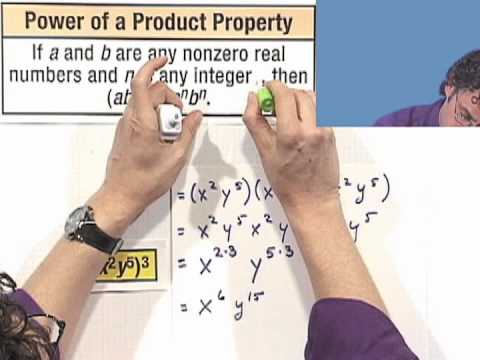
In this formula, , , and are all real numbers. We plug in values for each number and simplify. This is an example of using the order of operations. We simplify the power first. Once the power is simplified, we calculate the exponent.
Let's do one more example.
Simplify
We are trying to simplify If we use the variables from the graphic, this means that and Now all we have to do is substitute these values into our equation for Power Rule for Exponents.