如何求c

Before this, know如何推导二次公式

Video · + 1 min read

(Video) How to Solve by Completing the Square

by Brian McLogan

In this video by Brian McLogan it is shown how to complete the square.

The first example he looks at is: x2+4x=10x^2+4x=10

To complete the square, you first want to isolate your variables. Notice in the equation, the xx's are on one side and the constant, 1010, is on the other.

The goal is to turn the xx side into a squared binomial. This means we turn it into something like (x±?)2(x\pm ?)^2. To do this, we need to add an extra term to the xx side.

To do this, we take the middle coefficient, in this case it's the 44 in 4x4x, and halve it, square it, then add it.

Since our coefficient is 44, we first halve it. 42=2\frac42=2 Then square it. 22=42^2=4 And finally add it. This means we add it to both sides of the equation. x2+4x+4=10+4x2+4x+4=14x^2+4x+\color{Red}{4}=10+\color{Red}{4}\\ x^2+4x+4=14

We just created a perfect square trinomial! This means it can be easily factored into the form we wanted, (x±?)2(x\pm?)^2. (x+2)2=14(x+2)^2=14

Now, we can take the square root of both sides. Be careful though, we need the positive and negative version of the right hand side. (x+2)2=±14\sqrt{(x+2)^2}=\pm\sqrt{14}

This simplifies to: x+2=±14x+2=\pm\sqrt{14}

Thus, we get two solutions. x=14−2x=−14−2x=\sqrt{14}-2\quad\quad x=-\sqrt{14}-2

Which expression equals x2+12x+18?x^2 + 12x + 18?

Choose one answer

Interactive · 1 question

If you ever want to solve a quadratic equation that might be hard to factor and very difficult to use Quadratic Formula on, it's time to use Completing the Square.

Let's first start with a random equation, such as 0=x2−6x+20 = x^2 - 6x + 2.

We know that the quadratic 0=x2−6x+90 = x^2 - 6x + 9 would factor nicely, it would be 0=(x−3)(x−3)0 = (x - 3)(x - 3).

So let's add 77 on both sides so we can factor the right side to what we want: 7=x2−6x+97 = x^2 - 6x + 9.

Factoring it now, we get: 7=(x−3)(x−3)7 = (x - 3)(x - 3).

Now we need to be careful! When we square root a number like 77, there are two answers: 7\sqrt 7 and −7-\sqrt 7, so we need to put a ±\pm.

Following that step, we have: ±7=x−3\pm\sqrt 7 = x - 3

And simplifying that: ±7+3=x\pm\sqrt 7 + 3 = x

Is this our final answer?

Choose one answer

Video

(Videos) Completing the Square to Solve Quadratics

by PatrickJMT

Patrick JMT has a bunch of videos with examples for completing the square if you need more practice.

In this first video he focuses on solving x2+4x−20=12x^2+4x-20=12 by completing the square. x2+4x−20=12 Add 20 to both sides x2+4x−20+20=12+20x2+4x+000‾=32 Use (12(4))2 to complete the square x2+4x+4=32+4x2+4x+4=36 Factor out x2+4x+4(x+2)(x+2)=36(x+2)2=36 Take the square root of both sides(x+2)2=36x+2=±6 Solve for 6 and -6x+2=6x=4x+2=−6x=−8x=4,−8\begin{alignat}{2}x^2+4x-20&=12 &&{\text{ Add 20 to both sides }}\\ x^2+4x-20 \color{red}{ +20}&=12\color{red}{+20} \\ x^2+4x+\underline{\phantom{000}}&=32 && {\text{ Use }\left(\frac{1}{2}(4)\right)^2} \text{ to complete the square}\ \\ x^2+4x\color{red}{ +4} &= 32 \color{red}{ +4} \\ x^2+4x+4 &= 36 &&\text{ Factor out } x^2+4x+4\\ (x+2)(x+2) &= 36 \\ (x+2)^2&=36 &&\text{ Take the square root of both sides}\\ \sqrt{(x+2)^2 } &= \sqrt{36}\\ x+2&=\pm6 &&\text{ Solve for 6 and -6}\\ x+2&=6 \\ x&=4\\ x+2&=-6\\ x&=-8\\ x&= \boxed{4, -8}\\ \end{alignat}

Both 44 and −8-8 are solutions to the original equation!

There are more example videos below if you want more help with completing the square. These videos are also by Patrick JMT.

Read · 1 min

Completing the Square: How to find cc

cc is the number you need to add to allow for factoring into a square polynomial.

Follow these simple steps and you can find the value you need to add. For demonstration purposes we will use the following equation:

2y+4=6x2−8x+192y + 4 = 6x^2 - 8x + 19

STEP 1: Isolate the xx variables.

2y−15=6x2−8x2y -15 = 6x^2 - 8x

STEP 2: Make the coefficient on x2x^2 equal to 11.

2y−166=x2−86x\frac{2y-16}{6} = x^2 - \frac{8}{6}x

STEP 3: Add the square of one-half times the coefficient of the second "xx term."

In this example the coefficient of the xx term is 86\frac{8}{6}.

One half times this value is 46\frac{4}{6}

This value squared is 1636=49\frac{16}{36} = \frac{4}{9}

2y−166+49=x2−86x+49\frac{2y-16}{6}+\frac{4}{9} = x^2 - \frac{8}{6}x +\frac{4}{9}

Note that here c=49c = \frac{4}{9}

STEP 4: Factor!

2y−166+49=(x+23)2\frac{2y-16}{6}+\frac{4}{9} = (x + \frac{2}{3})^2

Note the second term in the square polynomial is c\sqrt{c}

In general terms, whenever you see this pattern:

x2+axx^2 + ax

c=(a2)2c = (\frac{a}{2})^2

Read · 1 min

Sometimes you might see an quadratic equation which would be very hard to factor and the quadratic formula would be a lot of work. That's when it's time to use Completing The Square. Let's look at the steps below:

Here's an equation.0=x2+6x+190 = x^2 + 6x + 19 We know that 0=x2+6x+90 = x^2 + 6x + 9 would be very easy to factor:0=(x+3)(x+3)0=(x + 3)(x + 3)So what we want to try to do is transform our first equation to look like this which is much easier to deal with. −10+0=x2+6x+19−10  →  −10=x2+6x+9-10+0 = x^2 + 6x + 19-10 \;\rightarrow\;-10 = x^2 + 6x + 9 −10=(x+3)(x+3)-10 = (x + 3)(x + 3) ±−10=(x+3)\pm\sqrt{-10} = (x + 3) ±10⋅i=(x+3)\pm\sqrt{10}\cdot i = (x + 3) ±10⋅i−3=x\pm\sqrt{10}\cdot i - 3 = x So we found our value of xx using the Completing The Square method.

Illustrated · 1 min

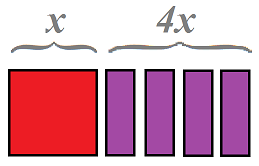
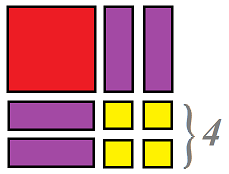
Let's say we have a quadratic expression x2+4xx^2+4x. We can model this with the diagram below:

A visual representation of x^2 + 4x

A visual representation of x2+4xx^2 + 4x

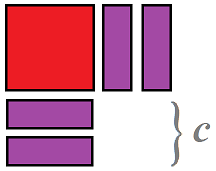
We can rearrange this to look like a square:

Rearrangement of x^2+4x

Rearrangement of x2+4xx^2+4x

We are able now to "complete the square" by filling in the empty space with little 1-tile squares:

Filling the hole with 4 tiles

Filling the hole with 4 tiles

We are able to fit 44 11-tiles into the space. We can go back to our expression in number form and add these in:x2+4x+4x^2+4x+4The number of 11-tiles is equal to cc. General Case

The point of this technique is to find a cc that will leave us with a perfect square trinomial, which we know how to deal with. In our standard form ax2+bx+cax^2+bx+c in a perfect square, c=(b24a)c=(\frac{b^2}{4a}). Or when a=1a=1:c=(b2)2c=(\frac{b}{2})^2

This is the equation you will be using the most. Notice that since bb is being squared, it does not matter if bb is positive or negative.

Here we have the quadratic equation: 0=x2−12x+170=x^2-12x+17 This definitely does not look like an easy problem to factor. But, we can complete the square to do so. First is to isolate the xx's to one side: −17=x2−12x-17=x^2-12x Next we can complete the square on the right hand side by adding cc to both sides: c=(−122)2    c=36c=(\frac{-12}{2})^2\;\;c=3636+  −17=x2−12x+3636+\;-17=x^2-12x+3619=(x−6)219=(x-6)^2x−6=±19  →  x=1.64    x=10.36x-6=\pm\sqrt{19}\;\rightarrow\;x=1.64\;\;x=10.36

Video

(Videos) Complete the Square

by HEGARTYMATHS

Here are two videos by HEGARTYMATHS explaining how you set up a problem involving completing the square and secondly, how you solve that problem to find solutions for xx. The steps he uses to complete the square are:

  1. Make sure the quadratic function is in the form x2+bx+c=0x^2+bx+c=0. That is, make sure there's NO coefficient in front of the x2x^2 term.
  2. Write down (x      )2(x\ \ \ \ \ \ )^2.
  3. Whatever sign bb has, put it inside the brackets.
  4. Take one half of bb and put that number inside the parenthesis. (x+12b)2(x+\frac12b)^2.
  5. Square the number you put inside the parenthesis and subtract it outside. (x+12b)2−(12b)2(x+\frac12b)^2-(\frac12b)^2.
  6. Take your cc value and add it outside. (x+12b)2−(12b)2+c=0(x+\frac12b)^2-(\frac12b)^2+c=0.
  7. Simplify and solve. x=14b2−c−12bx=\sqrt{\frac14b^2-c}-\frac12b.

Test Yourself: Solve by completing the square. x2−6x+4=0x^2-6x+4=0

Choose one answer

Video

(Videos) Completing the Square

by PatrickJMT

Here's a video by PatrickJMT showing you how to complete the square.

Patrick JMT has a good video explaining how to complete the square.

The first example he looks at is: x2+5x+6=0x^2+5x+6=0

You could solve this by factoring. (x+2)(x+3)=0x+2=0x+3=0x=−2x=−3(x+2)(x+3)=0\\ x+2=0\quad\quad x+3=0\\ x=-2\quad\quad x=-3 But let's see how we solve it by completing the square.

You first want to get your xx terms on one side. We can do this, by subtracting 6 from both sides. x2+5x=−6x^2+5x=-6

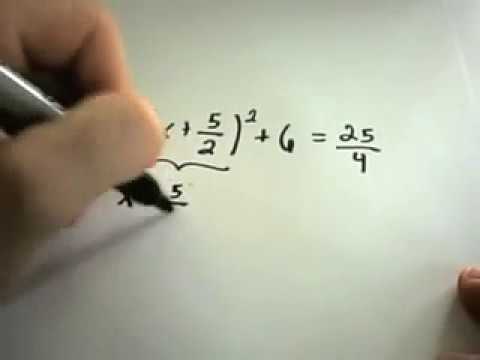
Next, take the coefficient of the middle term, the 55 in 5x5x, and halve it, square it, and add it. 52→(52)2=254\frac52\rightarrow\left(\frac52\right)^2=\frac{25}4 We add this to both sides of the equation. x2+5x+254=−6+254x^2+5x+\color{Red}{\frac{25}{4}}=-6+\color{Red}{\frac{25}4}

The left hand side is now a perfect square trinomial and we can factor it into a square binomial. (x+52)2=14\left(x+\frac52\right)^2=\frac14

Now we take the square root of each side. Remember, that we want the positive and negative version of the right hand side. (x+52)2=±14x+52=±12x=12−52x=−12−52x=−2x=−3\begin{align} \sqrt{\left(x+\frac52\right)^2}&=\pm\sqrt{\frac14}\\ x+\frac52&=\pm\frac12\\ x=\frac12-\frac52\quad&\quad x=-\frac12-\frac52\\ x=-2\quad&\quad x=-3 \end{align}

Complete the square:

x2−8x−33x^2 - 8x - 33
Choose one answer

Video

(Video) Solve by Completing the Square

by HEGARTYMATHS

Here's another video by HEGARTYMATHS on completing the square. In this video he goes through some examples where your answers turn out to be radical numbers. The steps he uses to complete the square are:

  1. Make sure the quadratic function is in the form x2+bx+c=0x^2+bx+c=0. That is, make sure there's NO coefficient in front of the x2x^2 term.
  2. Write down (x      )2(x\ \ \ \ \ \ )^2.
  3. Whatever sign bb has, put it inside the brackets.
  4. Take one half of bb and put that number inside the parenthesis. (x+12b)2(x+\frac12b)^2.
  5. Square the number you put inside the parenthesis and subtract it outside. (x+12b)2−(12b)2(x+\frac12b)^2-(\frac12b)^2.
  6. Take your cc value and add it outside. (x+12b)2−(12b)2+c=0(x+\frac12b)^2-(\frac12b)^2+c=0.
  7. Simplify and solve. x=14b2−c−12bx=\sqrt{\frac14b^2-c-\frac12b}.

Test Yourself: Solve by completing the square. x2+5x+12=0x^2+5x+12=0

Choose one answer

Video

(Videos) Complete the Square

by HEGARTYMATHS

Here's two more videos by HEGARTYMATHS on completing the square. He goes over how you do it and how to solve for xx. There are a lot of examples done as well if you need some more practice. The steps he uses to complete the square are:

  1. Make sure the quadratic function is in the form x2+bx+c=0x^2+bx+c=0. That is, make sure there's NO coefficient in front of the x2x^2 term.
  2. Write down (x      )2(x\ \ \ \ \ \ )^2.
  3. Whatever sign bb has, put it inside the brackets.
  4. Take one half of bb and put that number inside the parenthesis. (x+12b)2(x+\frac12b)^2.
  5. Square the number you put inside the parenthesis and subtract it outside. (x+12b)2−(12b)2(x+\frac12b)^2-(\frac12b)^2.
  6. Take your cc value and add it outside. (x+12b)2−(12b)2+c=0(x+\frac12b)^2-(\frac12b)^2+c=0.
  7. Simplify and solve. x=(14b2−c)−12bx=\sqrt{(\frac14b^2-c)-\frac12b}.

Test Yourself: Solve by completing the square. x2−2x−8=0x^2-2x-8=0

Choose one answer

Video · + 1 min read

(Video) Completing the Square

by yaymath

Here's a video by yaymath showing you how to find cc when completing the square and then how to factor the new quadratic and solve. Some quadratic functions can't be factored by simply choosing numbers. In the video he uses the example x2−10x−18=0x^2-10x-18=0. Completing the Square is a method that helps solve quadratic equations when the solution isn't obvious. The steps are:

  1. Move the last term to the other side of the equation so the xx terms are the only ones on the side. It should be in the form x2+bx=cx^2+bx=c.
  2. Make sure there are no coefficients in front of the x2x^2 term. If there is a coefficient, divide all the terms by that number so it cancels out. If you had ax2+bx=cax^2+bx=c then divide everything by aa to get x2+bax=cax^2+\frac{b}{a}x=\frac{c}{a}.
  3. The next step is to find a "new" cc value so that the quadratic function can be factored. To find this you take half of the bb value, square it, and add it on as the new cc value AND onto the end of the other side. So it would now be x2+bx+(12b)2=c+(12b)2x^2+bx+(\frac12b)^2=c+(\frac12b)^2
  4. Factor the quadratic. It will always be in the form (x+12b)2=c+(12b)2(x+\frac12b)^2=c+(\frac12b)^2.
  5. Take the square root of both sides. x+12b=±c+(12b)2x+\frac12b=\pm\sqrt{c+(\frac12b)^2}.
  6. Solve for xx. x=±√(c+(12b)2)−12bx=\pm√(c+(\frac12b)^2)-\frac12b

Test Yourself: Solve by completing the square. x2−2x−8=0x^2-2x-8=0

Choose one answer

Video · + 2 min read

(Videos) Completing the Square

by mathman1024

Here's a video by mathman1024 showing you how to complete the square. The goal of completing the square is to find the missing piece at the end that will allow the polynomial to factor: x2+6x+□=x^2+6x+\square= We want it to factor into a binomial square: (       )2(\ \ \ \ \ \ \ )^2 So the trick to do this is to take the middle term's coefficient, divide it by 2, and square it. (62)2=9\bigg(\frac62\bigg)^2=9 So this tells us that if we put a 99 in that last slot then our trinomial will factor into a binomial square. x2+6x+9=(x+3)2\begin{align} &x^2+6x+9\\ =&(x+3)^2 \end{align} The term that goes into the binomial square will always be the half the middle term. Here the middle term was 66 so 33 goes into the binomial square.

He then does some more examples. See if you can factor them yourself and then watch the rest of the video to see if your answers were correct.

  1. x2−14x+□x^2-14x+\square
  2. x2−5x+□x^2-5x+\square
  3. x2+34x+□x^2+\frac34x+\square

Now that you know how to complete the square, in this next video he shows you how to solve equations by completing the square. The general steps are:

  1. Get all the variable terms on one side of the equation and the constant on the other side.
  2. Divide all terms by the coefficient of x2x^2. This is important to remember because to complete the square you can't have a coefficient in front of the x2x^2 term.
  3. Complete the square. Remember to add the term to both sides of the equal sign.
  4. Factor as a binomial square.
  5. Apply the square root property and solve.

The first example he does is: x2+6x=14x^2+6x=14. As you can see Step 1 has already been done. Also, there's no coefficient in front of x2x^2 so Step 2 does not apply. So we start with Step 3. x2+6x=14x2+6x+(62)2=14+(62)2x2+6x+32=14+32x2+6x+9=14+9x2+6x+9=23(x+3)2=23(x+3)2=±23x+3=±23x+3−3=−3±23x=−3±23\begin{align} x^2+6x&=14\\ x^2+6x+\color{red}{\bigg(\frac62\bigg)^2}&=14+\color{red}{\bigg(\frac62\bigg)^2}\\ x^2+6x+\color{red}{3^2}&=14+\color{red}{3^2}\\ x^2+6x+\color{red}{9}&=14+\color{red}{9}\\ x^2+6x+9&=23\\ (x+3)^2&=23\\ \sqrt{(x+3)^2}&=\pm\sqrt{23}\\ x+3&=\pm\sqrt{23}\\ x+3\color{red}{-3}&=\color{red}{-3}\pm\sqrt{23}\\ x&=-3\pm\sqrt{23} \end{align}

The next example he does is: x2−20x+109=0x^2-20x+109=0. Try this one on your own and see if you get the same answer. Fair warning: this problem will result in an imaginary answer so if you haven't learned imaginary numbers yet you can skip.

In this final video he does some examples where there's a coefficient in front of the x2x^2 term. The first example he does is: 2x2−7x+6=02x^2-7x+6=0. So the first step is to move all constant terms to the other side of the equation. 2x2−7x+6=02x2−7x+6−6=0−62x2−7x=−6\begin{align} 2x^2-7x+6&=0\\ 2x^2-7x+6\color{red}{-6}&=0\color{red}{-6}\\ 2x^2-7x&=-6 \end{align} Now we divide by the coefficient in front of the x2x^2. 2x2−7x=−62x22−7x2=−62x2−72x=−3\begin{align} 2x^2-7x&=-6\\ \frac{2x^2}{\color{red}{2}}-\frac{7x}{\color{red}{2}}&=\frac{-6}{\color{red}{2}}\\ x^2-\frac72x&=-3 \end{align} Finally, we complete the square and solve. x2−72x=−3x2−72x+(72⋅12)2=−3+(72⋅12)2x2−72x+(74)2=−3+(74)2x2−72x+4916=−3+4916x2−72x+4916=116(x−74)2=116(x−74)2=±116x−74=±14x−74+74=74±14x=74+14 or x=74−14x=84 or x=64x=2 or x=32\begin{align} x^2-\frac72x&=-3\\ x^2-\frac72x\color{red}{+\bigg(\frac72\cdot\frac12\bigg)^2}&=-3\color{red}{+\bigg(\frac72\cdot\frac12\bigg)^2}\\ x^2-\frac72x\color{red}{+\bigg(\frac74\bigg)^2}&=-3\color{red}{+\bigg(\frac74\bigg)^2}\\ x^2-\frac72x+\frac{49}{16}&=-3+\frac{49}{16}\\ x^2-\frac72x+\frac{49}{16}&=\frac{1}{16}\\ \bigg(x-\frac74\bigg)^2&=\frac1{16}\\ \sqrt{\bigg(x-\frac74\bigg)^2}&=\pm\sqrt{\frac1{16}}\\ x-\frac74&=\pm\frac14\\ x-\frac74\color{red}{+\frac74}&=\color{red}{\frac74}\pm\frac14\\ x=\frac74+\frac14\text{ or }x&=\frac74-\frac14\\ x=\frac84\text{ or }x&=\frac64\\ x=2\text{ or }x&=\frac32 \end{align}

Test Yourself: Solve x2−18x+65=0x^2-18x+65=0.

Choose all correct answers

Read · 1 min

Completing the Square: the Basics

Back when we were working with quadratics, we learned how to use completing the square to find the vector form of a quadratic. We'll do a really quick refresher on how to complete the square for quadratics.

In order to complete the square, your quadratic equation must first be in standard form, ax2+bx+c=0ax^2+bx+c=0.

There are five steps to completing the square:

  1. Divide all terms by aa, in order for a=1a=1.

  2. Move the constant term to the right side.

  3. Complete the square by adding (b2)2(\frac{b}{2})^2 to both sides, and simplify.

  4. Take the square root of both sides.

  5. Simplify and solve for xx.

Completing the Square: Finding Complex Roots

So far, when we've talked about completing the square, we have dealt with quadratics with real roots. However, we can also complete the square for quadratics with complex roots! Remember that you can use the discriminant to find out whether a quadratic has real and/or complex roots.

The main difference you'll notice is that your solution will have imaginary numbers.

Let's walk through an example!

x2+2x+5=0x2+2=−5x2+2x+(22)2=−5+(22)2x2+2x+1=−4(x+1)2=−4(x+1)2=−4x+1=−4x+1=±2ix=−1±2i\begin{align} x^2 +2x +5 &=0 \\ x^2 +2 &= -5 \\ x^2 +2x + (\frac22)^2 &= -5 + (\frac22)^2 \\ x^2 +2x +1 &= -4 \\ (x+1)^2 &= -4 \\ \sqrt{(x+1)^2} &= \sqrt{-4} \\ x +1 &= \sqrt{-4} \\ x +1 &= \pm 2i \\ x &= -1 \pm 2i \\ \end{align}

Video · + 1 min read

(Video) Completing the Square with Complex Roots

by Krista King

In this video by Krista King, you will see an example of using the complete the square method to find complex roots.

Summary

Example: Find the roots of the quadratic equation

−x+3x2+5=0-x + 3x^2 +5 =0

Our first step is to put the terms in this equation in descending order of power. We can rewrite the equation as: 3x2−x+5=03x^2-x+5=0.

From here, we can see that this is a trinomial of a quadratic. We can try factor it, but we don't see any easily factorable terms. So, we can complete the square! To do that, we need to first make sure that the leading coefficient is 11. Here, the leading coefficient is 33, so we need to fix that. We will divide all terms by 33. That means our new equation is:

x2−x3x+53=0x^2 - \frac{x}{3}x + \frac{5}{3} = 0

You should already be familiar with the general steps to complete the square, so we will do that now:

−13⋅12=(−16)2=136-\frac{1}{3} \cdot \frac12 = (-\frac{1}{6})^2 = \frac{1}{36} x2−x3x+53=0(x2−x3x+136)−136+53=0(x−16)2−136+6036=0(x−16)2+5936=0(x−16)2=−5936(x−16)2=−5936x−16=±−5936x−16=±−1⋅596x−16=±−1⋅596x−16=±i596x=16±i596x=1±i596\begin{align} x^2 - \frac{x}{3}x + \frac{5}{3} &= 0 \\ (x^2 - \frac{x}{3}x + \frac{1}{36}) - \frac{1}{36} + \frac{5}{3} &=0 \\ (x- \frac{1}{6})^2 - \frac{1}{36} + \frac{60}{36} &= 0 \\ (x- \frac{1}{6})^2 + \frac{59}{36} &= 0 \\ (x- \frac{1}{6})^2 &= -\frac{59}{36} \\ \sqrt{(x- \frac{1}{6})^2} &= \sqrt{-\frac{59}{36}} \\ x- \frac{1}{6} &= \pm \frac{\sqrt{-59}}{\sqrt{36}} \\ x- \frac{1}{6} &= \pm \frac{\sqrt{-1 \cdot 59}}{6} \\ x- \frac{1}{6} &= \pm \frac{\sqrt{-1} \cdot \sqrt{59}}{6} \\ x- \frac{1}{6} &= \pm \frac{i\sqrt{59}}{6} \\ x &= \frac{1}{6} \pm \frac{i\sqrt{59}}{6} \\ x &= \frac{1 \pm i\sqrt{59}}{6} \\ \end{align}

We now have two roots! Both roots have a complex number with ii, so these are complex roots.

Type a concept, like “slope” or “photosynthesis”.

↑ ↓ to choose · Enter to openSearch explanations and problems