Have you ever wondered what type of solutions a quadratic equation will have without actually finding the solutions?
The discriminant does just that! It is the part of the quadratic formula that appears directly under the radical sign. Take a look at the photo shown below:
The Quadratic Formula
Based on what the value of the discriminant is we can tell what types of solutions we will have.
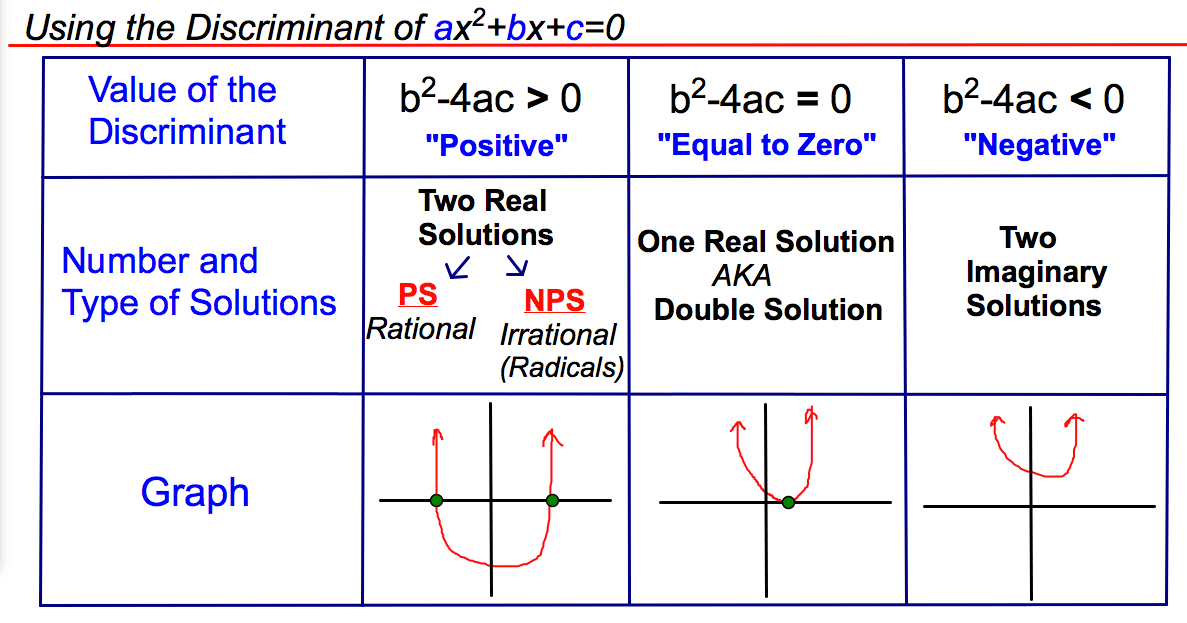
For instance, imagine the discriminant is a negative number. In this scenario, we will have a negative number under the radical sign. This would indicate 2 imaginary solutions.
Now let's imagine another scenario. If the discriminant equals zero we will now have zero under the radical sign. Well the square root of zero is zero so we would essentially be adding zero to negative b in the numerator. Because adding or subtracting zero yields the same response, having a discriminant value of zero would indicate only one real solution. This is often called a "double solution" or "two equal solutions"
The last scenario is when the discriminant is positive. In this case, we will have two real solutions. The solutions cannot be imaginary because the number under the radical sign is not negative. If the positive discriminant value is a perfect square, we will have two rational solutions. If the discriminant value is a non perfect square, we will have two irrational solutions.
This chart below should summarize the information about the discriminant.
Now that we know what quadratics are, a pressing question arises. Just as we were able to find solutions to linear equations like 2x+3=5, can we find the solutions to a quadratic like 5x2−12x+5=1?
Let's start simple.
Think about the solutions to x2−9=0.
We know that the solutions are x=3 and x=−3. The equation x2−a=0 always has two solutions for x: a and −a. The only exception is a=0.
Now, think about what the solutions are to (x−1)2=9.
We have two cases: x−1=3 or x−1=−3. This gives the solutions −2 and 4.
Diving In
Think about the solutions to x2+12x+20=48.
We can start by trying to make a perfect square using x. Note that x2+12x+36=(x+6)2; thus, if we add 16 to both sides of our equation, we get (x+6)2=64. That's great -- we know how to solve that! Since 64=82, we have x+6=8 or x+6=−8. In the first case we get x=2, and in the second we get x=−14. Hence those are our two solutions.
Let's move things up a notch.
What are the solutions to 3x2−12x+25=16?
Let's get rid of that 3 in front of the x2 by dividing both sides of the equation by it. We obtain x2−4x+325=316. Now in order to make a perfect square, we want the left-hand side to be x2−4x+4; hence, we subtract 313 from both sides to get x2−4x+4=1. And since x2−4x+4=(x−2)2, we now have two cases: x−2=1 or x−2=−1. They give the two solutions x=3 and x=1.
Sweet! Now we're ready to tackle the general form of a quadratic equation. If we have the equation ax2+bx+c=0, how can we solve for x in terms of a, b, and c?
Just like the last problem, we start by getting rid of the a in front of the x2. So after we divide, the equation becomes
x2+abx+ac=0.
Now we want to form a perfect square. The ideal square is
(x+2ab)2=x2+abx+4a2b2,
so we subtract ac and add 4a2b2 to both sides of our equation. That leaves us with
(x+2ab)2=4a2b2−ac.
All right, we're getting close! We can combine the two fractions on the right-hand side by making a common denominator:
4a2b2−ac=4a2b2−4ac.
Now we have (x+2ab)2=4a2b2−4ac.
Hence
x+2ab=±2ab2−4ac.
Finally, moving over the 2ab term, we conclude that
x=2a−b±b2−4ac.
At last, we're done! This is known as the quadratic formula. It can be used to find the solutions to any quadratic equation. Learn to love it; it'll come up a lot in algebra for its usefulness.
In fact, general formulas (although far, far more complicated) also exist for cubic and quartic equations, whereas it is impossible to find one for 5th (or higher) degree equations. Though the proof of that last fact is far beyond the scope of this post :)
Let our equation be of the form x2+bx+c=0 and let x1 and x2 be the roots of the quadratic.
Then x2+bx+c=(x−x1)(x−x2)=x2−(x1+x2)x+x1x2 and therefore x1+x2=−b and x1x2=c. Now, if we knew d=x1−x2, we could figure out x1=(−b+d)/2 and x2=(−b−d)/2.
The trouble is that our equation does not know which of the roots is x1 and which one is x2, so we can know d only up to a sign, so we can know d2. Let us try to figure it out in terms of b and c. Can you do it?
Here comes a little magic: d2=x12−2x1x2+x22 and b2=x12+2x1x2+x22, they differ just by 4x1x2=4c. Ta-taam!
Now we get d2=b2−4c and finally we get our quadratic formula: x1,2=(−b±b2−4c)/2
When given an equation in the form ax2+bx+c, usually the simplest way to solve for the value of x is to factor the quadratic, set each factor equal to zero, and then solve for each factor. However, the quadratic can sometimes be too difficult to solve by factoring. At this point, you may want to throw in the towel, give up on math, and run far away. Never fear! You can count on the quadratic formula to find the solution for you!
When using the quadratic formula, you will need to have an ”a”,“b”, and ”c” term from ax2+bx+c, where ”a”,“b”, and ”c” are numbers. These are considered numerical coefficients of the quadratic equation that you are asked to solve.
You may be asking, “but what IS the quadratic formula?” Well, here it is, derived from the process of completing the square (which you can refresh on here!)
x=2a−b±b2−4ac
This beautiful equation will be engrained into your mind forever. I learned it five years ago, and I still remember it to this day!
Rules for the Quadratic Formula
1) In order for the quadratic formula to work, you must have the equation arranged so that x=2a−b±b2−4ac is set equal to 0.
2) Make sure that you are careful not to drop the square root, or the ± before the square root. Because you have the ±, this means you will have 2 roots!
3) Our a term can NEVER be 0. This will cause the denominator of the quadratic formula to be 0, and it will void the equation since you can never EVER divide by 0. If you are given an equation in the form of bx+c=0, you will have to solve for x by subtracting both sides by c, then dividing both sides by b.
4) The b2 under the square root means that you square ALL of b, including a negative sign if applicable. So, the b2 term will never be negative!
5) Also, take note that you will multiply your b by a negative sign at the beginning of the numerator.
All in all, make sure you take note of your signs! If you try to take shortcuts, or try to shorthand the problem, you will mess it up! Take the quadratic formula slow, and I promise you will become a pro!
Example of Quadratic Formula
Solve x2+7x–4
Since this is a quadratic equation in the form ax2+bx+c, we can say that our a term is 1, since the coefficient of x2 is 1 (even if you can’t see it!) Our b term is 7, and our c term is −4. Make sure that you include the negative sign in your c term, or you’ll get the wrong answer!
With a=1, b=7, and c=−4 we can plug these values into the quadratic formula to get:
x=2(1)−7±72−4(1)(−4)=0
We can simplify what is being multiplied, to get:
x=2−7±49+16=0
NOTE that under the square root, we now have a summation of the numbers rather than a subtraction, because our c term is negative! (and we know that two negative numbers multiplied together give us a positive!)
We can further simplify this to:
x=2−7±65=0
Now, since 65 is not a perfect square, and it does not contain a perfect square, we can leave our answer in this form!
What is x in the following equation?
3x2+7x−2=0
Great! With some more practice, you'll be a quadratic equation expert!
Now that you have had some practice with the quadratic formula, its time to move on to complex roots. This can sound scary at first, but I promise that once you get it, it will be a piece of cake! However, if you want a review, you can click the respective links below.
For a review on the quadratic formula, click here!
A complex root is a solution to a quadratic equation that also contains an i term, similar to a complex number. Complex roots occur when the b2−4ac term is a negative number, since you will then be taking the square root of a negative number. This will become more apparent with an example.
Example of Complex Roots
Find the roots: x2−4x+13=0
Let's define our a,b and c terms. For this expression, our a term is 1, our b term is −4, and our c term is 13. Great, let's plug these into the quadratic equation!
x=2a−b±b2−4acx=2(1)−(−4)±(−4)2−4(1)(13)x=24±16−52x=24±−36
At this point, we can see that we have a negative term under the square root. No worries though, we know what we need to do. We know that 36 is a perfect square, therefore −36 is a perfect square as well. Taking the square root in the problem, we will get:
x=24±6i
4 and 6 are divisible by 2, so we can further simplify this to:
x=2±3i
Therefore, we have our final answer! The roots to our problem are 2+3i and 2−3i.
And there you have it! Complex roots aren't as complex as you thought, huh?
Find the roots: x2+4x+5=0
Keep practicing, and you'll master this just like you mastered the quadratic formula the first time!
The discriminant of a quadratic equation tells you the nature of the roots. That means you can use the discriminant to find out whether a quadratic function has two solutions, one solution, or imaginary solutions.
The discriminant is found within the quadratic equation, the value under the radicand.
(Video) Using the Discriminant to Find How Many Roots
by FerranteMath
In this video by FerranteMath, you will learn how to determine the number of roots in a quadratic by using the discriminant.
Summary
The discriminant is the expression found under the radical in the quadratic formula.
b2−4ac
For any standard form of a quadratic, we can use the discriminant to find the number of roots that solve the quadratic equation.
If the parabola crosses the x-axis one time, the parabola is basically sitting on the x-axis. That means there is one real root or solution. That means that the discriminant is equal to zero.
b2−4ac=0
If the parabola crosses the x-axis twice, there are two real roots or solutions. That means the discriminant is greater than zero.
b2−4ac>0
If the parabola does not cross the x-axis, then there are no real solutions, but there are two imaginary roots. That means that the discriminant is less than zero.