
Illustrated · 2 min
+1 contributors

In trigonometry, so far we have learned about the characteristics of periodic functions and various trig functions like sine, cosine, cosecant, etc. However, now we are going to learn about two new types of angles.
##Reference Angle
Let's take a look at an angle of in [degrees] or in radians.
To find the reference angle for an angle of , we have to first find what quadrant the terminal side is in. Luckily, there are some nifty rules regarding the quadrant we can use to help determine the amount to subtract from.
If the terminal side is in the first quadrant, you don't have to find a reference angle! Your angle is the reference angle:)
If the terminal side is in the second quadrant, the reference angle is of minus the angle.
If the terminal side is in the third quadrant, the reference angle is the angle minus or .
If the terminal side is in the fourth quadrant, the reference angle is or minus the angle.
In this example, the angle of is in the fourth quadrant, so know that in order to find the reference angle, we must subtract the angle from or .
. In terms of radians, . Therefore the reference angle is or .

Image source: by Trisha
Looking at this graph, we can see the terminal side and the angle of labeled, along with the reference angle of . We can see how together, they form a complete circle of a angle.
Another way of thinking about the reference angle graphically is to find the angle distance between the terminal side and the -axis.
##Coterminal Angle
Coterminal angles are angles that have the same terminal side.
To find the coterminal angle, just add or subtract or from the angle.
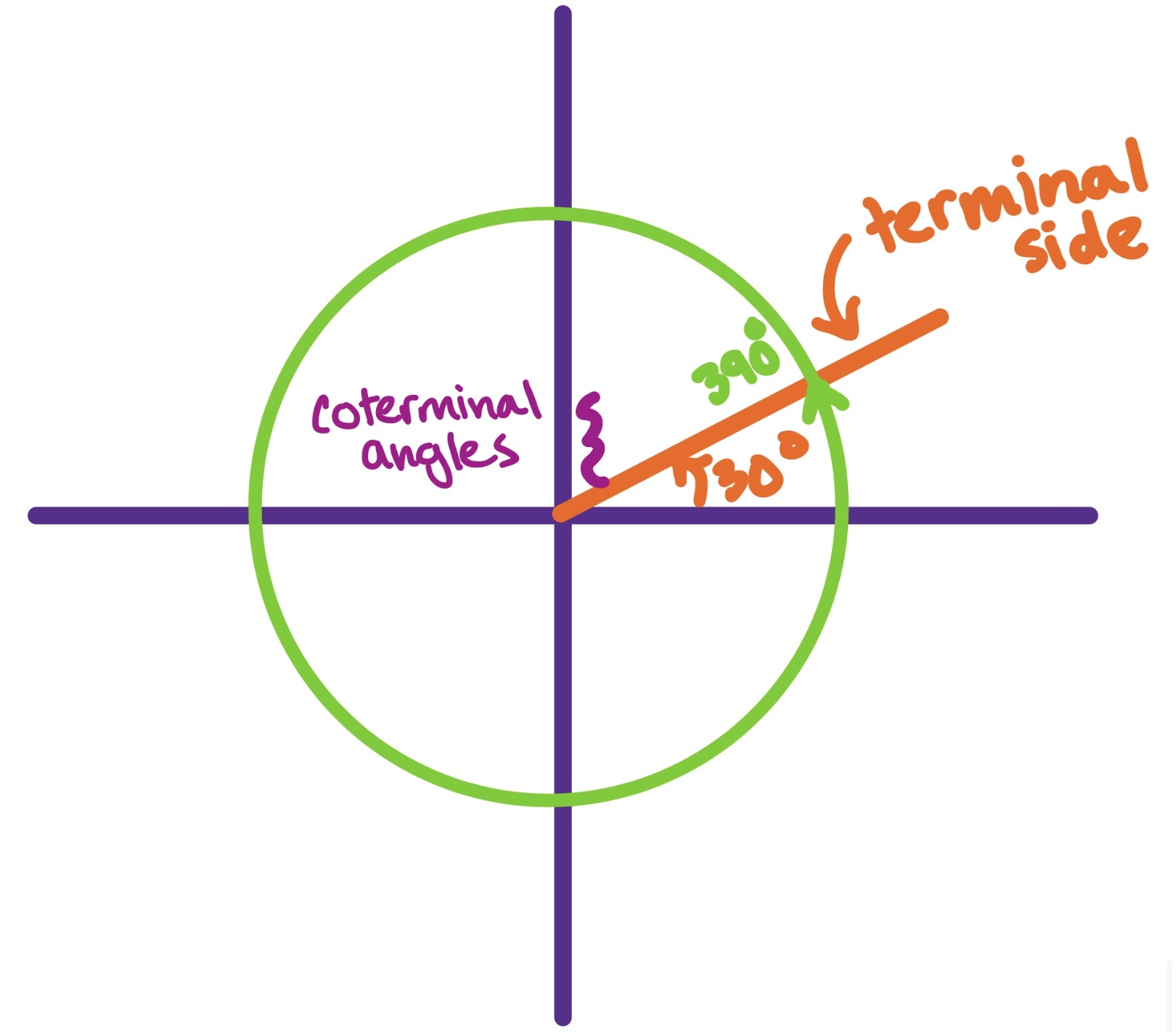
Image source: by Trisha
In the example above, the angle is . If we add , we get , which is a coterminal angle. We can subtract or add another as many times as we like and we would always receive a coterminal angle.


