坐标平面中的角:标准位置

Illustrated · 1 min

An Angle in Standard Position?

You can create any angle in the coordinate plane using two rays with a common endpoint about the origin. One ray is called the initial side and the other one is called terminal side. If the angle is in standard position, then the initial side must be fixed on the x-axis and the terminal side rotates about the origin. The amount of rotation is the angle.

A coordinate plane, with a light blue arrow on the x-axis, labeled the "Initial Side". A dark blue arrow at an arbitrary angle in the second quadrant, labeled the "Terminal Side".

Angle in Standard Position

The Quadrantal Angle

In instances where the terminal side lies on one of the axes (the x- or y-axis), we call those angles quadrantal angles. The main quadrantal angles are: 00, π2\frac{\pi}{2}, π\pi, and 3π23\frac{\pi}{2}.

Illustrated · 1 min

In trigonometry, one thing we like to do a lot is draw angles on the coordinate plane. This consists of drawing two rays which intersect, conventionally at the origin, to form an angle that has a measure between 0∘0^{\circ} and 360∘.360^{\circ}.

We want to be consistent in how we draw these angles, and we call these decisions the standard position of an angle. The first decision was to have the two rays intersect at the origin.

The second decision is to start the angle at the positive xx-axis. That is, the first ray we draw will point outward to the right from the origin, traveling along the xx-axis.

The final important thing to discuss is whether we travel clockwise or counterclockwise. When the angle measure is positive, we travel counterclockwise to determine where the second ray will be. If thought of in terms of the hands of a clock, a 90∘90^{\circ} angle will have one hand on the 33 and the other hand on the 12.12.

For another example, look at the picture below:

A 45-degree angle in standard form

Graph courtesy of Desmos

To be in standard position, we'd start by drawing the red line, then travel 4545 degrees counterclockwise to determine the location of the blue line. In other words, this is what a 45∘45^{\circ} angle in standard position looks like.

In the next few lessons, you will learn about coterminal and reference angles and how to convert between radians and degrees.


Video · + 1 min read

(Video) Drawing Angles in Standard Position

by MrStanislow

This video by MrStanislow talks about how to draw angles in standard position.

Summary

Very generally, drawing angles in standard position will follow much of the same steps. Your origin of the plane will function as the vertex. The initial ray will lie on the xx-axis. The terminal ray is the terminal side of the angle.

So, angles in standard position have the initial ray on the positive xx-axis, the vertex at the origin, and the terminal ray somewhere on the plane in one of the quadrants (counter clockwise if positive, clockwise if negative).

If you angle is positive, the angle will open counterclockwise.

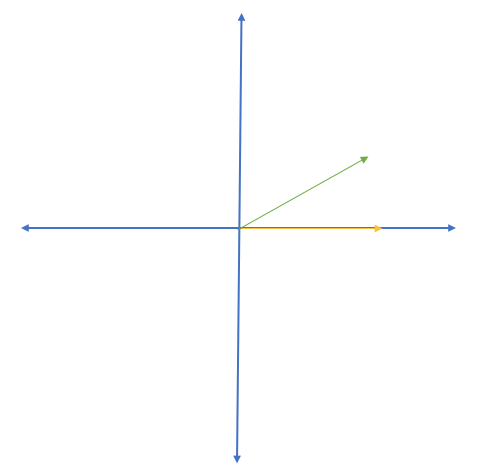
Coordinate plane with 30 degree positive angle

Image source: by Anusha Rahman

As we can see from this graph, the yellow ray is the initial ray, sitting on the xx-axis.

If we wanted to show a negative angle, the angle would open counterclockwise.

Coordinate plane with 30 degree negative angle

Image source: by Anusha Rahman

In this second graph, the angle opens downwards, so we know it's a negative angle.

Angles can also go around the origin multiple times! We can have angles that are greater than 360∘360 ^{\circ}.

Coordinate plane showing an angle greater than 360 degrees.

Image source: by Anusha Rahman

As we can see from this graph, this angle goes around the coordinate plane 33 times. We also know that the angle is 30∘30 ^{\circ} from the xx-axis. That means if we want to calculate the angle degree of this angle, we will have to calculate:

(3⋅360)+30=1110∘(3 \cdot 360) + 30 = 1110 ^{\circ}

These same rules if we want to use radians, not degrees.

MrStanislow walks through some practice problems. Try them on your own, then follow along!

Type a concept, like “slope” or “photosynthesis”.

↑ ↓ to choose · Enter to openSearch explanations and problems