对数

Before this, know$f^(-1)$ (反函数)的导数

Video · + 2 min read

(Videos) Derivatives of Logarithmic Functions

by PatrickJMT

Here's a video by patrickJMT where he goes through some examples of finding the derivative of a logarithmic function.

The rule for logarithmic differentiation are as follows: ddxln⁡[x]=1xddxln⁡[f(x)]=1f(x)⋅f′(x)ddxlog⁡a(x)=1x⋅ln⁡addxlog⁡a[f(x)]=1f(x)⋅ln⁡a⋅f′(x)\begin{align} &\frac{d}{dx}\ln[x]=\frac1x\\ &\frac{d}{dx}\ln[f(x)]=\frac{1}{f(x)}\cdot f'(x)\\ &\frac{d}{dx}\log_a(x)=\frac{1}{x\cdot\ln a}\\ &\frac{d}{dx}\log_a[f(x)]=\frac{1}{f(x)\cdot\ln a}\cdot f'(x) \end{align}

Remember to also use the properties of logarithms when taking derivatives. They can help turn a complicated problem into a less complicated problem.

The first problem he looks at is: f(x)=ln⁡(x2+10)f(x)=\ln(x^2+10) So we take one over the inside and multiply that by the derivative of the inside. f′(x)=1x2+10⋅(x2+10)′=1x2+10⋅2x=2xx2+10\begin{align} f'(x)&=\frac{1}{x^2+10}\cdot\color{red}{(x^2+10)'}\\ &=\frac{1}{x^2+10}\cdot2x\\ &=\boxed{\frac{2x}{x^2+10}} \end{align}

The second problem is f(x)=x⋅ln⁡xf(x)=\sqrt x\cdot\ln x Here we need to use the product rule to find this derivative. f′(x)=(x)′ln⁡x+x(ln⁡x)′=12x−12ln⁡x+x(1x)=ln⁡x2x+xx=ln⁡x2x+1x=ln⁡x2x+22x=2+ln⁡x2x\begin{align} f'(x)&=\color{red}{(\sqrt x)'}\ln x+\sqrt x\color{red}{(\ln x)'}\\ &=\frac12x^{-\frac12}\ln x+\sqrt x\bigg(\frac1x\bigg)\\ &=\frac{\ln x}{2\sqrt{x}}+\frac{\sqrt x}{x}\\ &=\frac{\ln x}{2\sqrt{x}}+\frac{1}{\sqrt x}\\ &=\frac{\ln x}{2\sqrt{x}}+\frac{2}{2\sqrt x}\\ &=\boxed{\frac{2+\ln x}{2\sqrt{x}}} \end{align}

The third problem is: f(x)=ln⁡[(2x+1)3(3x−1)4]f(x)=\ln\bigg[\frac{(2x+1)^3}{(3x-1)^4}\bigg] This is an example of a problem where it would be made easier if we used a logarithmic property. So let's use: ln⁡(ab)=ln⁡a−ln⁡bln⁡an=nln⁡a\ln\bigg(\frac ab\bigg)=\ln a-\ln b\\ \ln a^n=n\ln a f(x)=ln⁡(2x+1)3−ln⁡(3x−1)4=3ln⁡(2x+1)−4ln⁡(3x−1)f′(x)=3(12x+1)(2x+1)′−4(13x−1)(3x−1)′=62x+1−123x−1\begin{align} f(x)&=\ln(2x+1)^3-\ln(3x-1)^4\\ &=3\ln(2x+1)-4\ln(3x-1)\\ f'(x)&=3\bigg(\frac{1}{2x+1}\bigg)\color{red}{(2x+1)'}-4\bigg(\frac{1}{3x-1}\bigg)\color{red}{(3x-1)'}\\ &=\boxed{\frac{6}{2x+1}-\frac{12}{3x-1}} \end{align}

The final example is: y=[log⁡4(1+ex)]2y=[\log_4(1+e^x)]^2 Here we will need to use the chain rule first. y′=2log⁡4(1+ex)⋅[log⁡4(1+ex)]′=2log⁡4(1+ex)⋅1(1+ex)⋅ln⁡4⋅(1+ex)′=2log⁡4(1+ex)⋅1(1+ex)⋅ln⁡4⋅ex=2exlog⁡4(1+ex)(1+ex)⋅ln⁡4\begin{align} y'&=2\log_4(1+e^x)\cdot\color{red}{[\log_4(1+e^x)]'}\\ &=2\log_4(1+e^x)\cdot\frac{1}{(1+e^x)\cdot\ln 4}\cdot\color{red}{(1+e^x)'}\\ &=2\log_4(1+e^x)\cdot\frac{1}{(1+e^x)\cdot\ln 4}\cdot e^x\\ &=\boxed{\frac{2e^x\log_4(1+e^x)}{(1+e^x)\cdot\ln 4}} \end{align}

Here's another video with some more examples.

The first example he looks at: y=ln⁡(x2+x)y′=1x2+x⋅(x2+x)′=1x2+x⋅(2x+1)=2x+1x2+x\begin{align} y&=\ln(x^2+x)\\ y'&=\frac{1}{x^2+x}\cdot\color{red}{(x^2+x)'}\\ &=\frac{1}{x^2+x}\cdot(2x+1)\\ &=\boxed{\frac{2x+1}{x^2+x}} \end{align}

The next problem is: y=log⁡7x3y=\sqrt[3]{\log_7 x} Here we have a log inside a chain rule. But first let's rewrite the problem without the radical symbol. y=(log⁡7x)13y′=13(log⁡7x)−23⋅(log⁡7x)′=13(log⁡7x)−23⋅1x⋅ln⁡7=13(log⁡7x)23⋅x⋅ln⁡7\begin{align} y&=(\log_7 x)^{\frac13}\\ y'&=\frac13(\log_7 x)^{-\frac23}\cdot\color{red}{(\log_7 x)'}\\ &=\frac13(\log_7 x)^{-\frac23}\cdot\frac{1}{x\cdot\ln7}\\ &=\boxed{\frac{1}{3(\log_7 x)^{\frac23}\cdot x\cdot\ln7}} \end{align}

The third problem is: y=ln⁡(x4⋅sin⁡x)y=\ln(x^4\cdot\sin x) Here we have a chain rule inside a logarithm...or we can use a logarithm property to make everyone's lives easier. y=ln⁡(x4)+ln⁡(sin⁡x)=4ln⁡x+ln⁡(sin⁡x)y′=4(1x)+1sin⁡x⋅(sin⁡x)′=4x+1sin⁡x⋅(cos⁡x)=4x+cos⁡xsin⁡x=4x+cot⁡x\begin{align} y&=\ln(x^4)+\ln(\sin x)\\ &=4\ln x+\ln(\sin x)\\ y'&=4\bigg(\frac1x\bigg)+\frac{1}{\sin x}\cdot\color{red}{(\sin x)'}\\ &=\frac4x+\frac1{\sin x}\cdot(\cos x)\\ &=\frac4x+\frac{\cos x}{\sin x}\\ &=\boxed{\frac4x+\cot x} \end{align}

The final example is: y=ln⁡x1+ln⁡(2x)y=\frac{\ln x}{1+\ln(2x)} Here we have logarithms inside a quotient rule. y′=(ln⁡x)′[1+ln⁡(2x)]−ln⁡x[1+ln⁡(2x)]′[1+ln⁡(2x)]2=1+ln⁡(2x)x−ln⁡x[12x⋅(2x)′][1+ln⁡(2x)]2=1+ln⁡(2x)x−ln⁡x[22x][1+ln⁡(2x)]2=1+ln⁡(2x)x−ln⁡xx[1+ln⁡(2x)]2=1+ln⁡(2x)−ln⁡xx[1+ln⁡(2x)]2=1+ln⁡(2x)−ln⁡xx[1+ln⁡(2x)]2=1+ln⁡(2xx)x[1+ln⁡(2x)]2=1+ln⁡2x[1+ln⁡(2x)]2\begin{align} y'&=\frac{\color{red}{(\ln x)'}[1+\ln(2x)]-\ln x\color{red}{[1+\ln(2x)]'}}{[1+\ln(2x)]^2}\\ &=\frac{\frac{1+\ln(2x)}{x}-\ln x[\frac{1}{2x}\cdot\color{red}{(2x)'}]}{[1+\ln(2x)]^2}\\ &=\frac{\frac{1+\ln(2x)}{x}-\ln x[\frac{2}{2x}]}{[1+\ln(2x)]^2}\\ &=\frac{\frac{1+\ln(2x)}{x}-\frac{\ln x}{x}}{[1+\ln(2x)]^2}\\ &=\frac{\frac{1+\ln(2x)-\ln x}{x}}{[1+\ln(2x)]^2}\\ &=\frac{1+\ln(2x)-\ln x}{x[1+\ln(2x)]^2}\\ &=\frac{1+\ln(\frac{2x}{x})}{x[1+\ln(2x)]^2}\\ &=\boxed{\frac{1+\ln2}{x[1+\ln(2x)]^2}}\\ \end{align}

Illustrated · 2 min

(Video) Solving Every Derivative Ever

by PatrickJMT

Okay, maybe it's not EVERY derivative ever but here's a video by patrickJMT going over different derivatives for a whopping 35 minutes.

Let's have a season recap of some formulas before we go in. ddxxn=nxn−1ddxcot⁡x=−csc⁡2xddxk=0ddxsec⁡x=sec⁡xtan⁡xddxsin⁡x=cos⁡xddxex=exddxcos⁡x=−sin⁡xddxax=axln⁡addxtan⁡x=sec⁡2xddxln⁡x=1xddxcsc⁡x=−csc⁡xcot⁡xddxlog⁡ax=1xln⁡a\begin{alignat}{2} & \frac{d}{dx}x^n=nx^{n-1} \quad && \frac{d}{dx}\cot x=-\csc^2 x\\ & \frac{d}{dx}k=0 \quad && \frac{d}{dx}\sec x=\sec x \tan x\\ & \frac{d}{dx}\sin x=\cos x \quad && \frac{d}{dx}e^x=e^x\\ & \frac{d}{dx}\cos x=-\sin x \quad && \frac{d}{dx}a^x=a^x\ln a\\ &\frac{d}{dx}\tan x=\sec^2x \quad && \frac{d}{dx}\ln x=\frac1x\\ &\frac{d}{dx}\csc x=-\csc x\cot x \quad &&\frac{d}{dx}\log_ax=\frac1{x\ln a} \end{alignat}

Also let's recap the product, quotient, and chain rule. [f(x)g(x)]′=f′(x)g(x)+f(x)g′(x)[f(x)g(x)]′=f′(x)g(x)−f(x)g′(x)[g(x)]2[f( g(x) )]′=f′( g(x) )⋅g′(x)\begin{align} [f(x)g(x)]'&=f'(x)g(x)+f(x)g'(x)\\ \bigg[\frac{f(x)}{g(x)}\bigg]'&=\frac{f'(x)g(x)-f(x)g'(x)}{[g(x)]^2}\\ [f(\ g(x)\ )]'&=f'(\ g(x)\ )\cdot g'(x) \end{align}

Problem 1

y=x2+3x+4y′=2x2−1+3(1x1−1)+0=2x+3\begin{align} y&=x^2+3x+4\\ y'&=2x^{2-1}+3(1x^{1-1})+0\\ &=\boxed{2x+3} \end{align}

Problem 2

y=5t−23y′=5(−23t−23−1)=−103t−53=−103t53\begin{align} y&=5t^{-\frac23}\\ y'&=5(-\frac23t^{-\frac23-1})\\ &=-\frac{10}3t^{-\frac53}\\ &=\boxed{-\frac{10}{3t^{\frac53}}} \end{align}

Problem 3

y=3x−1x=3x−1x12=3xx12−1x12=3x12−x−12y′=3(12x−12)−(−12x−32)=32x12+12x32=3x+12x32\begin{align} y&=\frac{3x-1}{\sqrt x}\\ &=\frac{3x-1}{x^{\frac12}}\\ &=\frac{3x}{x^{\frac12}}-\frac{1}{x^{\frac12}}\\ &=3x^{\frac12}-x^{-\frac12}\\ y'&=3(\frac12x^{-\frac12})-(-\frac12x^{-\frac32})\\ &=\frac{3}{2x^{\frac12}}+\frac{1}{2x^{\frac32}}\\ &=\boxed{\frac{3x+1}{2x^{\frac32}}} \end{align}

Problem 4

y=(x+4)(x−4)=x2−4x+4x−16=x2−16y′=2x2−1−0=2x\begin{align} y&=(x+4)(x-4)\\ &=x^2-4x+4x-16\\ &=x^2-16\\ y'&=2x^{2-1}-0\\ &=\boxed{2x} \end{align}

Problem 5

y=x−1x+1=x12−1x12+1y′=(x12−1)′(x12+1)−(x12−1)(x12+1)′(x12+1)2=12x−12(x12+1)−(x12−1)(12x−12)(x12+1)2=12x−12[(x12+1)−(x12−1)](x12+1)2=(x12+1)−(x12−1)2x(x12+1)2=22x(x12+1)2=1x(x12+1)2\begin{align} y&=\frac{\sqrt x-1}{\sqrt x+1}\\ &=\frac{x^{\frac12}-1}{x^{\frac12}+1}\\ y'&=\frac{\color{red}{(x^{\frac12}-1)'}(x^{\frac12}+1)-(x^{\frac12}-1)\color{red}{(x^{\frac12}+1)'}}{(x^{\frac12}+1)^2}\\ &=\frac{\frac12x^{-\frac12}(x^{\frac12}+1)-(x^{\frac12}-1)(\frac12x^{-\frac12})}{(x^{\frac12}+1)^2}\\ &=\frac{\frac12x^{-\frac12}[(x^{\frac12}+1)-(x^{\frac12}-1)]}{(x^{\frac12}+1)^2}\\ &=\frac{(x^{\frac12}+1)-(x^{\frac12}-1)}{2\sqrt x(x^{\frac12}+1)^2}\\ &=\frac{2}{2\sqrt x(x^{\frac12}+1)^2}\\ &=\boxed{\frac{1}{\sqrt x(x^{\frac12}+1)^2}} \end{align}

Problem 6

y=2x−x⋅xx2=2x−x32x2=2xx2−x32x2=2x−1x12=2x−1−x−12y′=2(−1x−2)−(−12x32)=12x32−2x2\begin{align} y&=\frac{2x-\sqrt{x}\cdot x}{x^2}\\ &=\frac{2x-x^{\frac32}}{x^2}\\ &=\frac{2x}{x^2}-\frac{x^{\frac32}}{x^2}\\ &=\frac{2}{x}-\frac{1}{x^{\frac12}}\\ &=2x^{-1}-x^{-\frac12}\\ y'&=2(-1x^{-2})-(-\frac12x^{\frac32})\\ &=\boxed{\frac{1}{2x^{\frac32}}-\frac{2}{x^2}} \end{align}

Problem 7

y=(sin⁡x)(x12)y′=(sin⁡x)′(x12)+(sin⁡x)(x12)′=(cos⁡x)(x12)+(sin⁡x)(12x−12)=xcos⁡x+sin⁡x2x\begin{align} y&=(\sin x)(x^{\frac12})\\ y'&=\color{red}{(\sin x)'}(x^{\frac12})+(\sin x)\color{red}{(x^{\frac12})'}\\ &=(\cos x)(x^{\frac12})+(\sin x)(\frac12x^{-\frac12})\\ &=\boxed{\sqrt{x}\cos x+\frac{\sin x}{2\sqrt x}} \end{align}

Problem 8

y=(sin⁡x)(cos⁡x)y′=(sin⁡x)′(cos⁡x)+(sin⁡x)(cos⁡x)=(cos⁡x)(cos⁡x)+(sin⁡x)(−sin⁡x)=cos⁡2x−sin⁡2x=cos⁡(2x)\begin{align} y&=(\sin x)(\cos x)\\ y'&=\color{red}{(\sin x)'}(\cos x)+(\sin x)\color{red}{(\cos x)}\\ &=(\cos x)(\cos x)+(\sin x)(-\sin x)\\ &=\cos^2x-\sin^2x\\ &=\boxed{\cos(2x)} \end{align}

Problem 9

y=sin⁡(cos⁡x)y′=cos⁡(cos⁡x)⋅[cos⁡x]′=cos⁡(cos⁡x)⋅(−sin⁡x)=−sin⁡xcos⁡(cos⁡x)\begin{align} y&=\sin(\cos x)\\ y'&=\cos(\cos x)\cdot\color{red}{[\cos x]'}\\ &=\cos(\cos x)\cdot(-\sin x)\\ &=\boxed{-\sin x\cos(\cos x)} \end{align}

Problem 10

y=sec⁡[(1+x2)12]y′=sec⁡[(1+x2)12]⋅tan⁡[(1+x2)12]⋅[(1+x2)12]′=sec⁡[(1+x2)12]⋅tan⁡[(1+x2)12]⋅12(1+x2)−12⋅(1+x2)′=sec⁡[(1+x2)12]⋅tan⁡[(1+x2)12]⋅12(1+x2)−12⋅(2x)=xsec⁡[(1+x2)12]tan⁡[(1+x2)12]1+x2\begin{align} y&=\sec[(1+x^2)^{\frac12}]\\ y'&=\sec[(1+x^2)^{\frac12}]\cdot\tan[(1+x^2)^{\frac12}]\cdot\color{red}{[(1+x^2)^{\frac12}]'}\\ &=\sec[(1+x^2)^{\frac12}]\cdot\tan[(1+x^2)^{\frac12}]\cdot\frac12(1+x^2)^{-\frac12}\cdot\color{red}{(1+x^2)'}\\ &=\sec[(1+x^2)^{\frac12}]\cdot\tan[(1+x^2)^{\frac12}]\cdot\frac12(1+x^2)^{-\frac12}\cdot(2x)\\ &=\boxed{\frac{x\sec[(1+x^2)^{\frac12}]\tan[(1+x^2)^{\frac12}]}{\sqrt{1+x^2}}} \end{align}

Problem 11

y=tan⁡2[sin⁡(θ3)]y′=2tan⁡[sin⁡(θ3)]⋅[ tan⁡[sin⁡(θ3)] ]′=2tan⁡[sin⁡(θ3)]⋅sec⁡2[sin⁡(θ3)]⋅[sin⁡(θ3)]′=2tan⁡[sin⁡(θ3)]⋅sec⁡2[sin⁡(θ3)]⋅cos⁡(θ3)⋅(θ3)′=2tan⁡[sin⁡(θ3)]⋅sec⁡2[sin⁡(θ3)]⋅cos⁡(θ3)⋅3θ2=6θ2tan⁡[sin⁡(θ3)]sec⁡2[sin⁡(θ3)]cos⁡(θ3)\begin{align} y&=\tan^2[\sin(\theta^3)]\\ y'&=2\tan[\sin(\theta^3)]\cdot\color{red}{[\ \tan[\sin(\theta^3)]\ ]'}\\ &=2\tan[\sin(\theta^3)]\cdot\sec^2[\sin(\theta^3)]\cdot\color{red}{[\sin(\theta^3)]'}\\ &=2\tan[\sin(\theta^3)]\cdot\sec^2[\sin(\theta^3)]\cdot\cos(\theta^3)\cdot\color{red}{(\theta^3)'}\\ &=2\tan[\sin(\theta^3)]\cdot\sec^2[\sin(\theta^3)]\cdot\cos(\theta^3)\cdot3\theta^2\\ &=\boxed{6\theta^2\tan[\sin(\theta^3)]\sec^2[\sin(\theta^3)]\cos(\theta^3)} \end{align}

Problem 12

y=xsin⁡(3x−1)y′=(x)′[sin⁡(3x−1)]+(x)[sin⁡(3x−1)]′=(1)sin⁡(3x−1)+(x)cos⁡(3x−1)⋅(3x−1)′=sin⁡(3x−1)+(x)cos⁡(3x−1)⋅3(−1x−2)=sin⁡(3x−1)−3xcos⁡(3x−1)x2=sin⁡(3x)−3cos⁡(3x)x=xsin⁡(3x)−3cos⁡(3x)x\begin{align} y&=x\sin(3x^{-1})\\ y'&=\color{red}{(x)'}[\sin(3x^{-1})]+(x)\color{red}{[\sin(3x^{-1})]'}\\ &=(1)\sin(3x^{-1})+(x)\cos(3x^{-1})\cdot\color{red}{(3x^{-1})'}\\ &=\sin(3x^{-1})+(x)\cos(3x^{-1})\cdot3(-1x^{-2})\\\\ &=\sin(3x^{-1})-\frac{3x\cos(3x^{-1})}{x^{2}}\\ &=\sin(\frac3x)-\frac{3\cos(\frac3x)}{x}\\ &=\boxed{\frac{x\sin(\frac3x)-3\cos(\frac3x)}{x}} \end{align}

Problem 13

y=(x3+4)2(x2+1)4y′=[(x3+4)2]′(x2+1)4−(x3+4)2[(x2+1)4]′[(x2+1)4]2=2(x3+4)(x3+4)′(x2+1)4−4(x3+4)2(x2+1)3(x2+1)′(x2+1)8=6x2(x3+4)(x2+1)4−8x(x3+4)2(x2+1)3(x2+1)8=6x2(x3+4)(x2+1)4−8x(x3+4)2(x2+1)3(x2+1)8=2x(x3+4)(x2+1)3[3x(x2+1)−4(x3+4)](x2+1)8=2x(x3+4)[3x(x2+1)−4(x3+4)](x2+1)5=2x(x3+4)[(3x3+3x)−(4x3+16)](x2+1)5=2x(x3+4)(−x3+3x−16)(x2+1)5\begin{align} y&=\frac{(x^3+4)^2}{(x^2+1)^4}\\ y'&=\frac{\color{red}{[(x^3+4)^2]'}(x^2+1)^4-(x^3+4)^2\color{red}{[(x^2+1)^4]'}}{[(x^2+1)^4]^2}\\ &=\frac{2(x^3+4)\color{red}{(x^3+4)'}(x^2+1)^4-4(x^3+4)^2(x^2+1)^3\color{red}{(x^2+1)'}}{(x^2+1)^8}\\ &=\frac{6x^2(x^3+4)(x^2+1)^4-8x(x^3+4)^2(x^2+1)^3}{(x^2+1)^8}\\ &=\frac{6x^2(x^3+4)(x^2+1)^4-8x(x^3+4)^2(x^2+1)^3}{(x^2+1)^8}\\ &=\frac{2x(x^3+4)(x^2+1)^3[3x(x^2+1)-4(x^3+4)]}{(x^2+1)^8}\\ &=\frac{2x(x^3+4)[3x(x^2+1)-4(x^3+4)]}{(x^2+1)^5}\\ &=\frac{2x(x^3+4)[(3x^3+3x)-(4x^3+16)]}{(x^2+1)^5}\\ &=\boxed{\frac{2x(x^3+4)(-x^3+3x-16)}{(x^2+1)^5}} \end{align}

Problem 14

y=ln⁡(x)+x3y′=1x+3x2=3x3+1x\begin{align} y&=\ln(x)+x^3\\ y'&=\frac1x+3x^2\\ &=\boxed{\frac{3x^3+1}{x}} \end{align}

Problem 15

y=x2exy′=(x2)′ex+x2(ex)′=2xex+x2ex=xex(x+2)\begin{align} y&=x^2e^x\\ y'&=\color{red}{(x^2)'}e^x+x^2\color{red}{(e^x)'}\\ &=2xe^x+x^2e^x\\ &=\boxed{xe^x(x+2)} \end{align}

Problem 16

y=et⋅cos⁡(2t)y′=et⋅cos⁡(2t)⋅[t⋅cos⁡(2t)]′=et⋅cos⁡(2t)⋅[(t)′cos⁡(2t)+t[cos⁡(2t)]′]=et⋅cos⁡(2t)⋅[cos⁡(2t)−tsin⁡(2t)⋅(2t)′]=et⋅cos⁡(2t)⋅[cos⁡(2t)−2tsin⁡(2t)]\begin{align} y&=e^{t\cdot\cos(2t)}\\ y'&=e^{t\cdot\cos(2t)}\cdot\color{red}{[t\cdot\cos(2t)]'}\\ &=e^{t\cdot\cos(2t)}\cdot[\color{red}{(t)'}\cos(2t)+t\color{red}{[\cos(2t)]'}]\\ &=e^{t\cdot\cos(2t)}\cdot[\cos(2t)-t\sin(2t)\cdot\color{red}{(2t)'}]\\ &=\boxed{e^{t\cdot\cos(2t)}\cdot[\cos(2t)-2t\sin(2t)]} \end{align}

Problem 17

y=cos⁡(eπx)y′=−sin⁡(eπx)⋅(eπx)′=−sin⁡(eπx)⋅eπx(πx)′=−πeπxsin⁡(eπx)\begin{align} y&=\cos(e^{\pi x})\\ y'&=-\sin(e^{\pi x})\cdot\color{red}{(e^{\pi x})'}\\ &=-\sin(e^{\pi x})\cdot e^{\pi x}\color{red}{(\pi x)'}\\ &=\boxed{-\pi e^{\pi x}\sin(e^{\pi x})} \end{align}

Problem 18

y=(1+2e3x)12y′=12(1+2e3x)−12⋅(1+2e3x)′=12(1+2e3x)−12⋅2e3x⋅(3x)′=3e3x1+2e3x\begin{align} y&=(1+2e^{3x})^{\frac12}\\ y'&=\frac12(1+2e^{3x})^{-\frac12}\cdot\color{red}{(1+2e^{3x})'}\\ &=\frac12(1+2e^{3x})^{-\frac12}\cdot2e^{3x}\cdot\color{red}{(3x)'}\\ &=\boxed{\frac{3e^{3x}}{\sqrt{1+2e^{3x}}}} \end{align}

Problem 19

y=5−1x=5−x−1y′=5−x−1⋅ln⁡5⋅(−x−1)′=5−x−1⋅ln⁡5⋅(x−2)=ln⁡551xx2\begin{align} y&=5^{-\frac1x}\\ &=5^{-x^{-1}}\\ y'&=5^{-x^{-1}}\cdot\ln5\cdot\color{red}{(-x^{-1})'}\\ &=5^{-x^{-1}}\cdot\ln5\cdot(x^{-2})\\ &=\boxed{\frac{\ln5}{5^{\frac1x}x^2}} \end{align}

Problem 20

y=ln⁡(x4sin⁡2x)y′=1x4sin⁡2x⋅[x4sin⁡2x]′=1x4sin⁡2x⋅[(x4)′sin⁡2x+x4(sin⁡2x)′]=4x3sin⁡2x+2x4sin⁡x⋅(sin⁡x)′x4sin⁡2x=4x3sin⁡2x+2x4sin⁡xcos⁡xx4sin⁡2x=2x3sin⁡x(2sin⁡x+xcos⁡x)x4sin⁡2x=2(2+xcos⁡x)xsin⁡x=4x+2cot⁡x\begin{align} y&=\ln(x^4\sin^2x)\\ y'&=\frac{1}{x^4\sin^2x}\cdot\color{red}{[x^4\sin^2x]'}\\ &=\frac{1}{x^4\sin^2x}\cdot[\color{red}{(x^4)'}\sin^2x+x^4\color{red}{(\sin^2x)'}]\\ &=\frac{4x^3\sin^2x+2x^4\sin x\cdot\color{red}{(\sin x)'}}{x^4\sin^2x}\\ &=\frac{4x^3\sin^2x+2x^4\sin x\cos x}{x^4\sin^2x}\\ &=\frac{2x^3\sin x(2\sin x+x\cos x)}{x^4\sin^2x}\\ &=\frac{2(2+x\cos x)}{x\sin x}\\ &=\boxed{\frac4x+2\cot x} \end{align}

Problem 21

y=ln⁡5x−12x+3=ln⁡(5x−12x+3)12=12[ln⁡(5x−12x+3)]=12[ln⁡(5x−1)−ln⁡(2x+3)]y′=12[15x−1⋅(5x−1)′−12x+3⋅(2x+3)′]=12[55x−1−22x+3]=12[5(2x+3)−2(5x−1)(5x−1)(2x+3)]=12[10x+15−−10x+210x2+13x−3]=12[1710x2+13x−3]=1720x2+26x−6\begin{align} y&=\ln\sqrt{\frac{5x-1}{2x+3}}\\ &=\ln\bigg(\frac{5x-1}{2x+3}\bigg)^{\frac12}\\ &=\frac12\bigg[\ln\bigg(\frac{5x-1}{2x+3}\bigg)\bigg]\\ &=\frac12[\ln(5x-1)-\ln(2x+3)]\\ y'&=\frac12[\frac{1}{5x-1}\cdot\color{red}{(5x-1)'}-\frac{1}{2x+3}\cdot\color{red}{(2x+3)'}]\\ &=\frac12\bigg[\frac{5}{5x-1}-\frac{2}{2x+3}\bigg]\\ &=\frac12\bigg[\frac{5(2x+3)-2(5x-1)}{(5x-1)(2x+3)}\bigg]\\ &=\frac12\bigg[\frac{10x+15--10x+2}{10x^2+13x-3}\bigg]\\ &=\frac12\bigg[\frac{17}{10x^2+13x-3}\bigg]\\ &=\boxed{\frac{17}{20x^2+26x-6}} \end{align}

Problem 22

y=t3−3ty′=3t2−3t⋅ln⁡3=3t2−3tln⁡3\begin{align} y&=t^3-3^t\\ y'&=3t^2-3^t\cdot\ln3\\ &=\boxed{3t^2-3^t\ln3} \end{align}

Problem 23

y=ln⁡(sec⁡x+tan⁡x)y′=1sec⁡x+tan⁡x⋅[sec⁡x+tan⁡x]′=1sec⁡x+tan⁡x⋅[sec⁡x⋅tan⁡x+sec⁡2x]=sec⁡xtan⁡x+sec⁡2xsec⁡x+tan⁡x\begin{align} y&=\ln(\sec x+\tan x)\\ y'&=\frac{1}{\sec x+\tan x}\cdot\color{red}{[\sec x+\tan x]'}\\ &=\frac{1}{\sec x+\tan x}\cdot[\sec x\cdot\tan x+\sec^2x]\\ &=\boxed{\frac{\sec x\tan x+\sec^2x}{\sec x+\tan x}} \end{align}

Problem 24

y=log⁡10(2xx−1)=log⁡10(2x)−log⁡10(x−1)y′=12xln⁡10⋅(2x)′−1(x−1)ln⁡10⋅(x−1)′=22xln⁡10−1(x−1)ln⁡10=1xln⁡10−1(x−1)ln⁡10\begin{align} y&=\log_{10}\bigg(\frac{2x}{x-1}\bigg)\\ &=\log_{10}(2x)-\log_{10}(x-1)\\ y'&=\frac{1}{2x\ln10}\cdot\color{red}{(2x)'}-\frac{1}{(x-1)\ln10}\cdot\color{red}{(x-1)'}\\ &=\frac{2}{2x\ln10}-\frac{1}{(x-1)\ln10}\\ &=\boxed{\frac{1}{x\ln10}-\frac{1}{(x-1)\ln10}} \end{align}

Problem 25

y=ln⁡xx2y′=(ln⁡x)′(x2)−(ln⁡x)(x2)′[x2]2=1x(x2)−2x(ln⁡x)x4=x−2x(ln⁡x)x4=1−2ln⁡xx3\begin{align} y&=\frac{\ln x}{x^2}\\ y'&=\frac{\color{red}{(\ln x)'}(x^2)-(\ln x)\color{red}{(x^2)'}}{[x^2]^2}\\ &=\frac{\frac1x(x^2)-2x(\ln x)}{x^4}\\ &=\frac{x-2x(\ln x)}{x^4}\\\\ &=\boxed{\frac{1-2\ln x}{x^3}} \end{align}

Video · + 1 min read

(Videos) Derivatives of Logarithms

by PatrickJMT

Here's a video by patrickJMT where he shows you how to take the derivative of logarithmic functions.

The two derivative rules you need to know are for natural logs and regular logs. ddxln⁡[f(x)]=1f(x)⋅f′(x)ddxlog⁡a[f(x)]=1f(x)⋅ln⁡a⋅f′(x)\frac{d}{dx}\ln[f(x)]=\frac{1}{f(x)}\cdot f'(x)\\ \frac{d}{dx}\log_a[f(x)]=\frac{1}{f(x)\cdot\ln a}\cdot f'(x)

The first derivative problem he looks at is: y=ln⁡x+2x+sin⁡xy=\ln x+2^x+\sin x This is a very straight forward problem that only requires you to know the different derivative rules. y′=1x+2x⋅ln⁡2+cos⁡x\begin{align} y'&=\boxed{\frac1x+2^x\cdot\ln2+\cos x} \end{align}

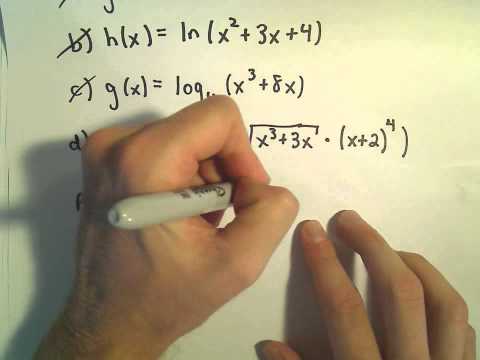
The next problem is: h(x)=ln⁡(x2+3x+4)h(x)=\ln(x^2+3x+4) Here we need to use the chain rule when taking the derivative of the natural log. h′(x)=1x2+3x+4⋅(x2+3x+4)′=1x2+3x+4⋅(2x+3)=2x+3x2+3x+4\begin{align} h'(x)&=\frac{1}{x^2+3x+4}\cdot\color{red}{(x^2+3x+4)'}\\ &=\frac{1}{x^2+3x+4}\cdot(2x+3)\\ &=\boxed{\frac{2x+3}{x^2+3x+4}} \end{align}

This next video is a continuation of the first. It has two more logarithmic derivative problems that he solves.

The first problem of this video is: g(x)=log⁡4(x3+8x)g(x)=\log_4(x^3+8x) Here we have a chain rule paired with a logarithm with base four. g′(x)=1(x3+8x)⋅ln⁡4⋅(x3+8x)′=1(x3+8x)⋅ln⁡4⋅(3x2+8)=3x2+8(x3+8x)⋅ln⁡4\begin{align} g'(x)&=\frac{1}{(x^3+8x)\cdot\ln4}\cdot\color{red}{(x^3+8x)'}\\ &=\frac{1}{(x^3+8x)\cdot\ln4}\cdot(3x^2+8)\\ &=\boxed{\frac{3x^2+8}{(x^3+8x)\cdot\ln4}} \end{align}

The final problem he solves is: p(x)=ln⁡(x2⋅x3+3x⋅(x+2)4)p(x)=\ln(x^2\cdot\sqrt{x^3+3x}\cdot(x+2)^4) This problem looks like it will be a nightmare. We have a triple product rule inside a logarithm. Luckily, we can use our properties of logarithms to rewrite this into a more easily differentiated form. p(x)=ln⁡(x2)+ln⁡(x3+3x)12+ln⁡(x+2)4=2ln⁡x+12ln⁡(x3+3x)+4ln⁡(x+2)p′(x)=2(1x)+12(1x3+3x)(x3+3x)′+4(1x+2)=2x+12(x3+3x)⋅(3x2+3)+4x+2=2x+3x2+32(x3+3x)+4x+2\begin{align} p(x)&=\ln(x^2)+\ln(x^3+3x)^{\frac12}+\ln(x+2)^4\\ &=2\ln x+\frac12\ln(x^3+3x)+4\ln(x+2)\\ p'(x)&=2\bigg(\frac1x\bigg)+\frac12\bigg(\frac{1}{x^3+3x}\bigg)\color{red}{(x^3+3x)'}+4\bigg(\frac{1}{x+2}\bigg)\\ &=\frac2x+\frac{1}{2(x^3+3x)}\cdot(3x^2+3)+\frac{4}{x+2}\\ &=\boxed{\frac2x+\frac{3x^2+3}{2(x^3+3x)}+\frac{4}{x+2}} \end{align}

Type a concept, like “slope” or “photosynthesis”.

↑ ↓ to choose · Enter to openSearch explanations and problems