对数微分

Before this, know对数

Interactive · 5 questions

Let's start off with a nice, simple question on derivatives:

What is the derivative of the function f(x)=(x+13)(x−509)2(x−1)3(x+2)4f(x)=(x+13)(x-509)^2(x-1)^3(x+2)^4?

Choose one answer

Video · + 2 min read

(Videos) Logarithmic Differentiation

by PatrickJMT

Here's a video by patrickJMT showing how to solve problems using logarithmic differentiation. Logarithmic differentiation is different than derivatives of logarithms (something I just learned while writing this). Logarithmic differentiation is a technique where you take the logarithm of both sides in order to simplify the problem. Then you use implicit differentiation to solve for dydx\frac{dy}{dx}.

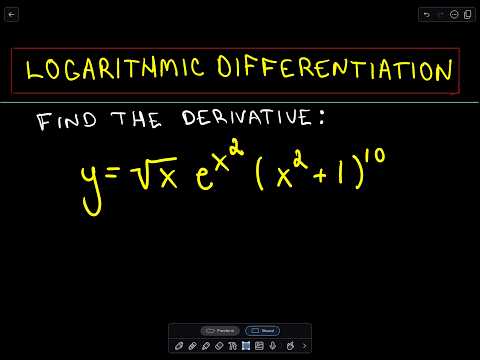
The first problem he looks at is: y=x⋅ex2⋅(x2+1)10y=\sqrt{x}\cdot e^{x^2}\cdot(x^2+1)^{10} Now you can use the product rule and solve this, but honestly that doesn't sound or look fun. What we can do is take the natural log of both sides. ln⁡y=ln⁡[x⋅ex2⋅(x2+1)10]ln⁡y=ln⁡(x12)+ln⁡(ex2)+ln⁡(x2+1)10ln⁡y=12ln⁡x+x2⋅ln⁡e+10ln⁡(x2+1)ln⁡y=12ln⁡x+x2+10ln⁡(x2+1)\begin{align} \ln y&=\ln[\sqrt{x}\cdot e^{x^2}\cdot(x^2+1)^{10}]\\ \ln y&=\ln(x^{\frac12})+\ln(e^{x^2})+\ln(x^2+1)^{10}\\ \ln y&=\frac12\ln x+x^2\cdot\ln e+10\ln(x^2+1)\\ \ln y&=\frac12\ln x+x^2+10\ln(x^2+1) \end{align} Now we can use implicit differentiation and solve for dydx\frac{dy}{dx}. 1y⋅dydx=12⋅1x+2x+10⋅1x2+1⋅2x1y⋅dydx=12x+2x+20xx2+1dydx=y[12x+2x+20xx2+1]\begin{align} \frac1y\cdot\frac{dy}{dx}&=\frac12\cdot\frac1x+2x+10\cdot\frac{1}{x^2+1}\cdot2x\\ \frac1y\cdot\frac{dy}{dx}&=\frac{1}{2x}+2x+\frac{20x}{x^2+1}\\ \frac{dy}{dx}&=y\bigg[\frac{1}{2x}+2x+\frac{20x}{x^2+1}\bigg] \end{align} We want this to be only in terms of xx, so how do we get rid of that yy? Well we can substitute in the beginning of the problem, y=x⋅ex2⋅(x2+1)10y=\sqrt{x}\cdot e^{x^2}\cdot(x^2+1)^{10}. y′=[x⋅ex2⋅(x2+1)10][12x+2x+20xx2+1]\boxed{y'=[\sqrt{x}\cdot e^{x^2}\cdot(x^2+1)^{10}]\left[\frac{1}{2x}+2x+\frac{20x}{x^2+1}\right]}

The second problem he looks at is: y=(ln⁡x)xy=(\ln x)^x So the way we solve this is by taking the natural log of both sides and then using implicit differentiation. ln⁡y=ln⁡[(ln⁡x)x]ln⁡y=x⋅ln⁡(ln⁡x)\begin{align} \ln y&=\ln[(\ln x)^x]\\ \ln y&=x\cdot \ln(\ln x) \end{align} So now we can use implicit differentiation to solve for dydx\frac{dy}{dx}. [ln⁡y]′=[x⋅ln⁡(ln⁡x)]′1y⋅(y)′=(x)′ln⁡(ln⁡x)+x[ln⁡(ln⁡x)]′1ydydx=ln⁡(ln⁡x)+x⋅1ln⁡x⋅(ln⁡x)′1ydydx=ln⁡(ln⁡x)+x⋅1ln⁡x⋅1x1ydydx=ln⁡(ln⁡x)+xxln⁡x1ydydx=ln⁡(ln⁡x)+1ln⁡xdydx=y[ln⁡(ln⁡x)+1ln⁡x]\begin{align} \color{red}{[\ln y]'}&=\color{red}{[x\cdot \ln(\ln x)]'}\\ \frac1y\cdot\color{red}{(y)'}&=\color{red}{(x)'}\ln(\ln x)+x\color{red}{[\ln(\ln x)]'}\\ \frac1y\frac{dy}{dx}&=\ln(\ln x)+x\cdot\frac{1}{\ln x}\cdot\color{red}{(\ln x)'}\\ \frac1y\frac{dy}{dx}&=\ln(\ln x)+x\cdot\frac{1}{\ln x}\cdot\frac1x\\ \frac1y\frac{dy}{dx}&=\ln(\ln x)+\frac{x}{x\ln x}\\ \frac1y\frac{dy}{dx}&=\ln(\ln x)+\frac{1}{\ln x}\\ \frac{dy}{dx}&=y\left[\ln(\ln x)+\frac{1}{\ln x}\right]\\ \end{align} Now we can use the beginning of the problem to substitute into yy in order to have the derivative only contain xx's. dydx=[(ln⁡x)x][ln⁡(ln⁡x)+1ln⁡x]=(ln⁡x)x[ln⁡(ln⁡x)+1ln⁡x]\begin{align} \frac{dy}{dx}&=\color{red}{[(\ln x)^x]}\left[\ln(\ln x)+\frac{1}{\ln x}\right]\\ &=\boxed{(\ln x)^x\left[\ln(\ln x)+\frac{1}{\ln x}\right]} \end{align}

Here's another video with another example of logarithmic differentiation. The example being: y=(sin⁡x)2(x3+1)4(x+3)8y=\frac{(\sin x)^2(x^3+1)^4}{(x+3)^8} We start by taking the log of both sides. ln⁡y=ln⁡[(sin⁡x)2(x3+1)4(x+3)8]ln⁡y=ln⁡[(sin⁡x)2(x3+1)4]−ln⁡[(x+3)8]ln⁡y=ln⁡[(sin⁡x)2]+ln⁡[(x3+1)4]−ln⁡[(x+3)8]ln⁡y=2ln⁡(sin⁡x)+4ln⁡(x3+1)−8ln⁡(x+3)\begin{align} \ln y&=\ln\bigg[\frac{(\sin x)^2(x^3+1)^4}{(x+3)^8}\bigg]\\ \ln y&=\ln[(\sin x)^2(x^3+1)^4]-\ln[(x+3)^8]\\ \ln y&=\ln[(\sin x)^2]+\ln[(x^3+1)^4]-\ln[(x+3)^8]\\ \ln y&=2\ln(\sin x)+4\ln(x^3+1)-8\ln(x+3)\\ \end{align} Now we can use implicit differentiation. (ln⁡y)′=[2ln⁡(sin⁡x)+4ln⁡(x3+1)−8ln⁡(x+3)]′1y(y)′=2⋅1sin⁡x⋅(sin⁡x)′+4⋅1x3+1⋅(x3+1)′+8⋅1x+31y⋅dydx=2sin⁡x⋅cos⁡x+4x3+1⋅3x2+8x+31y⋅dydx=2cos⁡xsin⁡x+12x2x3+1+8x+31y⋅dydx=2cot⁡x+12x2x3+1+8x+3dydx=y[2cot⁡x+12x2x3+1+8x+3]\begin{align} \color{red}{(\ln y)'}&=\color{red}{[2\ln(\sin x)+4\ln(x^3+1)-8\ln(x+3)]'}\\ \frac1y\color{red}{(y)'}&=2\cdot\frac{1}{\sin x}\cdot\color{red}{(\sin x)'}+4\cdot\frac{1}{x^3+1}\cdot\color{red}{(x^3+1)'}+8\cdot\frac{1}{x+3}\\ \frac1y\cdot\frac{dy}{dx}&=\frac{2}{\sin x}\cdot\cos x+\frac{4}{x^3+1}\cdot3x^2+\frac{8}{x+3}\\ \frac1y\cdot\frac{dy}{dx}&=\frac{2\cos x}{\sin x}+\frac{12x^2}{x^3+1}+\frac{8}{x+3}\\ \frac1y\cdot\frac{dy}{dx}&=2\cot x+\frac{12x^2}{x^3+1}+\frac{8}{x+3}\\ \frac{dy}{dx}&=y\bigg[2\cot x+\frac{12x^2}{x^3+1}+\frac{8}{x+3}\bigg]\\ \end{align} Substitute in y=(sin⁡x)2(x3+1)4(x+3)8y=\frac{(\sin x)^2(x^3+1)^4}{(x+3)^8}. y′=(sin⁡x)2(x3+1)4(x+3)8[2cot⁡x+12x2x3+1+8x+3]\boxed{y'=\frac{(\sin x)^2(x^3+1)^4}{(x+3)^8}\bigg[2\cot x+\frac{12x^2}{x^3+1}+\frac{8}{x+3}\bigg]}

Here's one more video with one final example of logarithmic differentiation. y=(x2)sin⁡xy=(x^2)^{\sin x} As always, start by taking the logarithm of both sides. ln⁡y=ln⁡[(x2)sin⁡x]ln⁡y=sin⁡x⋅ln⁡(x2)\begin{align} \ln y&=\ln[(x^2)^{\sin x}]\\ \ln y&=\sin x\cdot\ln(x^2) \end{align} Now we differentiate both sides. [ln⁡y]′=[sin⁡x⋅ln⁡(x2)]′1y⋅(y)′=(sin⁡x)′ln⁡(x2)+sin⁡x[ln⁡(x2)]′1y⋅dydx=cos⁡x⋅ln⁡(x2)+sin⁡x⋅1x2⋅(x2)′1y⋅dydx=cos⁡x⋅ln⁡(x2)+sin⁡x⋅1x2⋅2x1y⋅dydx=cos⁡x⋅ln⁡(x2)+2xsin⁡xx21y⋅dydx=cos⁡x⋅ln⁡(x2)+2sin⁡xxdydx=y[cos⁡x⋅ln⁡(x2)+2sin⁡xx]\begin{align} \color{red}{[\ln y]'}&=\color{red}{[\sin x\cdot\ln(x^2)]'}\\ \frac1y\cdot\color{red}{(y)'}&=\color{red}{(\sin x)'}\ln(x^2)+\sin x\color{red}{[\ln(x^2)]'}\\ \frac1y\cdot\frac{dy}{dx}&=\cos x\cdot\ln(x^2)+\sin x\cdot\frac{1}{x^2}\cdot\color{red}{(x^2)'}\\ \frac1y\cdot\frac{dy}{dx}&=\cos x\cdot\ln(x^2)+\sin x\cdot\frac{1}{x^2}\cdot2x\\ \frac1y\cdot\frac{dy}{dx}&=\cos x\cdot\ln(x^2)+\frac{2x\sin x}{x^2}\\ \frac1y\cdot\frac{dy}{dx}&=\cos x\cdot\ln(x^2)+\frac{2\sin x}{x}\\ \frac{dy}{dx}&=y\bigg[\cos x\cdot\ln(x^2)+\frac{2\sin x}{x}\bigg] \end{align} Now we substitute in y=(x2)sin⁡xy=(x^2)^{\sin x}. y′=(x2)sin⁡x[cos⁡x⋅ln⁡(x2)+2sin⁡xx]\boxed{y'=(x^2)^{\sin x}\bigg[\cos x\cdot\ln(x^2)+\frac{2\sin x}{x}\bigg]}

Type a concept, like “slope” or “photosynthesis”.

↑ ↓ to choose · Enter to openSearch explanations and problems