
Interactive · 1 question

+1 contributors

Directly Proportional Graphs
Let's take a look at some directly proportional graphs when , , and .

Made using Desmos
Notice anything? They're all linear! And they all pass through the origin. So any linear equation that passes through the origin is a direct proportion.
If we write the above equations out, we get: The constant of proportionality is just the slope of the linear equation.
Example
Suppose we're told to draw the graph of a proportion whose constant of proportionality is . Can we?
Yes! Remember, the constant of proportionality is just the slope of a line. The equation is:
Graphing this gives us:
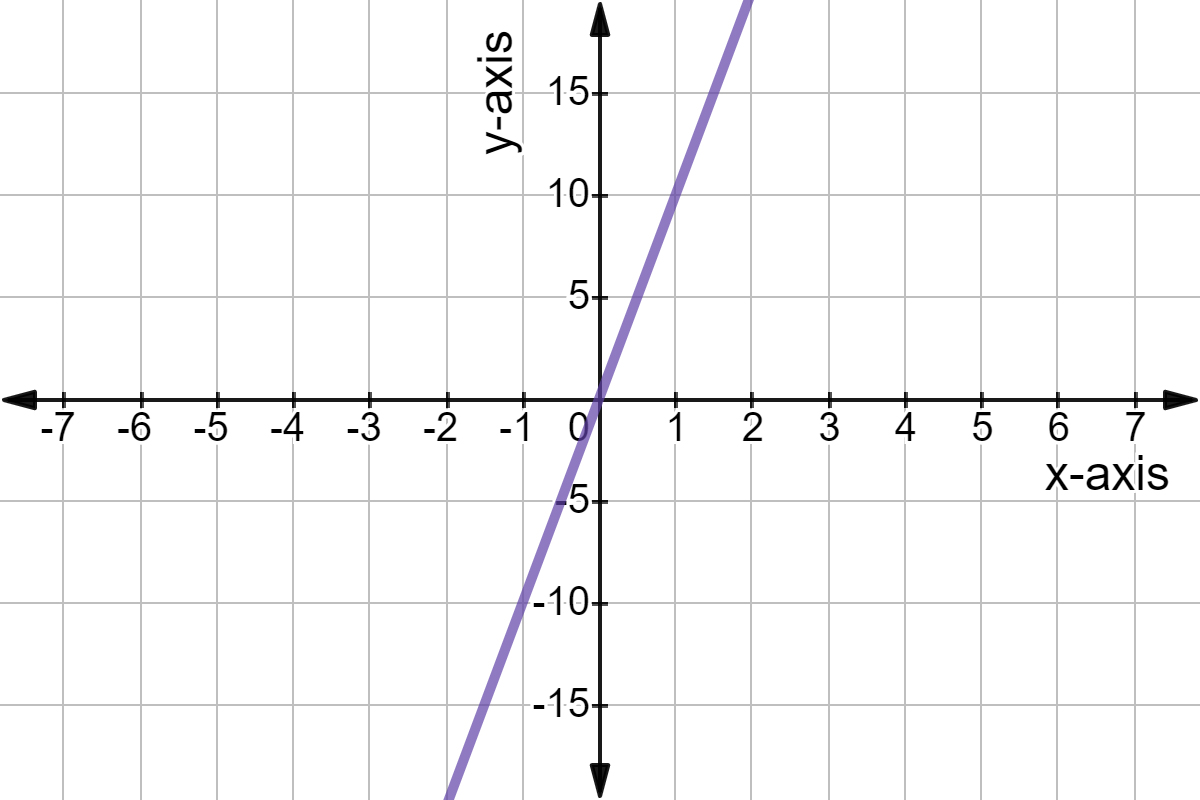
Made using Desmos
Practice Problem
A graph is given showing that the amount of money you make is directly proportional to the hours you worked.

Made using Desmos
How much do you make an hour?
Solution
We're told this graph is directly proportional so we know its equation is of the form:
Looking at the graph, we need to pick any coordinate and plug it in to solve for . One noticeable point is .
This is our answer! You make .
Another way we can think of solving this problem is that we are finding the slope from the graph.
We can also show this by plugging in and finding the amount you make for working : You make every hour.

