
Interactive · 1 question

+1 contributors

Inversely Proportional Graphs
Let's take a look at some directly proportional graphs when , , and .

Made using Desmos
These graphs are not linear. Instead they're hyperbolic. These graphs get infinitesimally close to the and axes, but they never touch them. If a graph gets close but never touches a line, we call that an asymptote. Inversely proportional equations will always have an asymptote at and .
Notice also that the and values of each point multiply to equal .
If we write the above equations out, we get:
Example
The following point is located on an inversely proportional graph.

Made using Desmos
Are you able to draw the rest of the graph?
Yes! We're told that the graph is inversely proportional so it has the form: We can rearrange this equation to find . So, can be found by multiplying the - and -coordinate.
We now know the equation of the graph. We can either use a graphing calculator, or plot points. Our graph will come out to be:

Made using Desmos
Practice Problem
Below is a portion of an inversely proportional graph.

Made using Desmos
Which of the following is also a point on the graph?
Solution
We're told the graph is inversely proportional, so we know its equation is of the form:
Recall that is the product of the - and -coordinate. Using the obvious point in the graph above, we see is:
The correct answer will be the coordinates whose product is also .
- This is the correct answer!
- This is not on our graph. Inversely proportional graphs never reach on any axis.
- This is not on our graph.
- This is not on our graph.
Plot of the answer choices along with a zoomed out version of the graph:
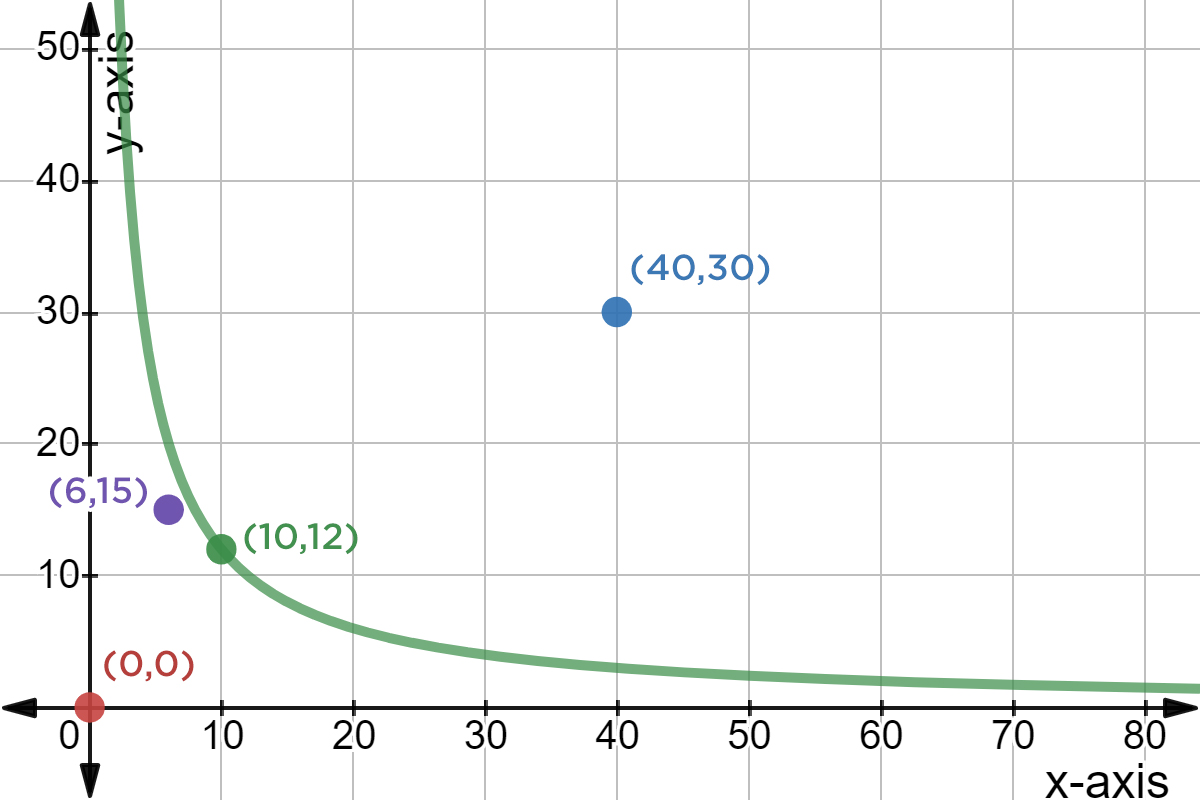
Made using Desmos
To review how to graph functions, check out this lesson. For more practice with continuous data and graphs, check out this lesson. For more practice with evaluation functions, check out this lesson.

