被2或更多未知数除

Before this, know多项式长除法

Illustrated · 1 min

Two or More

So we've learned how to use long division to divide polynomials but those were only with one variable. Now it's time for multiple variables. x2−y2x+y\frac{x^2-y^2}{x+y}

Worried seagull.

Image by MabelAmber via Pixabay (License)

Fortunately, it's not much different. But there is one thing we have to do.

Think about when we had to fill in zero coefficients for missing terms. x3+x−3⇒x3+0x2+x−3x^3+x-3\quad\Rightarrow\quad x^3+\color{purple}{0x^2}+x-3 Well, with multiple variables, we have to do the same thing but with combinations of the variables. Unfortunately, we won't really know what combinations are needed until we start the problem. So for now, just leave a blank space. x2−y2⇒x2+0000000−y2x^2-y^2\quad\Rightarrow\quad x^2+\phantom{0000000}-y^2

With the blank space in, our long division problem becomes: We go about solving this the same way as when there's only one variable. Starting with xx we ask what we need to multiply it by to get the first term in the dividend, x2x^2. The answer is xx, since x⋅x=x2x\cdot x=x^2.

Then, we multiply this quotient, xx, with our divisor, x+yx+y. This gives us: x2+xyx^2+xy.

When we come across a variable combination we don't have, we can add a zero coefficient in the dividend to make it more clear what to do. As you can see, we have an xyxy. Therefore, we can put a 0xy0xy in our dividend to help us with the subtraction easier.

Video

(Video) Dividing Multivariable Polynomials

by Krista King

In the video above, by the YouTube channel CalculusExpert.com it is explained how to divide polynomials that have multiple variables.

Summary\large{\text{Summary}}

She explains this with an example. x3−y3x−y\frac{x^3-y^3}{x-y}

To start, we set up our long division problem like before, but this time leave space between x3x^3 and −y3-y^3. You'll see why in just a bit.

So now we consider how many times xx goes into x3x^3." The answer is x2x^2-times. Then, multiply and subtract. And this is why we left space. To put in a placeholder 0x2y0x^2y.

Think about how many times xx goes into x2yx^2y." The answer is xyxy-times. And we have another blank space to fill in.

Finally, finish the problem off.

Divide x3+3x2y+3xy2+y3x+y.\frac{x^3 + 3x^2y + 3xy^2 + y^3}{x + y}.

Choose one answer

Illustrated · 1 min

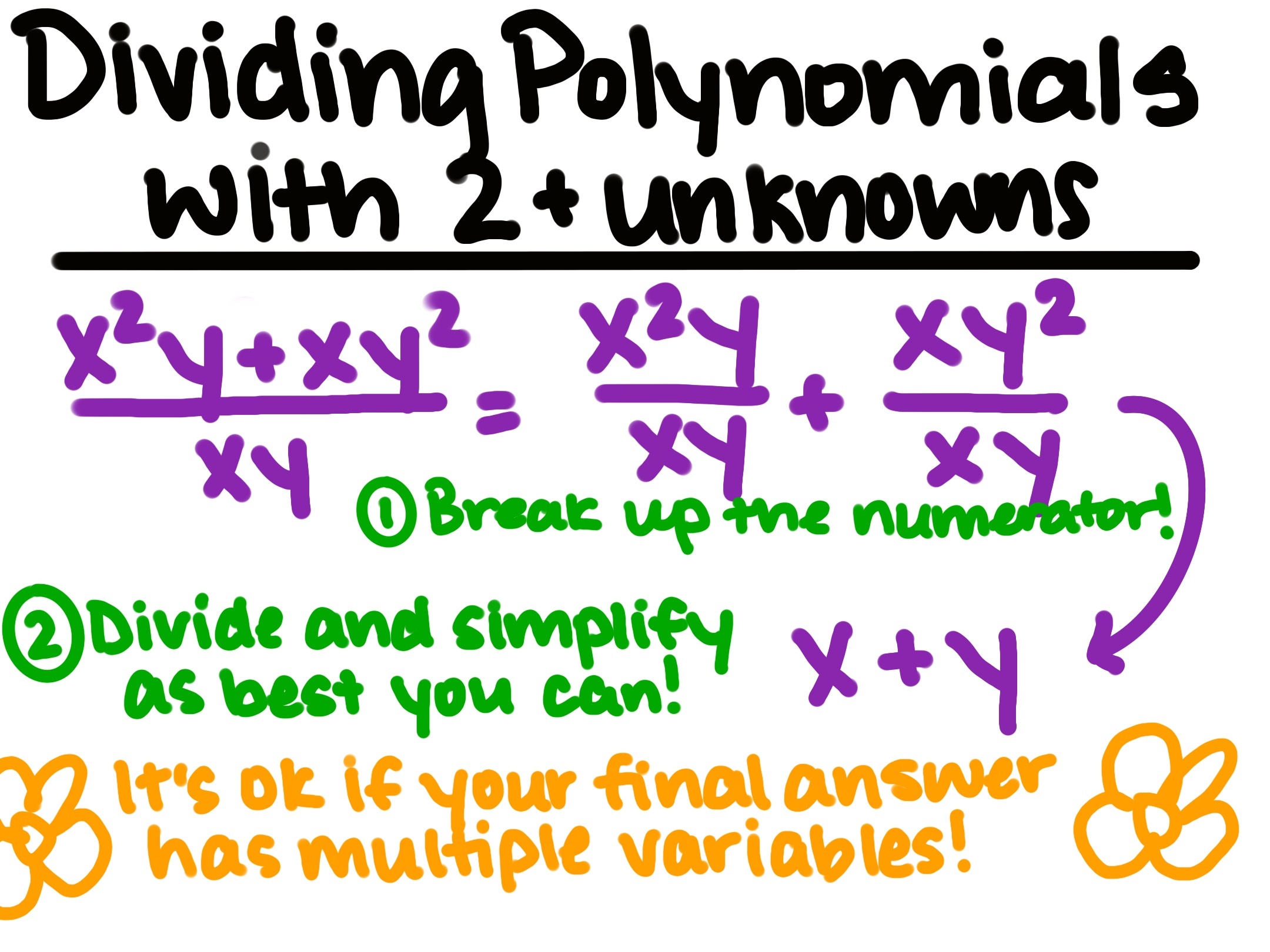
Dividing Polynomials with 2+ Variables

So far, we've learned polynomial division with just one variable. In this lesson, we're going to learn how to divide polynomials that have two or more variables, like xx and yy.

Dividing Polynomials with 2+ Unknowns
1) Break up the numerator
2) Divide and simplify as best you can
3) It's ok if your final answer has multiple variables

Image source: by Anusha Rahman

When you divide polynomials with more than one variable, you need to be extra careful when factoring and setting up your division. The variables can get confusing!

In the image above, we see a case where factoring wasn't needed, just careful dividing. But sometimes, you'll need to use long division, especially when the polynomials are more complicated. If you do long division with more than one variable, treat one variable like the main one. Think of the others as if they're just numbers. Make sure that every possible term is included - if one is missing, add a zero coefficient so you don't get confused. Most of the time, your final answer will include more than one variable, and your remainder might, too.

Type a concept, like “slope” or “photosynthesis”.

↑ ↓ to choose · Enter to openSearch explanations and problems