Interactive · 2 questions

+1 contributors


Polynomial long division isn't too different from integer long division. And like integer long division, it can be a pain. Therefore, it's best to use this new tool when you can't factor the polynomial.
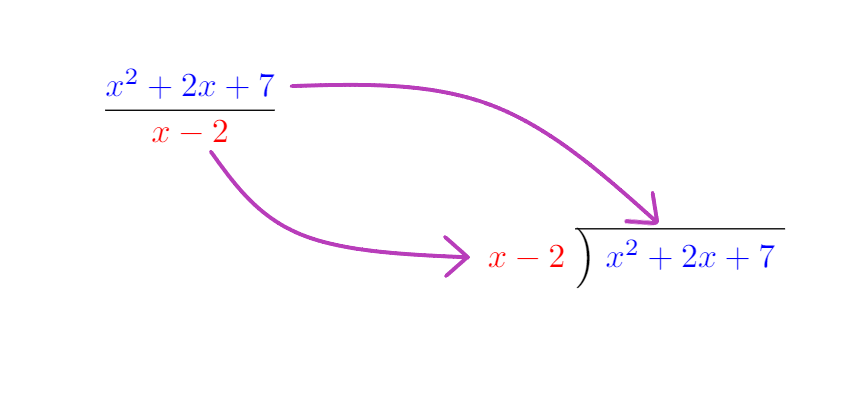
To start, we turn the rational expression into long division form.
Standard Practices
Before we start, there's two standard practices you should do. You can get by without them but they make the division problem easier and more structured. Make sure to apply these to the divisor and dividend if necessary.
- Put the polynomials in standard form.
- Add zero coefficients.
Standard form is when the highest exponent term comes first and lowest exponent term (usually the constant) comes last.
For example, is in standard form because the highest power, the in , comes first. Followed by the second highest power, , and the third highest power, the constant.
Is our numerator, , in standard form? If no, what is its standard form?
Our numerator isn't in standard form because the highest exponent term, isn't coming first. Similarly, the lowest exponent term, , should come last.
Next, we need to add in zero coefficients. This just means that if our polynomial is "missing" a term, we still write it out but with a as the coefficient.
For example, is "missing" its -term. So, we can write which is equivalent.
Is our numerator, , "missing" a term? If so, what term?
Starting at , we have all the terms except . Putting this in with a zero coefficient, our numerator becomes:
The Division Part of Long Division
Now that our polynomials are in standard form and have zero coefficients, we can begin the long division.
To start, want to only focus on the highest powered term in the divisor, , and the highest powered term in the dividend, . Then we ask:
What do I need to multiply by in order to get ?
Well, . So we place up top.
Next, we take this, multiply it through our divisor, , and subtract that from the dividend. Once we're finished, we drop down the next term.
We do these steps again with this new row.
What do I need to multiply by in order to get ?
The answer is . So we multiply this through the divisor and subtract.
Again, we do these steps again with this new row.
What do I need to multiply by in order to get ?
The answer is . So we multiply this through the divisor and subtract.
This is the last time, I promise.
What do I need to multiply by in order to get ?
The answer is . So we multiply this through the divisor and subtract.
So what do we do with this at the bottom? This is our remainder. We can write our answer as:
Or we can put the remainder in a fraction over the divisor and add that to our quotient.