线性近似总结

Illustrated · 1 min

What are linear approximations? They are basically ways to approximate certain values based on a function, using tangent lines and derivatives!

First, what is the equation of a tangent line to a function ff at the value aa? Well, since the slope of the line is f′(a)f'(a), and the line passes through (a,f(a))(a,f(a)), we can use the slope-intercept form of the line to get: y−f(a)=f′(a)(x−a)y=f(a)+f′(a)(x−a)\begin{align*} y - f(a) &= f'(a)(x - a) \\ y &= f(a) + f'(a)(x-a) \end{align*}

So the equation of our tangent line, which we'll call L(x)L(x), is L(x)=f(a)+f′(a)(x−a)L(x) = f(a) + f'(a)(x-a)

How is this useful? Well, let's say we wanted to approximate the value of 8.053\sqrt[3]{8.05} without a calculator (just using a lot of arithmetic). We'll use linear approximations to do this.

Rather than look at 8.053\sqrt[3]{8.05}, let's look at the function f(x)=x3f(x) = \sqrt[3]{x}, and the tangent line at x=8x=8:

What can we do to easily get the value of 8.053\sqrt[3]{8.05}? Well, from the graph, the value of this would be really close to the value of L(x)L(x) evaluated at 8.058.05.

By our above equation of the line, we get that L(x)=112x+43L(x) = \frac{1}{12}x + \frac{4}{3}. Substituting, we get that L(8.05)=2.00416667L(8.05) = 2.00416667.

Well, guess what? It turns out that 8.053=2.00415802\sqrt[3]{8.05} = 2.00415802, so this is a really good approximation!

However, when larger values of xx are chosen, the approximation becomes worse. Therefore, it is advisable, when doing this, to choose a suitable place to make a linear approximation.

So to approximate a certain value, we can generalize the value with a function, then find a linear approximation that's close to our desired value, and evaluate L(x)L(x) at that value, giving a good approximation.
Interactive · 8 questions

Now that you have some intuition on what a derivative is, how one finds it, and what it means, we're going to look at one practical use of the concept: using derivatives for approximation of functions.

Given some function f(x)f(x), we're going to investigate what it does near x=ax=a.

To start, what do differentiable functions look like locally?

Choose one answer

Video · + 2 min read

(Videos) Tangent Line Approximation

by PatrickJMT

Here's a video by patrickJMT where he shows you how to take a linear approximation at a point.

Linearization is when we take a find a tangent line near a point to estimate another point's value.

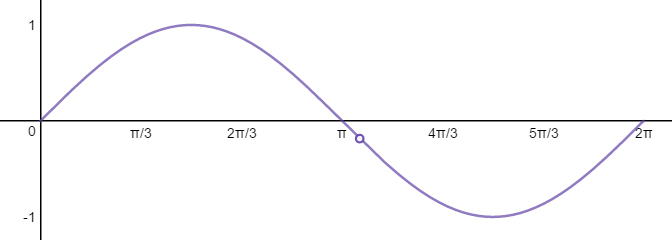
The first problem he looks at is finding the value of sin⁡(18π17)\sin(\frac{18\pi}{17}). Before we begin though, let's look at a graph in order to conceptualize what we're actually doing.

Here, we have our graph of sin⁡(x)\sin(x). The open circle is the xx point 18π17\frac{18\pi}{17}. That's the value we want to find when it's put into the sine function. What we want to do is select a point on the sine graph that we "easily" know the value of.

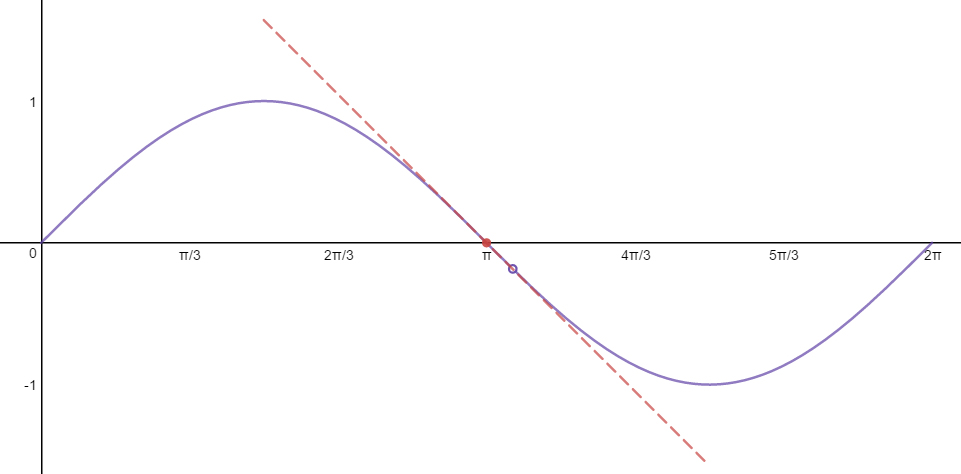
Here, we selected the point (π,0)(\pi,0), the red dot, because we easily know that sin⁡(π)=0\sin(\pi)=0.

So we draw our tangent line at the known point and we use it to plug in our unknown point. From this diagram it seems that the tangent line and the unknown point overlap.

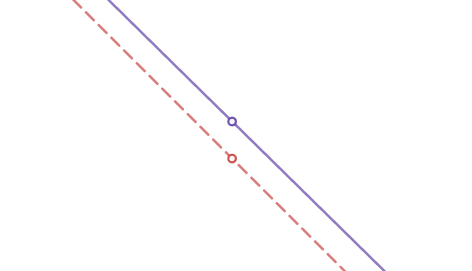
Here's what they look like zoomed in. I added where the point would be on the tangent line too. Notice that they're very close together. This means when we find the value we know it will be a close approximation of the point on the curve.

Let's look at how we solve this algebraically.

  1. Find the equation of the tangent line at our known point: (π,0)(\pi,0)
  2. Plug in the xx point of the unknown point to approximate the true value: x=18π17x=\frac{18\pi}{17}

So let's begin with the equation of our tangent line at (π,0)(\pi,0)! y−y0=m(x−x0)y−(0)=m(x−(π))y=m(x−π)\begin{align} y-y_0&=m(x-x_0)\\ y-\color{red}{(0)}&=m(x-\color{red}{(\pi)})\\ y&=m(x-\pi) \end{align}

To find mm we take the derivative of our function, f(x)=sin⁡xf(x)=\sin x, and evaluate it at our point, x=πx=\pi. f(x)=sin⁡xf′(x)=cos⁡xf′(π)=cos⁡πm=−1\begin{align} f(x)&=\sin x\\ f'(x)&=\cos x\\ f'(\pi)&=\cos \pi\\ m&=-1 \end{align}

Plug this back into our tangent line equation. y=m(x−π)y=(−1)(x−π)y=π−x\begin{align} y&=m(x-\pi)\\ y&=\color{red}{(-1)}(x-\pi)\\ y&=\pi-x \end{align}

Finally, we plug in the xx value of our unknown point to find its value. y=π−xy=π−18π17y=−π17\begin{align} y&=\pi-x\\ y&=\pi-\color{red}{\frac{18\pi}{17}}\\ y&=-\frac{\pi}{17} \end{align}

So we can say: sin⁡(18π17)≈−π17\boxed{\sin \bigg(\frac{18\pi}{17}\bigg)\approx-\frac{\pi}{17}}

If we plug these two numbers into a calculator we can see just how accurate an approximation it was. sin⁡(18π17)=−0.18375−π17=−0.18480\begin{align} \sin \bigg(\frac{18\pi}{17}\bigg)=-0.18375\\ -\frac{\pi}{17}=-0.18480 \end{align}

Here's another video in which Patrick looks at another linearization problem. This one dealing with square roots.

He looks to find the value of 15.9\sqrt{15.9}.

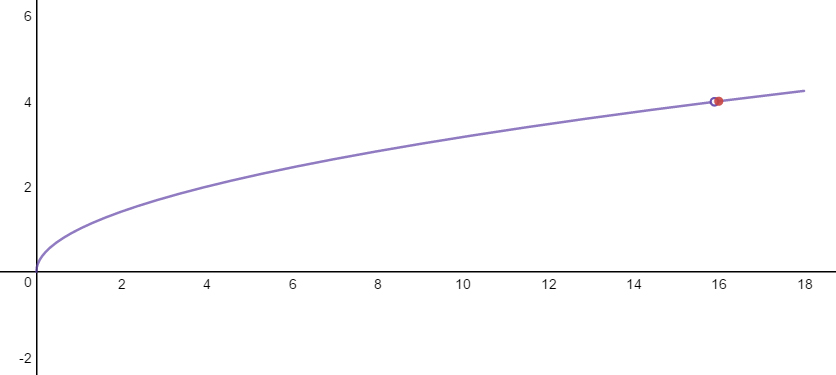
Graphically, we can see the point is very close to a known point (16,4)(16,4). Again our go is to find the tangent line at this point and use it to approximate the value of our unknown point.

So let's begin by finding the equation of the tangent line at (16,4)(16,4). y−y0=m(x−x0)y−4=m(x−16)\begin{align} y-y_0&=m(x-x_0)\\ y-4&=m(x-16) \end{align}

To find mm we take the derivative of our function and evaluate it at our known point. f(x)=xf′(x)=12xf′(16)=1216f′(16)=18\begin{align} f(x)&=\sqrt x\\ f'(x)&=\frac{1}{2\sqrt x}\\ f'(16)&=\frac{1}{2\sqrt{16}}\\ f'(16)&=\frac{1}{8} \end{align}

Now we plug this back into our tangent line equation. y−4=m(x−16)y−4=18(x−16)y−4=x8−2y=x8+2\begin{align} y-4&=m(x-16)\\ y-4&=\frac{1}{8}(x-16)\\ y-4&=\frac x8-2\\ y&=\frac x8+2 \end{align}

Finally, we plug in our unknown point to find its approximation. y=x8+2y=15.98+2y=15.98+168y=31.98\begin{align} y&=\frac x8+2\\ y&=\frac{15.9}{8}+2\\ y&=\frac{15.9}{8}+{16}{8}\\ y&=\frac{31.9}{8} \end{align}

So we can say: 15.9≈31.98\boxed{\sqrt{15.9}\approx\frac{31.9}{8}}

If we plug these two numbers into a calculator we can see just how accurate an approximation it was. 15.9=3.9874831.98=3.98750\begin{align} \sqrt{15.9}=3.98748\\ \frac{31.9}{8}=3.98750 \end{align}

Type a concept, like “slope” or “photosynthesis”.

↑ ↓ to choose · Enter to openSearch explanations and problems