每个函数都是偶数元素和奇数元素的总和

Before this, knowProving Functions are Even or Odd Algebraically

Read · 1 min

Some functions are even and some are odd, but most functions are not fortunate to have one or both of these properties. However, we can decompose a function into an "even part" and an "odd part." Consider a function f:R→Rf: \mathbb{R} \rightarrow \mathbb{R}, and we will write it as the sum of an even function and an odd function. Define

g(x):=f(x)+f(−x)2g(x) := \frac{f(x) + f(-x)}{2} h(x):=f(x)−f(−x)2,h(x) := \frac{f(x) - f(-x)}{2},

and we must show two things. The first is to show that f(x)=g(x)+h(x)f(x) = g(x) + h(x). The second is to show that g(x)g(x) is an even function and h(x)h(x) is an odd function. Showing f(x)=g(x)+h(x)f(x) = g(x) + h(x) is easy:

g(x)+h(x)=f(x)+f(−x)2+f(x)−f(−x)2=f(x)+f(−x)+f(x)−f(−x)2=2f(x)2=f(x).\begin{align} g(x) + h(x) &= \frac{f(x) + f(-x)}{2} + \frac{f(x) - f(-x)}{2} \\ &= \frac{f(x) + f(-x) + f(x) - f(-x)}{2} \\ &= \frac{2f(x)}{2} \\ &= f(x). \end{align}

On the other hand, showing that g(x)g(x) is even and h(x)h(x) is odd are more involved. Recall to show that gg is even, we must show that g(x)=g(−x)g(x) = g(-x) for each real number xx. This requires using the definition of gg:

g(x)=f(x)+f(−x)2=f(−(−x))+f(−(x))2=f(−(x))+f(−(−x))2=g(−x)\begin{align} g(x) &= \frac{f(x) + f(-x)}{2} \\ &= \frac{f(-(-x)) + f(-(x))}{2} \\ &= \frac{f(-(x)) + f(-(-x))}{2} \\ &= g(-x) \end{align}

In a similar vein, showing that h(x)h(x) is odd is basically the same procedure, except the negative signs pop up in different places.

h(x)=f(x)−f(−x)2=−f(−x)−f(x)2=−f(−x)−f(−(−x))2=−h(−x)\begin{align} h(x) &= \frac{f(x) - f(-x)}{2} \\ &= -\frac{f(-x) - f(x)}{2} \\ &= -\frac{f(-x) - f(-(-x))}{2} \\ &= -h(-x) \end{align}

In summary, we have shown that every real function ff can be written as the sum of an even function and an odd function.

Looking Further

This concept seems a little out of place right now, but it will come in handy in the future. For example, you will encounter odd functions when learning about the Fourier series. The Fourier transform of an even part of a function is even, while the Fourier transform of an odd part of a function is imaginary. Don't worry - you will learn more about this later!

When you learn more about real and imaginary spaces, you will also learn about how even and odd functions interact with vector spaces.

Video

Any Function Can be Expressed as a Sum of Even and Odd Functions

by Route66 Math

In this video by Route66 Math, you will learn how every function is really a sum of an even and an odd component.

Illustrated · 1 min

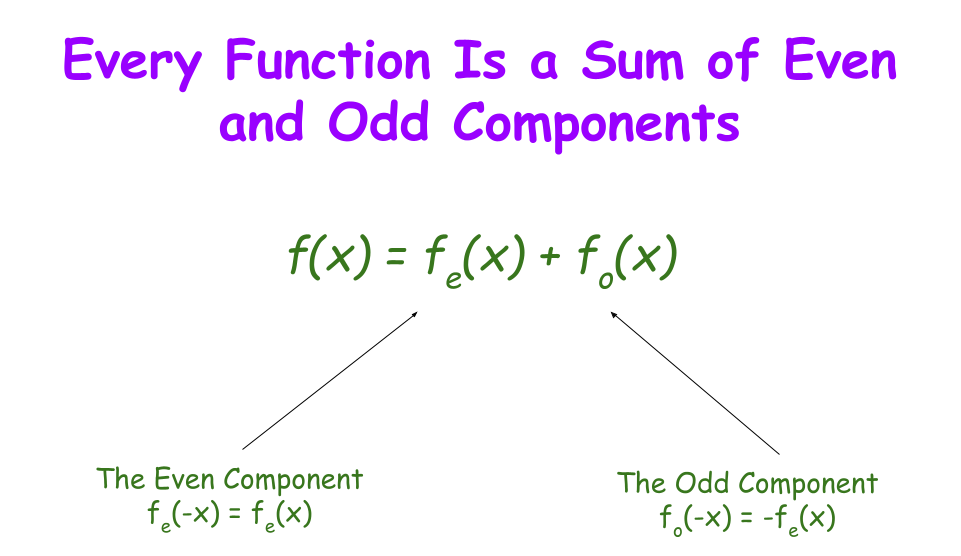
Every Function is a Sum of Even and Odd Components

Given any function, you can decompose the function into its even and odd components.

Every function is a sum of even and odd components
f(x) = fe(x) + fo(x)

Image source: by Anusha Rahman

Every function can be split into two parts: an even component and an odd component. The even part is symmetric, meaning it looks the same on both sides of the y-axis. The odd part has rotational symmetry, flipping upside down when you rotate it 180/circ180 ^{/circ} around the origin.

To decompose a function into these parts, you find the even part by averaging the function and its mirror image. You find the odd part by subtracting the even part from the original function.

Mathematically, if f(x)f(x) is a function, the even component is f(x)+f(−x)2\frac{f(x)+f(-x)}{2}, and the odd component is f(x)−f(−x)2\frac{f(x)-f(-x)}{2}. Once you know these two parts, you can add them back together to get the original function. This decomposition shows how any function can be understood as a combination of symmetry (even) and asymmetry (odd).

Type a concept, like “slope” or “photosynthesis”.

↑ ↓ to choose · Enter to openSearch explanations and problems

