Illustrated · 1 min

+3 contributors



Grouping Cubics
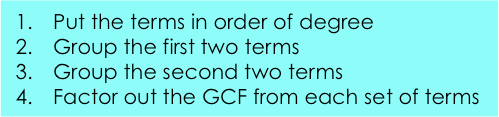
We can break a polynomial into smaller groups with a common factor. This method is especially helpful when factoring cubic functions. This is called factoring by grouping. Rearranging the terms in descending exponent order helps. Here's an example: Let's say you need to factor
First, let's rearrange the terms.

Image source: by Joshua Siktar
We can see the decreasing exponent order, where the cubic term is first, and the constant term is last. You'll see why the order is important in this next step.
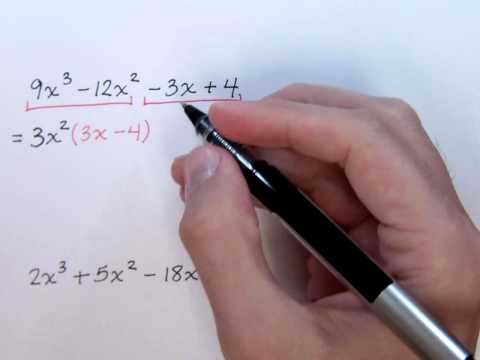
We can factor this expression by literally boxing terms into groups, as seen below:

Image source: by Joshua Siktar
We use these groups because each group has a common factor. The first two terms have a common factor of . The last two terms have a common factor of . Let's factor out each term.

Image source: by Joshua Siktar
Each group has a common factor of . We can add these groups back together to get:

Image source: By Caroline Kulczycky
As you can see, we looked for the greatest common factor, GCF, between the first two terms and the last two terms. Then, we essentially factored out the . You can use this pattern for nearly all polynomials.
Once you master these fundamentals, you will apply these concepts to more complex topics, like sums and differences of cubes.