分解分数

Before this, know假分数

Interactive · 1 question

Fraction Decomposition

We know that fractions show parts of a whole, but they can be broken down further. For instance, the fraction 56\frac56 means we have 55 parts out of a whole 66 parts. These parts can be separated into even smaller parts!

56=16+16+16+16+16\frac56 = \frac16 +\frac16 +\frac16 +\frac16 +\frac16

The fraction 56\frac56 has been broken down into 55 pieces of 16\frac16 each. When we add these parts of 16\frac16 together, we get the full fraction 56\frac56. These parts don't need to be equally sized. Let's look at some other decompositions of 56\frac56.

56=26+26+1656=36+2656=46+1656=16+16+16+26\begin{align}\frac56&=\frac26+\frac26+\frac16\\ \frac56&=\frac36+\frac26\\ \frac56&=\frac46+\frac16\\ \frac56&=\frac16+\frac16+\frac16+\frac26 \end{align}

Let's try a practice problem to check our understanding.

Which of the following are decompositions of 79\frac79? Select all correct answers.

Choose all correct answers

Interactive · 4 questions

Decomposing fractions means breaking fractions into individual pieces that can be added together. In the case of a pizza, it would mean looking at individual slices (or groups of individual slices) and adding them together to see how many there are total.

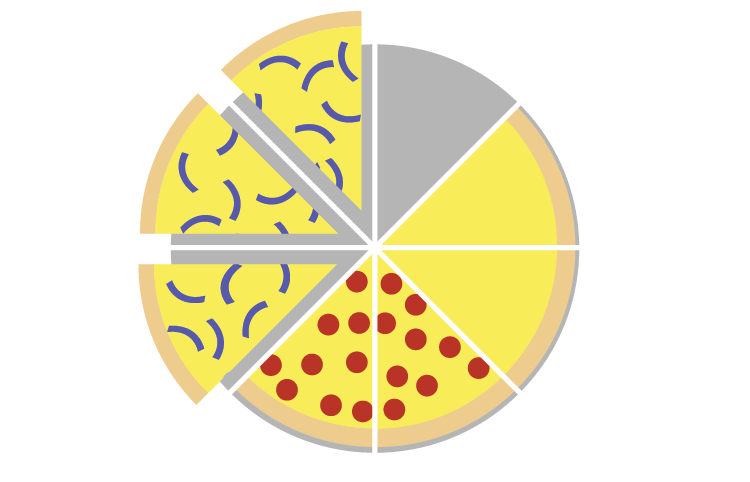
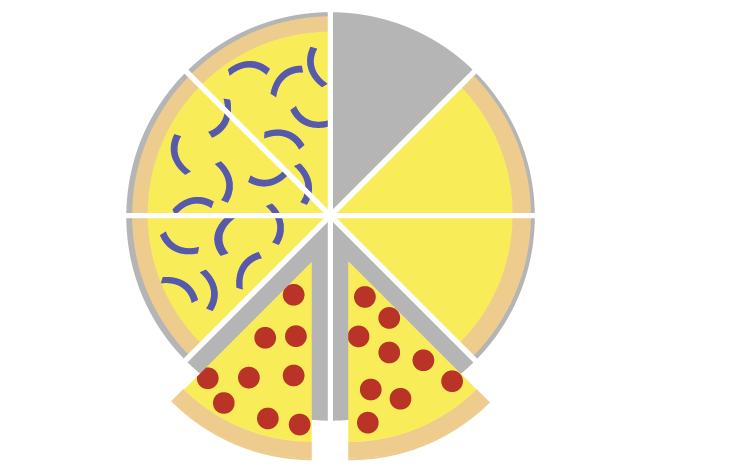
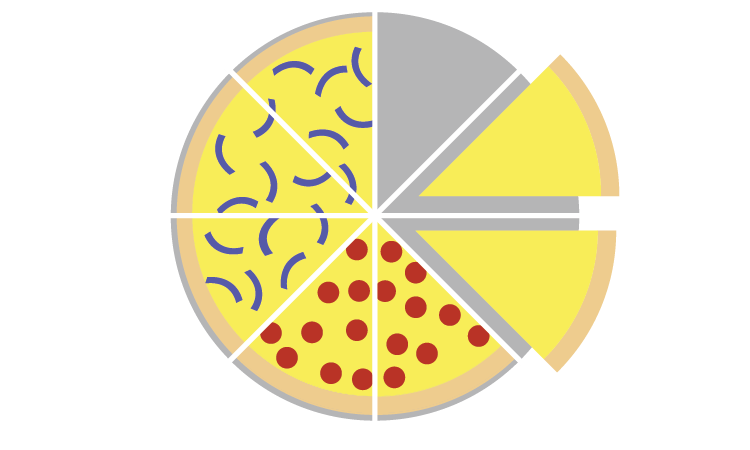
For example, if we have 77 slices of pizza, and we know that each slice is 18\frac{1}{8} of the whole thing, we'd have 78\frac{7}{8} of a pie.

7/8 of a pizza. 2 slices are cheese, 2 are pepperoni, and 3 and are onion.

78\frac{7}{8} of this pizza is left.

But what if we want to describe how many slices have different toppings on them? Then, we have to break up that 78\frac{7}{8} into smaller pieces. Maybe our toppings are onion and pepperoni. Then we want to know how many slices have onion, how many have pepperoni, and how many are plain. Technically a slice can have onion and pepperoni. For now, though, we'll assume that doesn't happen.

For some of these questions we may get a fraction that can reduce. However, it's not always advantageous to write fractions in simplest form. For instance, two of the slices in our pizza have pepperoni on them. That means 28\frac{2}{8} of the pizza has pepperoni. This fraction can be reduced to 14\frac{1}{4}.

The problem is, if we change the denominator, we forget how many slices there were to begin with. The denominator represents the number of parts.

How much of the pizza above has onion (purple) on it? Express your answer as a fraction where the denominator is 88.

Choose one answer

Video

(Video) Decomposing Fractions

by Math Antics

Math Antics has a helpful video that explains how to decompose fractions into parts.

Summary\large{\text{Summary}}

You can think of decomposing as breaking down a whole into parts. Since, the word fractions follows, it probably won't be a shock to know that we'll be doing this to fractions.

A unit fraction is a fraction that has 11 in its numerator.

When decomposing a fraction, we want to break it down into its unit fractions. For example, if we want to decompose the fraction 46\frac46 we would do the following: 46=16+16+16+16\frac46=\frac16+\frac16+\frac16+\frac16

Try it Yourself

Decompose the fraction 23\frac23.

Choose one answer

Type a concept, like “slope” or “photosynthesis”.

↑ ↓ to choose · Enter to openSearch explanations and problems