分数 <--> 小数

Interactive · 2 questions

Convert a Fraction to a Decimal

To convert a fraction to a decimal, divide the numerator by the denominator using long division. For example, let's convert 325\frac{3}{25} to a decimal: As we can see, 325=0.12.\frac{3}{25} = 0.12.

Convert a Decimal to a Fraction

To convert a decimal to a fraction, place the decimal above the number 11. Then multiply the top and bottom by 1010 the same number of times, until the numerator is a whole number. How many times do you have to do this? It depends how many digits are after the decimal point of the original numerator. In this example, 0.380.38 has two digits after the decimal point. This lets us find the numerator and denominator. Best of all, we haven't changed the value of anything!

Then, just simplify the fraction, if it's necessary! As an example, let's convert 0.380.38 into a fraction: 0.38=0.381=0.38×1001×100=38100=1950\begin{align} 0.38 &= \dfrac{0.38}{1}\\ &=\dfrac{0.38 \times 100}{1\times 100}\\ &=\dfrac{38}{100}\\ &=\dfrac{19}{50} \end{align}

The last step is where we reduced the fraction. We could reduce it because 3838 and 100100 share a factor of 22. There are no other factors to cancel though. This is because 22 is the greatest common factor of 3838 and 100100.

So, 0.38=19500.38 = \frac{19}{50}. We found a technique that converts a decimal number to a fraction!

Be careful, however. Some decimals that go on forever without a pattern can't be written as a fraction. These are called the irrational numbers. Otherwise the number is called rational.
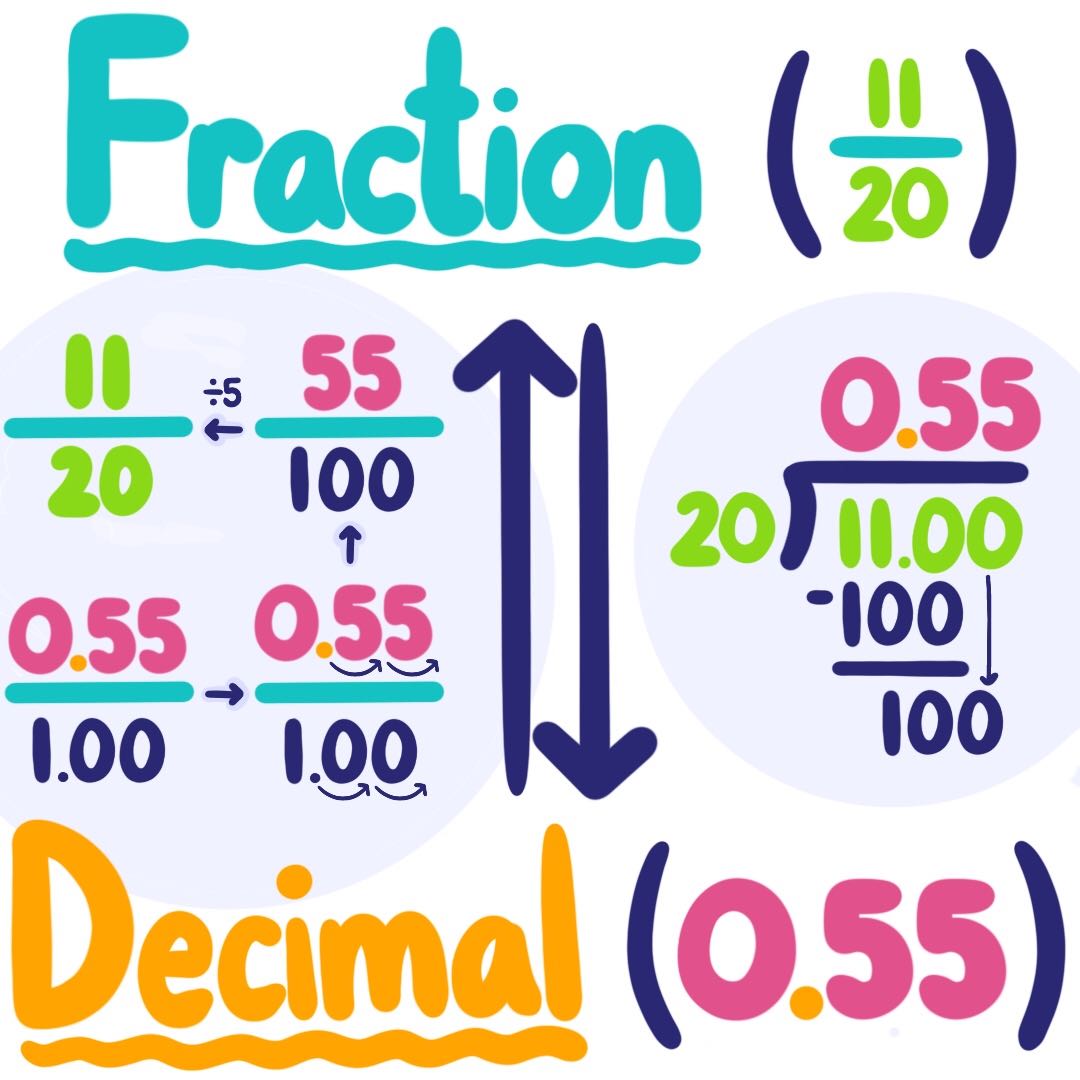
To convert a fraction to a decimal, divide the numerator by the denominator using long division. To convert from 11/20 to 0.55, divide 11 by 20 to get 0.55. To convert a decimal to a fraction, place the decimal above 1. Then multiply the numerator and denominator by 10 the same number of times, until the numerator is a whole number. Then, just simplify if necessary! To convert from 0.55 to 11/20, place 0.55 over one. Then multiply the numerator and denominator by 100 until you get 55/100. Finally, simplify 55/100 to 11/20.

Image by Caroline Kulczycky

We can also convert a repeating decimal to a fraction.

Let's do a couple more examples!

Convert 750\frac{7}{50} to a decimal.

Choose one answer

Check what you really know

If you can solve a contest problem with this idea, you know it well. If not, you know exactly what to review. These are real problems from the AMC 8, AMC 10, AMC 12 and AIME, the national math competitions for middle and high school students, each with a worked solution on LIVE by Po-Shen Loh.

Video · + 1 min read

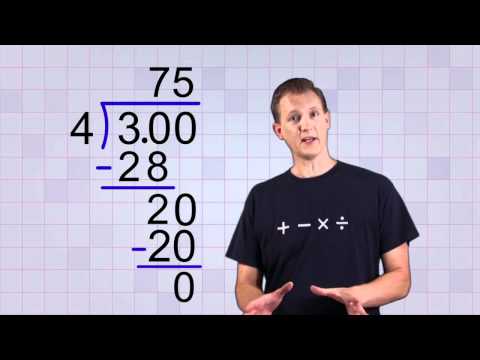
(Video) Convert any Fraction to a Decimal

by Math Antics

Here's a video by mathantics that explains how to convert any fraction into an equivalent decimal. There will only be one way to do this. However, we can't always turn a decimal into a fraction, perhaps if the number is irrational.

Summary\large{\text{Summary}}

Fractions are another way to write out division. We can convert a fraction to a decimal by dividing the numerator by the denominator. Sometimes we can do this by hand, often by first writing the fraction in simplest form. Other times we need a calculator.

Suppose we want to convert the fraction 12\frac12 into a decimal. Start by turning it into a division problem where the numerator is divided by the denominator. But wait, 22 doesn't go into 11. This means, we need to break out a decimal point. Begin by turning 11 into 1.01.0 (we're not changing the value of anything). We know that 22 goes into 1010 a total of 55 times. In other words, 1010 is the fifth positive multiple of 22. Thus, we can solve this division problem.

Test Yourself: Covert 419\frac{4}{19} into a decimal. Round your answer to the nearest hundredth.

Choose one answer

Interactive · 1 question

Fraction to Decimal

To convert a fraction to a decimal just divide the numerator by the denominator.

That's pretty much it. It can be a pain and division sucks, but there's really only one step. Sometimes that one step is long division, though.

Let's say we want to know the decimal equivalent of the fraction 1384\frac{13}{84}. To start, we divide 1313 by 8484. This is one of those problems we do using long division. It's too complicated to do in your head.

As you can see this continues on, seemingly forever. In fact, it does go on forever, so just stop when you see a pattern. It will actually come out to be 0.15476190‾0.15\overline{476190}. As a decimal though, we can get a clearer picture as to how big it really is. It is more difficult to compare fractions when the denominators are different. Even if the denominators are the same it is worthwhile to convert to a decimal. In some cases we can also convert to a percent.

Try it Yourself!

Which fraction is bigger: 1433\frac{14}{33} or 3073\frac{30}{73}?

Choose one answer

Type a concept, like “slope” or “photosynthesis”.

↑ ↓ to choose · Enter to openSearch explanations and problems