Here's a video by mathantics that explains how to convert percentages to fractions.
Summary
A percent is just an equivalent fraction that tells you how many you would have IF it was out of 100.
For example, 21 is an equivalent fraction of 10050. Since 100 is in the denominator, we know this is 50%. In other words, 50% of something is the same as half of that thing.
To turn a fraction into a percent, just multiply it by 100. To turn a percent into a fraction, just divide the percent by 100. Be sure to remove the percent sign at the end!
In the above example, the fraction we started with was a proper fraction because it was between 0 and 1. If the fraction is proper, then the percent will be between 0% and 100%. If the fraction we start with is a mixed number or an improper fraction, we use the same technique. However, the percentage will be greater than 100. Let's demonstrate by turning 811 into a percentage.
To convert a fraction to a percent, multiply the fraction by 100 and simplify.
To convert a percent to a fraction, divide the percent by 100 and reduce the fraction.
The diagram below might be referred to as a fractions calculator or a percentage calculator. But, both of those names are a bit misleading. Calling it a fraction calculator is confusing because that name doesn't suggest what we're turning fractions into. The name "percentage calculator" has the same issue. Thus it is more clear to call this a conversion between fractions and percentages.
Image by Caroline Kulczycky
Convert 53 to a percent.
To convert 53 to a percent, all we have to do is multiply the fraction by 100 and simplify.
53⋅100=53⋅100=5300=60
So, 53 in the form of a percent is 60%.
Convert 94% to a fraction.
To convert 94% to a fraction, all we have to do is divide 94 by 100 and simplify.
10094=5047
So 94% in the form of a fraction is 5047.
This video by tecmath explains how to convert fractions to percentages.
Summary
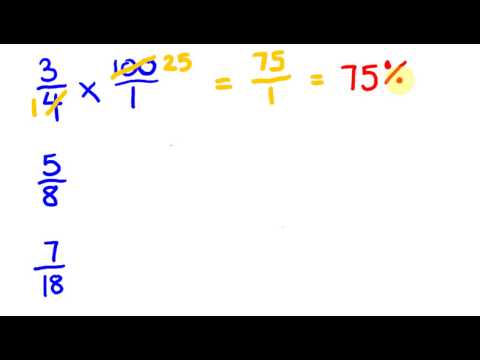
One way to turn a fraction into a percent is to multiply the fraction by 100. For example, let's convert 43 into a percent.
43×100=43×1100=13×125=75
Attach a percent sign and you're good to go.
75%
Another way is to first do the division that the fraction represents. Then, move the decimal place to the right by 2. Suppose we wanted to convert 85 into a percent.
Move the decimal in 0.625 to the right two places. This is the same as multiplying by 100.
0.625→6.25→62.5
In each movement, the digits do not change their order; only the decimal point moves.
The key idea is that percents are always fractions with one hundred in the denominator. The x% means 100x. As a result, we often want to convert between fractions and percents.
So the plan is to convert the fraction's denominator into 100 by multiplying the numerator and denominator by the same number. That number is chosen to turn the denominator into 100.
Let's try this with 54:
54×2020=10080=80%
In summary, we took the top number (4) and the bottom number (5) and multiplied them both by 20. We chose 20 because 5×20=100.
Additional Example: Fraction to Percent
In some cases we will be able to reduce the fraction first, before converting to a percent. If we're able to reduce first, that makes converting to a percent easier afterwards.
For example, we can use this technique on the fraction 129. The numerator and denominator have a common factor of 3, so
129=3×43×3=3×43×3=43
Now, we can multiply the numerator and denominator by 25. This turns the denominator into 100, from which we get a percent:
43×2525=10075=75%
Using Proportions
If we can't figure out what number to multiply the numerator and denominator by, there's a trick for that. We know we want the denominator to be 100, but don't know about the numerator. To find it, we set up a proportion:
43=100x
The value of x is the numerator we want to get. Multiply both sides of this equation by 100:
43×10075=100x×100=x
Finally, we can turn this into a percentage, just like before:
10075=75%
Luckily, we get the same numerator we did before. We did the same problem in two different ways, so we should get the same answer.
Converting Percents to Fractions
This appears to be even easier. Just put the percent on top of 100, and remove the percent sign.
37%=10037
However, you might end up with a situation where the fraction is not reduced in some way. In that case, act like it's a normal fraction problem and reduce it. Find the common factor between the numerator and denominator. Then cancel out that factor.