有理函数:求水平渐近线

Before this, know有理函数:什么是渐近线以及如何求渐近线?

Interactive · 1 question

As we know, a rational function r(x)r(x) is the quotient of two polynomial functions. A horizontal asymptote of a function is a horizontal line that a functions approaches, but never touches. Basically, the function reaches that value at ±∞\pm \infty. This problem is then reduced to finding lim⁡x→±∞r(x)\lim_{x \to \pm\infty} r(x), which can be done like this. If the limit is not ±∞\pm\infty, then the function has a horizontal asymptote at that value.

As an example, find all cc such that the equation y=cy = c is a horizontal asymptote of the function r(x)=10x2−4x+32x2+4x−1r(x) = \frac{10x^2-4x+3}{2x^2+4x-1}.

Choose one answer

Video

(Video) How to Find the Horizontal Asymptote (NancyPi)

by NancyPi

Luckily for us, Nancy has 3 great rules to help us find the horizontal asymptote. These rules are a way for us to avoid using limits, as those can be harder. Instead, you must examine the degree of the polynomial.

Rule #1: If the top degree is less than the bottom degree.

Nancy's example: x+1x2−1\frac{x+1}{x^2-1}

Since the degree on top is smaller, the horizontal asymptote is y=0y=0.

Rule #2: If the top degree equals the bottom degree.

Nancy's example: x2+13x2+1\frac{x^2+1}{3x^2+1}

Since the degrees on the top and bottom are equal, divide the highest degree terms in the numerator and denominator.

x23x2=13\frac{x^2}{3x^2} = \frac{1}{3}

So the horizontal asymptote is y=13y=\frac{1}{3}

Rule #3: If the top degree is greater than the bottom degree.

Nancy's example: x2+1x−3\frac{x^2+1}{x-3}

There is actually no horizontal asymptote. There is an oblique asymptote, but you will learn about that later. For now, just remember that there is no horizontal asymptote.


Illustrated · 1 min

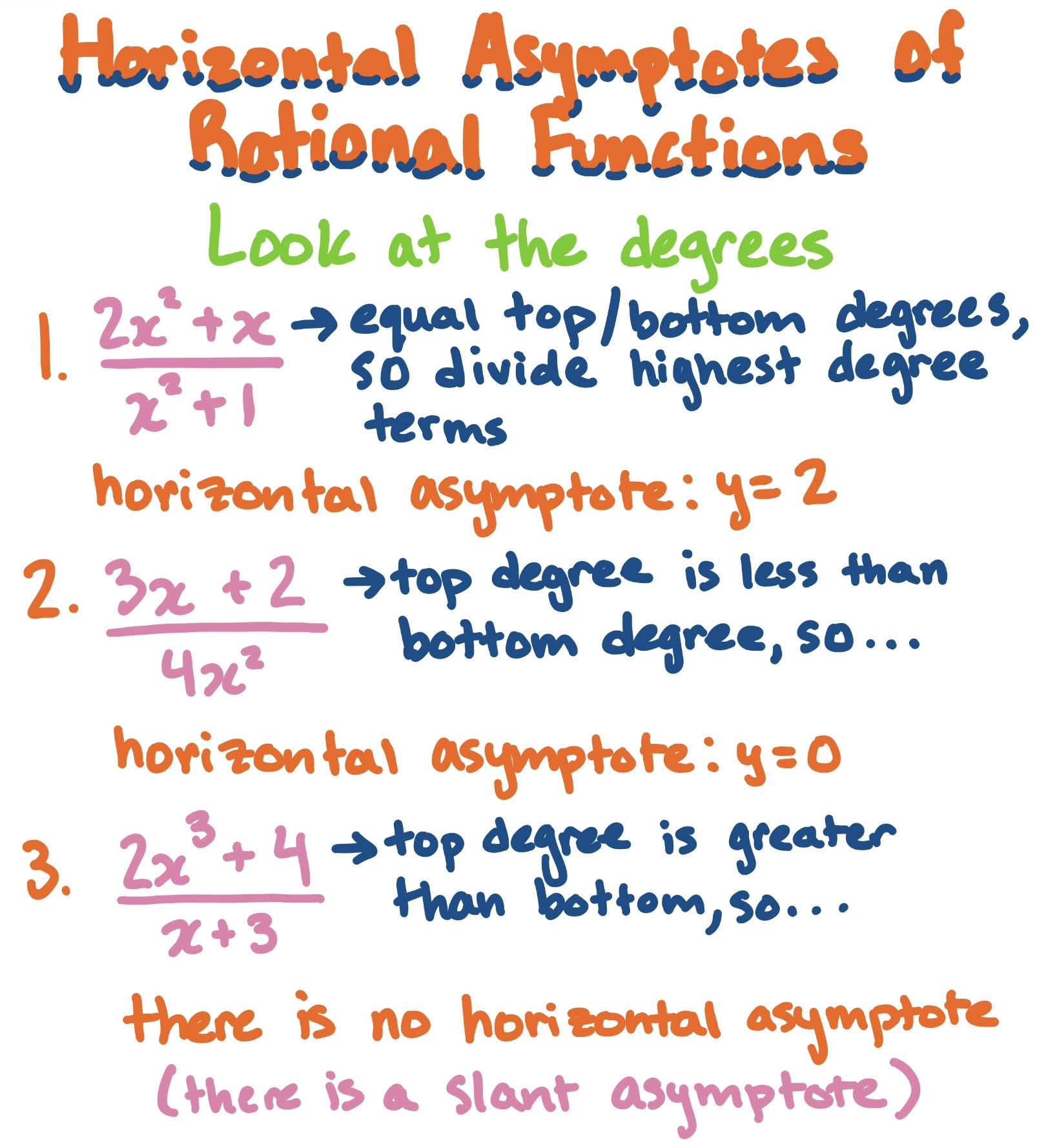
Horizontal Asymptotes of Rational Functions

Now that we've covered vertical asymptotes, we can move on to the next type.

In this lesson, we are going to learn about horizontal asymptotes. A horizontal asymptote is an invisible flat, straight line that a graph gets close to, but never actually touches.

Horizontal Asymptotes of Rational Functions

Look at the degrees
1. fraction{2x^2+x}/{x^2+1}$ --> equal top/bottom degrees, so divide highest degree terms
horizontal asymptote: y=2

2. fraction{3x+2}/{4x^2}$ --> top degree is less than bottom degree, so...
horizontal asymptote: y=0

3. fraction{2x^3+4}/{x+3}$ --> top degree is greater than bottom, so...
there is no horizontal asymptote
(there is a slant asymptote)

Image source: by Trisha

We usually see horizontal asymptotes in rational functions, which are functions with polynomials on the top and bottom. A rational function might look like this: f(x)=1xf(x)=\frac1x. As xx gets really big, the value of 1x\frac1x gets really small. It gets super close to 00, but never actually becomes 00. That means the horizontal asymptote is y=0y=0.

To find horizontal asymptotes, we look at the highest powers of xx in the top and bottom of the fraction. If the top power is smaller than the bottom, the asymptote is y=0y=0. If the top and bottom powers are the same, divide the leading coefficients.

For example, if we have: f(x)=2x3+3x2+1f(x) = \frac{2x^3+3}{x^2+1}

Then the asymptote is y=2y=2 because 22 and 11 are the leading coefficients.

Horizontal asymptotes show us what happens far to the left or right of the graph. They help us to understand how functions behave as numbers get really big or really small.

Read · 1 min

Rational Functions: Horiztonal Asymptotes

A rational function is a fraction where both the numerator and denominator are polynomials. When you graph a rational function, the curve often gets closer to a line as xx becomes very large or very small. This line is called a horizontal asymptote.

A horizontal asymptote shows the value that the function approaches as x→∞x \rightarrow \infty or x→−∞x \rightarrow -\infty. It helps you understand the end behavior of the graph.

To find the horizontal asymptote, compare the degrees (highest powers of xx) in the numerator and denominator.

  • If the degree of the numerator is less than the degree of the denominator, the horizontal asymptote is y=0y=0

  • If the degrees are equal, dividing the leading coefficients. For example: 3x22x2−5→y=32\frac{3x^2}{2x^2-5} \rightarrow y=\frac{3}{2}

  • If the degree of the numerator is greater than the degree of the denominator, there is no horizontal asymptote. However - there may be a slant asymptote.

Example

Let's think through an example together.

xx+1\frac{x}{x+1}

The degree of the numerator and the degree of the denominator are equal. Therefore, the asymptote is y=1y=1.

Horizontal asymptotes help you sketch graphs and understand how functions behave far away from the center. Even though the graph gets close to the asymptote, it may still cross it sometimes.

Type a concept, like “slope” or “photosynthesis”.

↑ ↓ to choose · Enter to openSearch explanations and problems