书写平移双曲线方程式

Before this, know中心点为(0,0)的双曲线

Illustrated · 1 min

Hyperbolas Translated

So far, we've learned about hyperbolas centered at the origin. However, we can also translate hyperbolas so they're not centered at the origin, but at a different point, typically (h,k)(h,k). The center is the hyperbola is the point around which the branches of the hyperbola are symmetric.

If a hyperbola is centered at (h,k)(h,k), then the standard equation shifts slightly to indicate the translation.

If the transverse axis is horizontal, the standard form of the hyperbola is: (x−h)2a2−(y−k)2b2=1\frac{(x-h)^2}{a^2} - \frac{(y-k)^2}{b^2} = 1

If the transverse axis is vertical, the standard form of the hyperbola is: (y−k)2b2−(x−h)2a2=1\frac{(y-k)^2}{b^2} - \frac{(x-h)^2}{a^2} = 1

In these equations, (h,k)(h,k) is the center. aa is the length of the semi-major axis, and bb is the length of the semi-minor axis. You could think of a hyperbola centered at the origin as having h=0h=0 and k=0k=0.

Here is an example of a hyperbola centered at (3,4)(3,4).

Hyperbola centered at (3,4)

Graph made by Desmos

As you can see, the hyperbola has shifted three units horizontally and four units vertically.

Video

(Video) Hyperbolas: Center Translated

by Anusha Rahman

In this video by Anusha Rahman, you will learn about hyperbolas with centers at (h,k)(h,k).

Summary

We know that a hyperbola is a type of conic section. Hyperbolas can be horizontal or vertical.

Horizontal Hyperbola

This is the standard equation for a horizontal hyperbola with its center at (h,k)(h,k):

(x−h)2a2−(y−k)2b2=1\frac{(x-h)^2}{a^2} - \frac{(y-k)^2}{b^2} = 1

, where aa is the distance from the origin to the vertices along the horizontal axis and bb is the distance from the origin to the vertices along the vertical axis.

Vertical Hyperbola

This is the standard equation for a vertical hyperbola with its center at (h,k)(h,k):

(y−k)2b2−(x−h)2a2=1\frac{(y-k)^2}{b^2} - \frac{(x-h)^2}{a^2} = 1

, where aa is the distance from the origin to the vertices along the vertical axis and bb is the distance from the origin to the vertices along horizontal axis.

Illustrated · 2 min

Hyperbolas with Center (h,k)(h,k)

In the previous lesson, we learned how to graph a hyperbola with the center at the origin. In this lesson, we will learn what happens with the center is not at the origin.

When the hyperbola is centered at the origin, the graph is easier to draw because everything lines up with (0,0)(0, 0). But when it’s centered at a point (h,k)(h,k), we say it’s a hyperbola in standard form with center (h,k)(h,k), and the graph of a hyperbola is shifted away from the origin.

As a reminder, a hyperbola is a conic section made by slicing through both sides of a double cone. A hyperbola is the set of all points where the difference of distances to two fixed points (called the foci of the hyperbola) is always the same. The equation of a hyperbola helps us describe this shape using math.

Hyperbolas with Center (h,k)
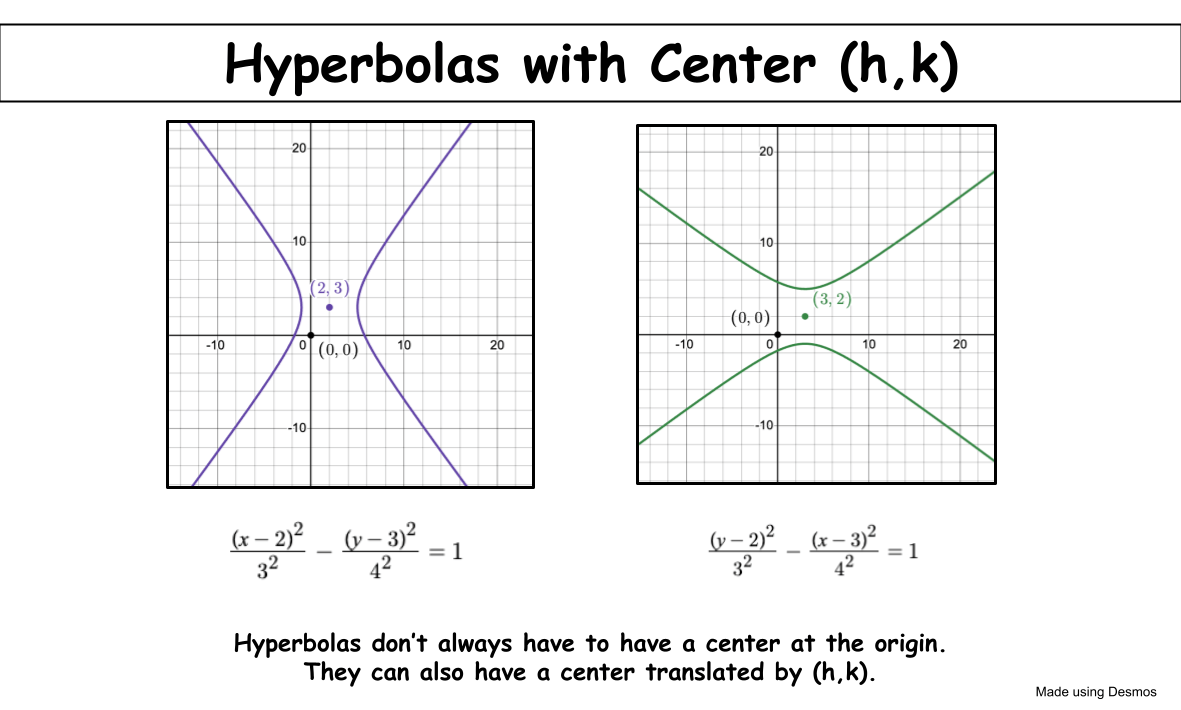
Hyperbolas don’t always have to have a center at the origin. They can also have a center translated by (h,k).

Made using Desmos

We would then use (h,k)(h,k) as the center. The equations look very similar, but they include shifts.

For a horizontal hyperbola:

(x−h)2a2−(y−k)2b2=1\frac{(x - h)^2}{a^2} - \frac{(y - k)^2}{b^2} = 1

For a vertical hyperbola:

(y−k)2b2−(x−h)2a2=1\frac{(y - k)^2}{b^2} - \frac{(x - h)^2}{a^2} = 1

The transverse axis is the line segment that connects the center to the vertices of the hyperbola - it goes through the branches of the hyperbola. If the transverse axis is parallel to the xx-axis, the branches open left and right. The conjugate axis is perpendicular to the transverse and helps define the box used to draw the graph.

The equations of the asymptotes go through the center and guide the shape — they show where the branches of the hyperbola get closer but never touch. These asymptotes are straight lines that pass through the center and follow the diagonals of the rectangle formed using aa and bb.

In both, (h,k)(h,k) is the center of the hyperbola. Watch the signs! This center is where the two asymptotes cross and where your box will be centered. The main difference from the origin case is that everything is translated away from the middle of the graph.

You still count aa and bb units to draw the rectangle and sketch the asymptotes, but now you're doing it from a new center. The shape of the graph stays the same, it's just in a different place on the coordinate plane.

So, the key difference is: the center at (0,0)(0, 0) means the graph is centered at the origin, but center at (h,k)(h, k) means the whole hyperbola is shifted.

Type a concept, like “slope” or “photosynthesis”.

↑ ↓ to choose · Enter to openSearch explanations and problems