Illustrated · 1 min

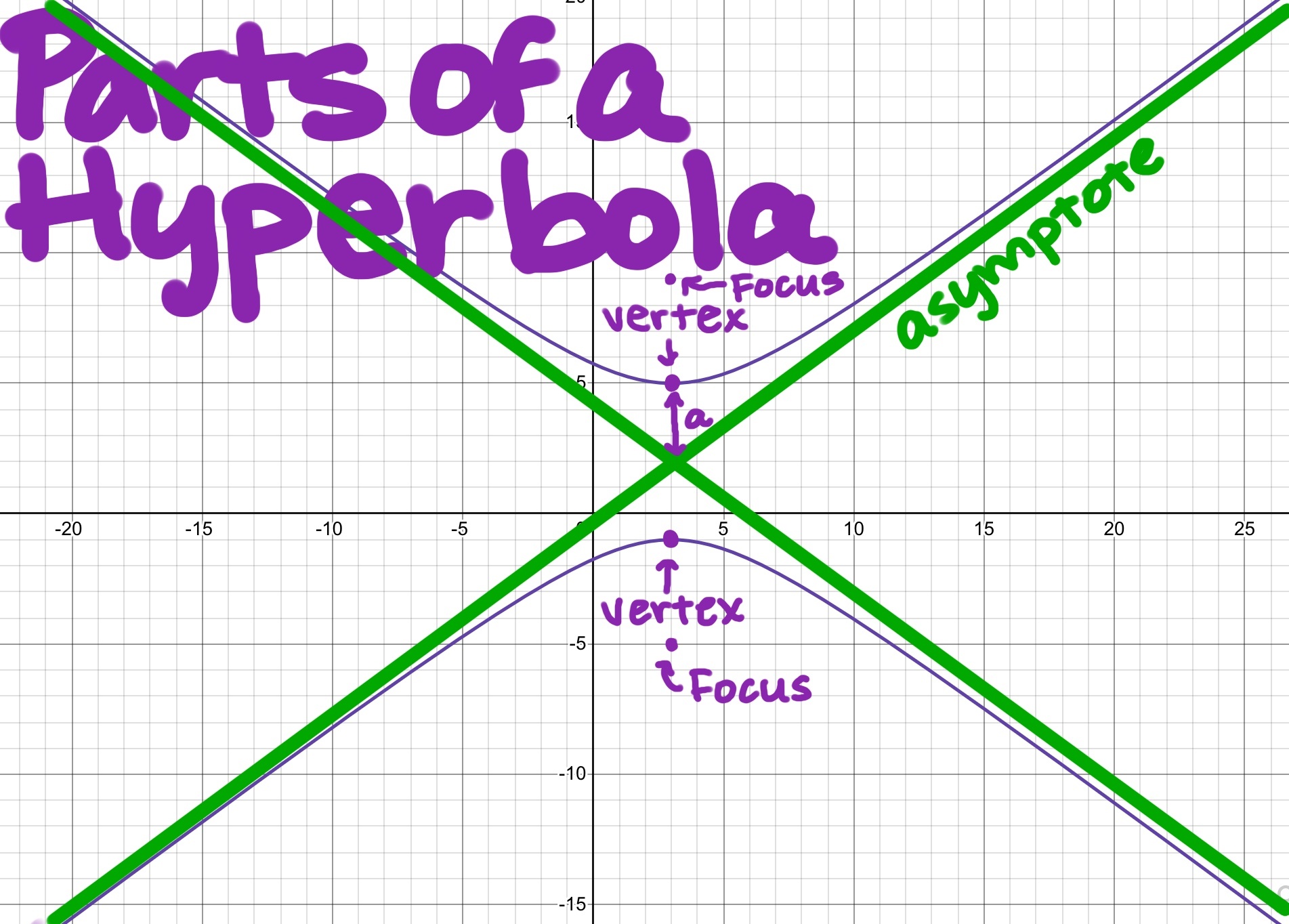
Parts of a Hyperbola
###Vertices
The vertices of a hyperbola are two distinct points on the hyperbola's axis, specifically the endpoints of the transverse axis.
If a hyperbola has a horizontal transverse axis, then the vertices lie horizontally. Likewise, if a hyperbola has a vertical transverse axis, then the vertices like vertically.
###Transverse Axis
The transverse axis is the segment that passes through the center and has the vertices as its endpoints, as the hyperbola's longest axis.
If the hyperbola is horizontal, then the transverse axis lies along the -axis. The equation of the transverse axis is:
If the hyperbola is vertical, then the transverse axis lies along the -axis. The equation of the transverse axis is:
is the center of the hyperbola. is the distance from the center to the vertices along the transverse axis, the semi-major axis. is the distance from the center to a point on the hyperbola along the conjugate axis, the semi-minor axis.
###Conjugate Axis
You might've guessed it already, but the conjugate axis is perpendicular to the transverse axis. It passes through the center of the hyperbola and is the shortest axis of the hyperbola.
Therefore, if the transverse axis is horizontal, then the conjugate axis is vertical. Likewise, if the transverse axis is vertical, then the conjugate axis is horizontal.

Image source: by Anusha Rahman
The main points to remember:
- The transverse axis is the longest axis, containing the vertices.
- The conjugate axis is the shortest axis, and is perpendicular to the transverse axis.