
Read · 1 min
By Liza Sulkin

+1 contributors
Contributors

Laws of Logs
Here's a summary of all the useful algebraic properties of logs that you can use!
Read · 1 min
Here's a summary of all the useful algebraic properties of logs that you can use!
Illustrated · 1 min

Image source: by Liza Sulkin
These are the properties of addition and subtraction for logarithms...
Let's think about where they come from.
Recall the relationship between exponents and logarithms:
We also know the following two properties of exponents:
Let's go one property at a time.
Suppose that and . Let's look at a base logarithm of the product of and : Since we know how to deal with products of exponents with the same base, we can rewrite this as: Now, by properties of logarithms, we can eliminate : But from our initial definitions, we know that and , so: And we have our formula!
Again, suppose that and . Let's look at a base logarithm of the quotient of and : And we have our formula!
Video · + 1 min read
by yaymath

This video by yaymath explains the properties of logarithms and works through some practice problems.
There are three main log properties:
These can be used to solve equations for logarithms. Let's work through a problem together.
Solve the following for : First, we're going to condense our exponents. The first term, , can be rewritten with an exponent. Now, we're going to translate the subtraction of our first two terms into division. We have a log of the same base on both sides of the equation, so we can remove the logs and solve this the same way we'd solve any other equation.
Try this question for yourself:
Solve for .
Let's work through this problem. First, we're going to deal with the exponents. Now we can combine our terms into division and multiplication, respectively. We have a log of the same base on each side, so we can ignore them and solve the same way we would any other equation.
Video
by PatrickJMT

This video by PatrickJMT covers addition and subtraction with logs of the same base.
The rules of logs state that:
Let's expand a logarithmic expression to show this. We can start by changing the fraction into subtraction. Now we can expand the first term from multiplication into addition. Finally, we can move the exponents to the front of each term.
Try a problem for yourself!
Which of the following is equivalent to ?
We can shorten our expression by multiplying the arguments and inside of the log.
Video
by ThinkwellVids

This video by ThinkwellVids video goes over some more complex logarithm examples.
There are five main rules of logarithms that help with logarithm combination and arithmetic.
Let's try a practice problem. We're going to combine the terms of the following: First, we're going to turn the multiplication into exponents. Now, we're going to combine the two subtracted terms. The final step is to combine the added terms as multiplication.
Try a question for yourself:
Simplify into one log.
Illustrated · 1 min
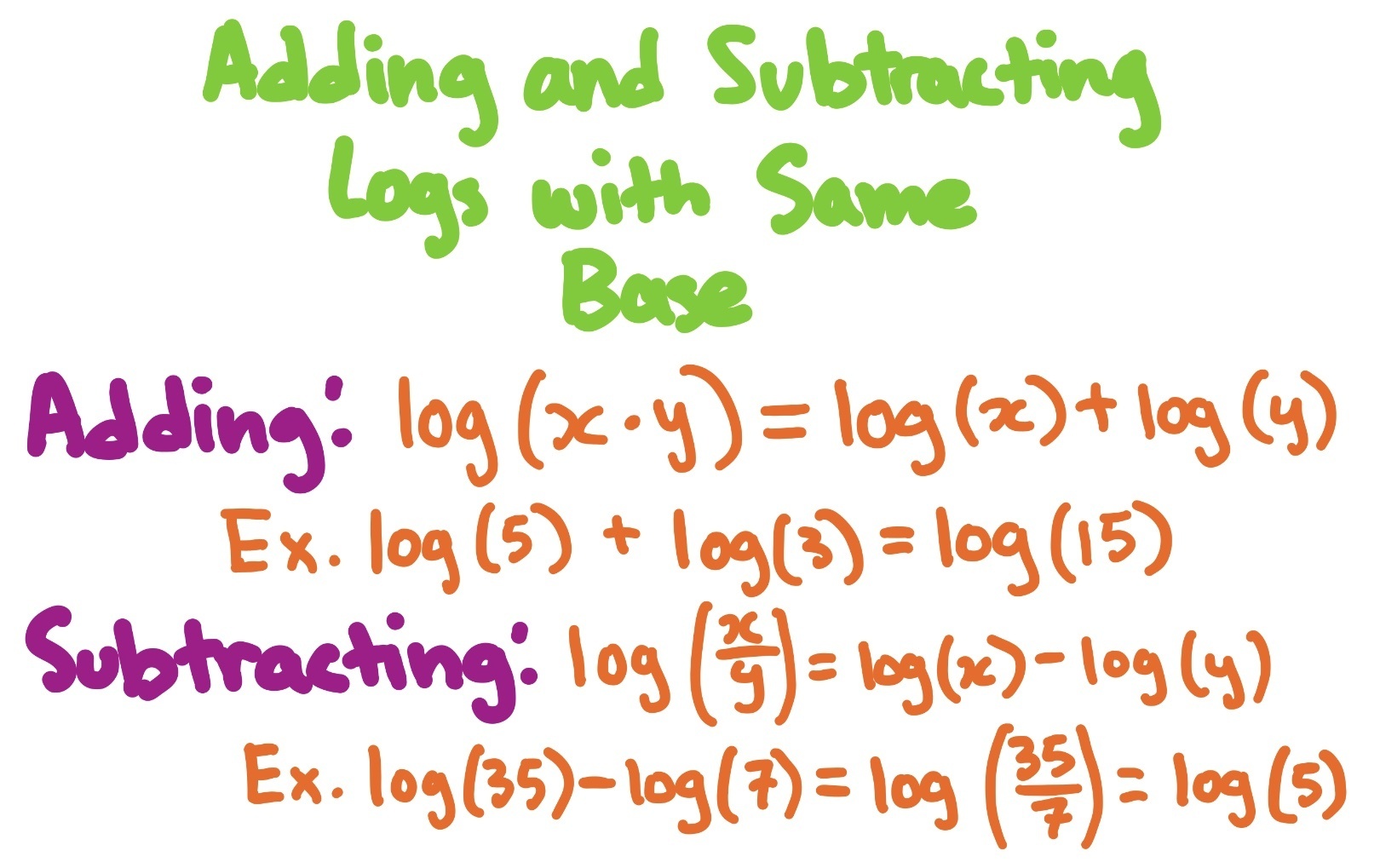
Image source: by Trisha

