
Interactive · 1 question
The power rule for logarithms states that
Proof: Taking the logarithm of the first and last terms implies the desired property.
What is the value of
Interactive · 1 question
The power rule for logarithms states that
Proof: Taking the logarithm of the first and last terms implies the desired property.
What is the value of
Video
by SnugglyHappyMathTime

Check out this video by SnugglyHappyMathTime to learn about the power rule!
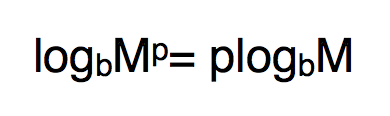
Image source: by Trisha
Try the example problem given in the video!
Simplify
Illustrated · 1 min
A logarithm is the inverse function of an exponential function. That means that if , then . In other words, a logarithm of a number tells you what exponent you need to get that number.
Previously, we have talked about common logarithms, which are logs with a base of . We understand that logarithms are the inverse function of an exponential function.
We've been learning basic rules about logarithms so that we can tackle more complex math and real-life problems.

Image source: by Trisha
One important rule is the log of a power:
This means the logarithm of a power is equal to the exponent times the log of the base.
This rule helps you solve equations where the exponent is a variable. It’s used all the time in logarithmic equations, especially when you want to “bring the power down” so you can solve for it. It also shows why logs were useful with the slide rule: logs turned multiplication into addition and powers into products.
This property works with any base and all positive real numbers. You can also use it with the natural logarithm, which is written as and has base . For example:
This rule is one of the three major log rules. Another rule is the product rule:
...and the quotient rule:
These rules will help you to simplify and solve all kinds of logarithmic functions. By understanding the log of a power, you can take apart exponents and work through tricky equations step-by-step.
In the next lesson, you will use this newfound skill to tackle log rules: the quotient rule, the product rule, and the power rule. Soon, you will also learn about natural logs.
