Interactive · 6 questions
+2 contributors

Partial fractions (in a "special case")
Partial fractions is a way of taking a rational function (a function of the form , where are both polynomials) and "splitting it up" into fractions. An example is
Let's find a way to do this. Let's first do it when the denominator is a quadratic, and use the function as an example.
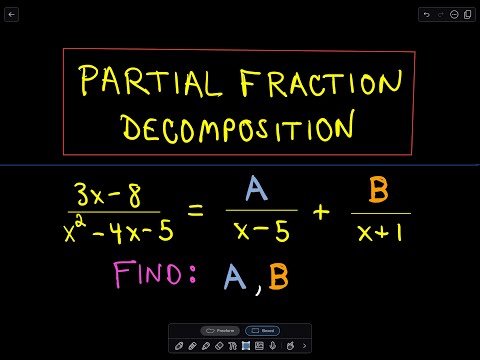
In the spirit of the example above, let's try to write
What should equal (given that for the sake of ordering them in your answer below)?
Why are they ? Because if you add together using a common denominator, that common denominator will be . Therefore, this must equal the denominator on the left hand side. So , which factors nicely as . A more general statement would be that are the roots of the polynomial .
So now we are working with the equation
Putting the right hand side under a common denominator gives us .
Since the above expression must also equal the LHS, what must equal?
What about ?
Good job. All you do is match coefficients: must match exactly with .
Now solve for .
So our final partial fraction decomposition is
This method works pretty well for quadratic denominators, but imagine when the denominator's degree increases! How many equations, variables, and coefficients will we have to match! Below I'll present a more efficient method.
After finding (that was a long time ago!), here is an alternate way of finding and .
Take the equation and multiply both sides by . Here is what you get:
Now plug in to get (since the last term cancels out)! It's that easy!
Find the same way now. Give your answer here:
Here's the process again: multiply both sides of the original equation by to get that . Now plug in to get that ! Once again, the first term on the right hand side cancels out.
Now let us do a bigger case: for polynomials . Note that in this whole process, we'll assume that . Or else, divide into , giving a quotient and a remainder. Then just work with the remainder.
What was our first step above?
So let's "factor" as the product of its roots. Let's say that ASSUME THAT ALL ROOTS ARE DISTINCT! If not, my above process described actually doesn't work. (Luckily, most things you encounter will have distinct roots)
Then, by our above arguments, we can write
Note that the denominator on the left hand side above is in fact . Let's multiply through by now.
You get that
This is where we have used that every root is distinct. Otherwise, we would be able to simplify other fractions on the right hand side.
Now plug in . The equation becomes So you have your value after plugging in everything!
You can repeat the argument similar for to find for all .
In a nicer form, you can actually show that (derivative), so in general we can write: . But this final formula is not really important: the process and algorithm described are more useful to think about. :)